Product Review: ECOlunchbox products

Last updated on July 26, 2025.

Apple on top of books. Photo from Pixabay.
Photo from Pixabay.

Last year, my son began school and I was confronted with the choice of sending his lunch with him or letting him eat school-provided lunches. It was not a difficult decision because, in our county, “nutrition” is a joke. Pop-Tarts are considered a healthy breakfast choice in the schools, and items such as Chicken Fried Steak, Cheese Pizza, and Uncrustables are often served for lunch. Hopefully, many parents know that those types of foods should be served as an occasional treat and not a frequent meal option.

But today I’m not here to debate school menu options and argue about nutrition. For me, it was an easy decision to send his lunch every day. So my next decision was on the type of lunch box and containers to purchase.

Plastic-free options

I didn’t want to buy plastic, nor did I want him to eat out of plastic containers because of the potentially toxic ingredients in them. Further, I did not want to regularly use single-use disposable items like plastic utensils, zipper bags, or individually wrapped foods like applesauce packets and prepackaged fruit. I also can’t send glass containers to school, which is what we use at home.

So I searched Google for all types of eco-friendly lunch boxes and such, and was delighted to find lots of options! I read up on different companies, read reviews, and looked at my options several times before settling on the ECOLunchbox (see link at the end). They assert that they offer “100% plastic-free, ocean-friendly, non-toxic food containers.” I read their story and read reviews of their products on their site as well as Amazon’s. Here’s a video from the founder, explaining why she founded this company:

“When I launched in 2008, my business plan was to take the tried-and-true tradition of metal lunch boxes and make it new again for modern consumers.” -Sandra Ann Harris, founder of ECOlunchbox and author of Say Goodbye To Plastic: A Survival Guide For Plastic-Free Living

Review of the products I ordered

I ordered the Blue Water Bento Splash Box and Pods Set, which consists of three stainless steel containers with leak-proof silicone lids. They are dishwasher safe (obviously not microwave safe but I try to avoid the microwave anyway). They have been used, transported, and washed 5 days per week for 8 months now and show little signs of wear! I’m really glad I chose these.

The containers are very easy to clean, are very durable, and eco-friendly. I like the sizes as well because they can accommodate a sandwich or salad in the large one, and crackers and fruit in the smaller containers.

These containers are light to carry and easy to use. The company indicated that the “non-slip tabs on the lid are embossed for kid-friendly easy opening,” and I have found that to be true! My son does just fine with them on his own. They are indeed leak-proof, as long as he puts the lids on tight (which he doesn’t every time, but it’s minimal leakage). He really likes his containers.

ECOlunchbox Splash Box and Pods Set
ECOlunchbox Splash Box and Pods Set, the exact set I’m reviewing.

We also ordered the Blue Water Bento lunch bag. Made of organic cotton, the bag is machine washable, which is practically a must with young children! It also features cute designs of ocean animals. My son chose the Dolphin print. I like the Sea Turtle print too:

ECOlunchbox Sea Turtle Lunchbag
ECOlunchbox Sea Turtle Lunchbag.

The bag is made to hold the Splash Box and Pods. I can also fit a small Kleen Kanteen water bottle inside. The top closes with Velcro and it has a handle to carry it. My son and I both like the bag, however, the velcro wore out within just a few months, albeit from the daily use (abuse?) of a 5-year-old:

ECOlunchbox Blue Water Bento lunch bag
ECOlunchbox Blue Water Bento lunch bag. Photo by Marie Cullis.
The Velcro wore out within a few months.,
The Velcro wore out within a few months. Photos by Marie Cullis.

Solution

It’s always better to repair something than to replace it, if and when possible. I decided that I’d just replace the Velcro. I bought white sewable Velcro strips at the craft store (unfortunately those come in plastic packaging). Then, I simply removed the old Velcro and sewed on the new strips. It took me about 10 minutes to fix and it was very easy.

Replacement Velcro strips. Photo by me.
Replacement Velcro strips. Photo by Marie Cullis.

Problem solved! The new Velcro works great.

Overall, I like the bag and would buy it again. Young children can be tough on their things, so I don’t know if it was faulty Velcro or just excessive wear and tear. And now I know I can just replace the Velcro easily. I could even try sew-on snap buttons!

I hope this post was helpful, and thanks for reading! Let me know about your eco-friendly and plastic-free lunch solutions in the comments below!

UPDATE, February 3, 2024: Five years later, my son is still using this set of containers from ECOlunchbox. These are stellar products! The cloth bag did not survive past the second year of school, but I think it would be fine for a teen or adult who took better care of their things. 

UPDATE, July 26, 2025: My son is now a rising 7th grader, going to a new school this year, and will be using the very same Ecolunchbox containers. We bought a second-hand insulated lunch bag and the containers fit great in it!

I did not get paid for this review and this article contains no affiliate links.

Additional Resource:

ECOlunchbox website.

Update: Death of a Plastic Shower Curtain, Part 2

Last updated on December 3, 2020.

If you read my previous article about the death of my plastic shower curtain liner, you’ll recall that my goal was to find a plastic-free alternative. First, I decided that we would try getting by with only the cloth shower curtain. And I told you I’d update you on how that went!

The Shower Curtain

I purchased the cloth shower curtain at Bed Bath & Beyond back in 2015. As I mentioned before, I also had a plastic liner to protect it. The cloth one is made of 100% cotton and listed as machine washable on their website. But it also indicated “liner not included,” meaning it was intended to be a  decorative curtain, protected by a separate liner. I think I knew that at the time I purchased it, but back then I thought I would always have a plastic/vinyl shower curtain liner.

However, the shower curtain has not withstood daily use in the shower and two subsequent washing machine cycles. The curtain got very dark and dingy with a few mold spots. After I washed it the first time in the washing machine, I noticed some small holes and areas where the fabric was starting to deteriorate. But I rehung it for a couple of more months and it got gross again.

Image shows the bottom section of the dingy shower curtain.

Close-up image of the mold spots and dinginess.

Washing the Shower Curtain

This week, it was time to wash it again. In recent weeks, I discovered Otter Wax, which is a waterproofing wax made of different waxes, including beeswax. This product does not contain paraffin, silicone, or other petroleum-based synthetic ingredients. So I ordered some and planned to waterproof my shower curtain.

Image of the Otter Wax I purchased.

The instructions are clear that the fabric item must be cleaned and dried, but also be able to cure for 24 hours. Since we only have one shower, I had to time this perfectly around three people’s daily use of the shower. I took it down after the last shower one morning this week and worked on it right away to make sure I had enough time.

The night before I pre-treated it by spraying 3% hydrogen peroxide on the inside of the curtain, to deal with the mold spots. (I avoid using bleach whenever possible because of its toxicity, and I keep reading that bleach just changes the color of mold and doesn’t actually kill it.) I let it sit on the curtain for a while and rinsed it off later. It did not make any visible difference but I had hoped it killed the mold.

I put 3% hydrogen peroxide in a spray bottle.

Next, I put it in the washing machine on the casual cycle (which is supposed to be gentler during the spin cycle than the regular cycle). But here’s what happened!

Image of the damaged shower curtain.
This is the damaged shower curtain. Thankfully the damage was isolated to the bottom portion of the curtain.

Oh, dear.

My initial thought was that I would have to purchase a new hemp shower curtain. But money is tight these days, so I decided not to give up on this curtain just yet!

Reparations

Damage this bad cannot be mended or patched up. My only option was to hem the shower curtain. I needed to cut off 7 inches (up to the highest points of the damaged areas) and then I used a half-inch folded twice to make a new bottom hem. This meant I was going to lose a total of 8 inches off the bottom.

I cut, pinned, and then held it up to the shower curtain rod to see if it would still be long enough before I completed it. It seemed fine and the curtain rod is adjustable, so I went ahead and hemmed the curtain.

Trimming the shower curtain.

Pinning the hem.
Pinning the hem.

The final hem.
The final hem.

Waterproofing

The last step was to apply the Otter Wax on the fabric, which took some elbow grease. I only ended up having enough wax to do the lower half of the shower curtain (and just enough time before going to work that day). My bar is only the size of a pat of butter now!

Full bar of Otter Wax before I began.

My tiny leftover piece after completion.

After it was coated, I allowed about 22 hours to cure. I left it out on my dining room table at room temperature. The next morning, my husband and I hung it back up. We did have to lower the shower curtain rod a couple of inches (which lightly damaged the paint, so I’ll have to touch that up this weekend). But the shorter length is not that noticeable.

Cleaned, repaired, and re-hung: a second life for this shower curtain.

The next step

It’s not perfectly coated, so I may need to apply another layer. For now, I’m going to see how it repels water. I followed the instructions on the paper label, but I’ve since watched YouTube videos about how others use OtterWax. Some users recommended using a hairdryer on low to make the wax easier to spread onto the fabric. Others recommended ironing the entire piece on low after rubbing the bar into the fabric. This is the option I will try should I need to make it more waterproof.

I hope this post was helpful! Have you had any struggles going plastic-free with a shower curtain? Leave me a comment below, I’d love to hear from you!

Please check out Part 3 in this series. Thanks for reading, and please subscribe!

All images in this post were taken by Marie Cullis.

Product Review: Osom Brand Socks made from Recycled Textiles

Last updated on January 3, 2024.

Array of Osom socks with packaging, blue hues.

What if I told you that you could buy upcycled socks, made from recycled textiles? Osom brand sells socks and other apparel that is made of up to 95% upcycled textiles. The company uses “high quality, upcycled yarns from discarded garments, reducing textile waste from going to landfill and the need for virgin fibers.” They use zero water or dyes in the process of making their yarns.1

By making high-quality upcycled clothing we are closing the loop in the fashion industry, the second largest polluting industry on the planet. -Osom Brand2

Disclaimer: I was not paid to review this product, nor does this post contain any affiliate links.

Good socks

I first heard about these when Osom Brand launched its Kickstarter in January 2017. By late 2018, they had an online store. I asked for these as a Christmas gift, and I was thrilled to receive them!

Images of Osom Cetus socks. Photo by me.
I love the subtitle, “Wear the Change.” Photo by Marie Cullis.

My Osom socks with whales design. Photo by me.
My Osom socks with whale design. Photo by Marie Cullis.

Overall, I am very pleased with these and I plan to order more. I’ll review the different aspects of these socks in a moment. But first, check out this video about the founder and company’s process:

Comfort

These are quite comfortable and they do not slip down as some socks do. I’ve seen one or two complaints about the elasticity of these socks since they are one size fits all (in a size range). Indeed they are not very stretchy compared to other socks. For me, once they are on, this is not an issue.

Price point

These socks cost between $16.00 and $18.00 per pair. While that cost is average, it may seem high compared to other socks made from new materials. But the cost to the environment is low.

Environmental impact

The company asserts that its process is waterless. It takes more than 700 gallons of water to produce a conventional cotton t-shirt, and that does not include the water it takes to grow the cotton. That’s enough water for one human to drink for 2 and a half years!3

Osom Brand does not use dyes or harsh chemicals, which prevents water pollution because there is no toxic waste being poured into drains or pumped into rivers. This process also reduces the use of pesticides, which harm the environment and pollute our waters.

Buying recycled textile products reduces textile waste. I’ll explain more about this below.

Materials

The materials are not 100% plastic-free. They are up to 95% upcycled textiles combined with small percentages of spandex and nylon (spandex and nylon are both plastic fabrics). The trademarked name of their fiber blended yarn is OSOMTEX and it changes based on consumer demand and textile availability.

However, the company is not claiming their yarns to be plastic or polyester-free. Their goals are to promote a circular economy in the textile industry. “At OSOMTEX®, we repurpose millions of pounds of discarded post-consumer and post-industrial textile waste directly from brands and supply chain waste streams to create high-quality upcycled yarns and fabrics.”4 Repurposing is a great way to support environmental and human health.

Packaging

The socks arrived almost plastic-free, except for the little black plastic holder at the top. I plan to write an email to the company to request they stop using the plastic holder.

Plastic hold from the socks. Photo by me.
Plastic holder from the socks. Photo by Marie Cullis.

Why is this a big deal?

We. Waste. Clothes.

In the United States, we throw millions of pounds of textiles into landfills per year – about 81 pounds per person! That does not include the heaps of clothing we donate, consign, or give away to friends and family.

In the United States “fast fashion” refers to our quick cycle of fashion trends changing. So we want cheap clothing. In turn, this means it is usually made cheaply and quickly. That same clothing wears out fast from wear and the harsh chemicals from fabric softeners and laundry detergents. Then we discard last season’s items as quickly as we can to “keep up” with the current styles. This cycle allows us to consume and shop more.

Clothing rack. Photo by Artem Bali from Pexels.
Photo by Artem Bali from Pexels.

We can do better!

What if we decided to buy less clothing that is higher quality? Or buy most of our clothing second-hand? Clothing that is more timeless or classic, instead of keeping up with fashion trends? This is an area where we all have great power to generate great change.

It takes a ton of energy and insane amounts of water to generate all of that new fashion.

Why buy recycled textiles?

I know some will say that only 100% natural, organic textiles are the answer, and I don’t disagree. There are problems with plastic microfibers reaching our oceans from just washing those fabrics in the washing machine. But with all that we waste, why not support visionary concepts like this?

There are many things we can do to make a difference.

I think that there is never just one answer or one solution to any environmental or social problem. Let’s all do what we can to be the change. We can buy less brand new clothing. Or purchase less clothing in general and snub “fast fashion.” We can buy clothing secondhand, or buy upcycled products like Osom socks. We can switch to a capsule wardrobe like Project 333.

Whatever you choose to do, just by starting today, will make a difference. Thanks for reading, please share and subscribe!

Footnotes:

Healthy options to replace toxic fabric softener and dryer sheets

Last updated on September 7, 2025.

Selection of fabric softeners at the supermarket on shelves.
There are so many choices for fabric softeners and dryer sheets. But many contain toxic chemicals. Photo by Marie Cullis.

I was an avid user of dryer sheets for most of my adult life until around 2015. I liked that they removed static electricity, I thought my clothes felt soft, and I loved the way they smelled!

But then I found out how dangerous they are to our health. My mother mentioned it to me several times, so I began reading about the ingredients. I discovered that dryer sheets and fabric softeners contain hormone-disrupting phthalates, chemicals that damage the reproductive system, and compounds that trigger asthma. I just wanted clean-smelling laundry!

“Seriously, how harmful can a flimsy little slip of fabric be? Especially when you consider how soft and sweet smelling it leaves your clothes. Think again, my friend. There’s a lot of badness contained in that tiny bit of laundry magic.” -Darin Olien, Fatal Conveniences

Toxic chemicals and ingredients

According to the Environmental Working Group (EWG), “fabric softeners and heat-activated dryer sheets pack a powerful combination of chemicals that can harm your health, damage the environment and pollute the air, both inside and outside your home.”6 Fabric softeners are designed to stay in your clothes for a long time, so chemicals can seep out gradually and be inhaled or absorbed directly through the skin.7 Notice how the scent lingers on your clothing?

I learned that “fragrance,” a common ingredient in products ranging from shampoo to laundry detergent to baby products, is a term that refers to a range of chemicals. The EWG explains what this term means:

“The word “fragrance” or “parfum” on the product label represents an undisclosed mixture of various scent chemicals and ingredients used as fragrance dispersants such as diethyl phthalate. Fragrance mixes have been associated with allergies, dermatitis, respiratory distress and potential effects on the reproductive system.”8

Bounce dryer sheets were my household's choice for dryer sheets for many years.
Bounce dryer sheets were my household’s choice for dryer sheets for many years.

I used Bounce dryer sheets for more than 15 years. EWG rated these dryer sheets with a D, almost the lowest rating they use.9 The top-scoring factors were poor disclosure of ingredients; the product may contain ingredients with the potential for respiratory effects; the product can cause acute aquatic toxicity; and possible nervous system effects. EWG noted that “fragrance” was their biggest ingredient problem. Again, note that these problems are not only from scented products. Bounce’s Free & Gentle (free of dyes and perfumes) only scored a C on EWG’s Healthy Cleaning Guide.10

“[Dryer sheets] are usually loaded with perfume and can contain the carcinogens benzene and acetaldehyde.” -Heather White, Eco-Anxiety11

Selection of fabric softeners at the supermarket on shelves.
Photo by Marie Cullis.

Dryer sheets create extra waste

Additionally, fabric dryer sheets are harmful to the environment because they are designed to be single-use disposable items. They are not made of anything remotely biodegradable, and as litter, they remain in the environment indefinitely. There are many ways to re-purpose them, in fact, I used to reuse them for dusting. Unfortunately, I was exposing myself and my home to the chemicals a second time, and they still had to be thrown away. Like many other types of waste, they end up in rivers and oceans. I’ve certainly picked them up myself during litter clean-ups. I even found a dryer sheet woven into a bird’s nest in my own yard.

Used dryer sheet woven into a bird's nest.
Used dryer sheet woven into a bird’s nest. Photo by Marie Cullis.

Bird's nest with sticks, moss, plastic items, and dryer sheets woven in.
Dryer sheet pieces (and other plastics) woven into a bird’s nest. Photo by Marie Cullis.

“These sheets…made from plastic polyester material, are coated with synthetic fragrances, contain estrogen-mimicking chemicals, as well as fatty acids that coat the clothing and reduce static.” -Sandra Ann Harris, Say Goodbye To Plastic: A Survival Guide For Plastic-Free Living

White clothing articles hanging on a line outdoors, green grass and mountains in background, laundry blowing in the breeze.
Image by Willi Heidelbach from Pixabay.

So what’s the solution?

If you are worried about toxic chemicals harming yourself or your family, stop using them immediately. The EWG recommends skipping fabric softeners altogether.12 There are many alternatives – and they are usually zero waste!

Your clothes don’t need to smell perfumed. They will smell clean just from being washed.

Distilled white vinegar

Add a half cup of distilled white vinegar to your washing machine during the rinse cycle (or put it in the machine’s rinse dispenser ahead of time). The smell does not linger on clothes. This works especially well if you are line-drying your clothes. (I’ve read that you should not mix vinegar with bleach, so always be aware of what you are mixing.)

Line or Air drying

Line drying is the most eco-friendly solution. I have several drying racks and a short clothesline outside that I use weekly for some items. You can install a longer clothesline or umbrella-style dryer outside. This makes doing laundry weather-dependent, but there would also be a reduction in your electric bill. Additionally, the sun can remove bad smells from items because ultraviolet rays kill bacteria that cause the smell.

Sophie Benson, author of Sustainable Wardrobe, wrote that drying your clothes in the dryer eventually ruins the fabric. “Just 20 cycles of tumble drying can reduce the strength of fabric by 50%, compromising the durability and longevity of your clothes.” Avoiding the dryer is also best for the environment. “Air drying is also the best choice for the environment; by choosing air drying over tumble drying, you can save 36 kilograms (80 pounds) of carbon each month. Academic researchers have also found that tumble drying can release as many microfibres into the air as washing releases into waterways.”13

“Air-drying clothes reduces the average household’s carbon footprint by 2,400 pounds per year.” -National Geographic14

Line drying is an eco-friendly and healthy option for drying your laundry. Photo by Wolfgang Eckert on Pixabay.

You can also invest in drying racks that you can use indoors and outdoors. I personally own three!

Drying rack, wood and white, in a gray painted room, window in background, white front loading washing machine in background, one striped shirt on drying rack.

Wool dryer balls

I use wool dryer balls for everything that I put in the dryer. These are either solid balls of felted wool or felted wool wrapped around a fiber core. They naturally soften laundry and reduce static. The balls also lift and separate clothes in the dryer, shortening drying time and saving energy. You can find them online or at some stores, just be sure you buy quality ones that are 100% wool and have good reviews.

wool dryer balls

Don’t over-dry

Static is caused by over-drying, plain and simple. Static especially happens when drying synthetic clothing, such as polyester, because they dry faster than cotton. If you don’t over-dry your clothes in the dryer, you shouldn’t have static.

Photo by Andy Fitzsimon on Unsplash.

I hope you found this helpful! Please also read about non-toxic laundry detergents.

I also have an article about how to make your clothes last longer with good laundry habits.

Do you have a different method that I didn’t mention here? Leave me a comment below, I’d love to hear from you! As always, thank you for reading.

This article does not contain any affiliate links.

Additional Resources:

Article, “Skip the most toxic fabric softeners,” by Samara Geller, EWG.com, August 16, 2022.

Video, “Laundry Tips to Take Care of Your Capsule Wardrobe,” Be More With Less, accessed May 2, 2023.

Article, How Dryers Destroy Clothes: We Delve into the Research,” Reviewed, updated October 10, 2019.

Footnotes:

Bag It: The Movie

Last updated December 11, 2022.Bag It film cover art

Have you seen this documentary? Bag It is an excellent film, and I wholeheartedly recommend it! It’s a great introduction to not only the problem of plastic bags but of plastics in general. Please check out the trailer:

A must-see documentary

I cannot say enough good about this film. It really hits on all the topics, from the perspective of an everyday person like you or me. Before I saw this film myself a couple of years ago, I had only limited knowledge of plastics, recycling, and toxic products. This film was like my gateway to bigger individual topics – like plastic bag usage; the Great Pacific Garbage Patch; toxins in food from plastic packaging; and single-use disposable plastic…everything. I had thought about those things, but I hadn’t researched them or even read much about them. I love this film! And Jeb Berrier is pretty funny too.

The film also introduced me, through interviews in the film, to a variety of plastic experts, ocean and marine life experts, and organizations trying to make the world a better place. To name a few: Beth Terry of myplasticfreelife.com; Annie Leonard of the Story of Stuff Project; Dr. Sylvia Earle of Mission Blue; Algalita (founded by Captain Charles Moore); the Midway Atoll National Wildlife Refuge; Oceana; the Environmental Working Group; authors Elizabeth Royte and Daniel Imhoff; and so many more that I’m forgetting to include. The filmmakers’ requests for interviews with the American Chemistry Council and others in the plastics industry were denied or received no response. Unfortunately, that has been fairly typical with films that investigate and educate the public on the plastic problem.

Plastic bags that have somehow made it into my home. I'm saving these for trash clean ups when I go hiking.
Plastic bags that have somehow made it into my home. I’m saving these for trash clean-ups when I go hiking. Photo by Marie Cullis.

Take action with Bag It The Movie

I was completely inspired by this movie! As I mentioned above, this film is one that led me to other important films, authors, individuals, and organizations that are all making a difference and trying to educate people. I consider Bag It to have been a core part of our household’s path to great changes.

I looked up the film’s website in anticipation of writing this article, and I was even more inspired! Most of their site is dedicated to using the film as a tool to educate schools, communities, and whole towns. They offer the ability for any person or organization to host a screening for a fee and have a free downloadable pdf Screening Tool Kit, which has step-by-step instructions and resources for screening Bag It. They also have a free downloadable pdf to initiate a Bag It Town campaign, meaning a plastic bag ban.

In my article about a weekend trip to Hilton Head Island, where I discovered that that town is implementing a plastic bag ban this month, I mentioned that I might try to propose one where I live! Between both, I’m SO moved and even more encouraged. If I do propose one in my town, I definitely know where to start now. With the tools provided by Bag It!

Thank you for reading! Stay inspired and be the change!

Plastic Bag laws in U.S. map from https://www.plasticbaglaws.org/
Plastic Bag laws in the U.S. from plasticbaglaws.org.

Footnote:

What’s the Big Deal about Plastic Straws?

Last updated on January 12, 2025.

straws colorful, Photo by Bilderjet on Pixabay
Photo by Bilderjet on Pixabay.

There is a coalition of aquariums across the United States striving to reduce the use of plastic straws. The coalition, called the Aquarium Conservation Partnership (ACP), is a collaboration of 22 public aquariums in 17 states, including the Tennessee Aquarium. They help advance conservation policies, educate and inspire audiences, and commit to sustainable business practices.1

Aquariums are awesome and full of wonder and thousands of children go through them daily. So they are poised to be leaders in positive change, and this is a great example of that! One of the things they’re doing is asking restaurants and others in the hospitality industry to reduce the use of straws by only giving them out upon request, instead of automatically. They’re asking individuals to sign a pledge to stop using plastic straws.

My son looking up at a large aquarium tank at the Tennessee Aquarium when he was just 2 and a half.
My son at the Tennessee Aquarium when he was just 2 and a half. Photo by Marie Cullis.

What’s wrong with plastic straws?

First, the sheer amount of them! Just like with all single-use disposable plastic products, it’s the over-consumption of them. Think 500 million plastic straws per day. That’s more than one straw per person per day in the United States. Our consumption has gone way overboard and has created a waste stream that is too large for us to keep up with! Second, they are not recyclable at all.

Don’t feel guilty about having used plastic straws. Just please refuse plastic straws – START TODAY. Politely refuse those plastic straws – if everyone refuses just one straw per day, we’ll more than cut our usage in half!

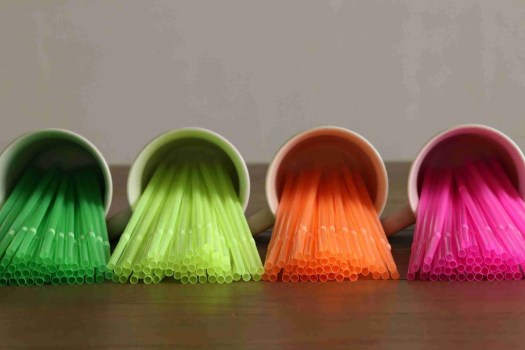
Colored plastic straws sorted in cups by color, neon green, neon yellow, neon orange, and neon pink.
Image by Marjon Besteman-Horn from Pixabay.

I threw my disposables into the trash/recycling receptacle like I’m supposed to, how are they ending up in the rivers and ocean?

One of the critical issues with all the media about single-use disposable plastics is that the biggest question is often not answered: How does the plastic end up in the ocean in the first place?

Most people assume that once they’ve placed their disposables into a receptacle, those disposables go to the proper facility. What people don’t know is that many items don’t make it to the recycling facility or landfill. Since that’s out of our control, it seems impossible to do anything about it. But it’s not impossible by any means. The best way to guarantee that your single-use disposable plastics don’t end up in the ocean is…

To just not use them! Refuse them. Find an alternative. Then you do have control. We have the power to be the change.

So back to the question – how are plastics ending up in the rivers and ocean?

There are so many causes! Spillage from recycling that has been transported across the ocean for years to Asia; plastic products shipped across the ocean to the U.S. have spilled from ships; the fishing industry regularly dumps their trash into the ocean; trash and litter get blown or washed into storm drains and rivers that then feed into the ocean; illegal dumping; beach trash; river pollution; microbeads washing down drains; and debris from natural disasters and floods. Plastic bags are picked up by the wind and blown into waterways that flow into the ocean.

Starbucks is one company that is striving to end use of plastic straws by 2020. Photo by Nadine Shaabana on Unsplash
Starbucks is one company that is striving to end the use of plastic straws by 2020. Photo by Nadine Shaabana on Unsplash.

Ok, so what steps can I take?

First, let’s support the Aquarium Conservation Partnership. You can do this by signing the pledge (linked under Additional Resources below).

Second, refuse. Just say no thank you. To all single-use disposable plastics. Because recycling is not the answer. Only about 9% of our plastics get recycled. That means 91% is not recycled!

Third, if you must have something commonly produced as a single-use disposable plastic, like a straw, please buy a reusable one. Paper disposables and supposedly biodegradable straws are a better option, but it’s still going to be thrown away after one use. Try a stainless steel straw, glass straw, or bamboo straw.

Fourth, tell others! Tell your friends, your co-workers, your favorite restaurant, the local coffee shop, and your local school. So many to tell!

Fifth, participate in trash clean-up efforts. Join the Litterati. Maybe you’ll prevent some of the trash you pick up from entering the ocean.

Single use disposable plastic straw found buried in the sand, Hilton Head Island, October 2018.
Single-use disposable plastic straw found buried in the sand, Hilton Head Island, October 2018. Photo by Marie Cullis.

Last, but not least: Stop supporting businesses that resist change. Consumers hold power: if businesses refuse to meet demands like eliminating single-use plastics, choose not to patronize them. Your spending decisions can push businesses to adapt or risk losing profitability.

Blue poster advertising that The Trading Post, a popular restaurant in Emerald Isle, NC, is recognized as an "Ocean Friendly Establishment" by the Plastic Ocean Project and Surfride Foundation, as "We Only Serve Straws Upon Request." An illustration of a Green Sea Turtle is swimming in waves with fish at the bottom.
Poster advertising that The Trading Post, a popular restaurant in Emerald Isle, North Carolina, is recognized as an “Ocean Friendly Establishment” by the Plastic Ocean Project and Surfride Foundation. “We Only Serve Straws Upon Request.” I love it and will eat there to support businesses like this! Photo by Marie Cullis.

Final Thoughts

Collectively, have the power to create change just by modeling the best behavior. Refuse that straw. Be polite, of course. But just say no. You might influence someone else to refuse straws too. If everyone starts refusing straws, businesses won’t need to order as many. Then the plastic straw manufacturers will have to produce less. And then less will end up in landfills, in nature, and in the oceans. Carry a reusable stainless steel straw with you. Be the change! And as always, thanks for reading.

Forest Gump meme on straws, I couldn't stop giggling at this, so I'm reposting it here.

Additional Resource:

First Step, Skipping the Plastic Straw Pledge.

Footnote:

  1. Page, “What We Do,” Aquarium Conservation Partnership, accessed January 12, 2025. ↩︎

Breaking Up With Dawn

Last updated on November 28, 2021.

Dawn soap
Dawn dishwashing liquid soap.

I’ve used Dawn dishwashing detergent my entire adult life. It seemed to work better than every other brand I  tried. The concentrated version seemed to go a lot further than other brands, therefore giving me my money’s worth. Even after I started reducing the number of products in plastic packaging that I buy, I kept buying Dawn. I used it not only to wash dishes but also used it in my Easy DIY all-purpose cleaner.

And, I was supporting clean-up efforts and saving wildlife after oil spills, right?

I believed that Dawn products were helping clean and save wildlife after oil spills. And I think they do in some cases, as well as raise money to donate toward rescue efforts. According to a 2010 article in the Washington Post after the major BP Deepwater Horizon spill, Dawn is legitimately used by the International Bird Rescue. “After a 1971 oil spill, the California-based nonprofit group began experimenting with products including paint thinner and nail polish remover to find the least traumatizing method for cleaning oiled animals.”16 So in 1978, the International Bird Rescue started a relationship with Procter and Gamble, the makers of Dawn. “Through trial, error, and our tenacity to find a solution, we discovered that Procter and Gamble’s Dawn dish soap, was the golden ticket! It was inexpensive, effective, readily available, and Procter and Gamble was excited to learn about this somewhat unusual use of their product.”17

Procter & Gamble heavily markets Dawn’s Saving Wildlife campaign toward conscientious consumers. Their advertisements pull at our heartstrings. One moved me to tears, which I originally shared in this post. The URL for that specific video changes frequently, so I decided to just let you search “dawn oil spill commercial” on YouTube where you’ll find many of these commercials. But the footage was not of wildlife actually affected by an oil spill. The commercials are a “simulated demonstration” and some have a caption indicating “no oil used.” I’ve read they coat the animals with a mixture of tempera paint and corn syrup so they can simulate cleaning the animals on camera. I find this to be a questionable practice.

Oil covered bird. Photo by Mike Shooter on Shutterstock.
Oil-covered bird. Photo by Mike Shooter on Shutterstock.

But Dawn is petroleum-based – so does that mean they’re part of the problem? 

NPR did a segment on this very issue after the BP oil spill disaster in 2010, looking at the story in detail and interviewing people from both sides. The overall conclusion was that yes, Dawn does help remove crude oil from the animals. But this is because the grease-cutting part of the solution is made from petroleum, according to Procter & Gamble, who was interviewed for the segment. There are alternatives to using petroleum products but that needs testing. Meanwhile, rescuers and veterinarians are sticking with what works, because, in the end, they are trying to save the animals’ lives.18

Yet others find the product to be hypocritical because Dawn is a petroleum-based soap.19 A writer for Treehugger.com wrote:

“The sad irony of the whole thing is that Dawn is petroleum-based. Every bottle of Dawn used to clean a bird actually adds to our nation’s demand for oil. Not only are we using an oil-based product to clean oiled birds, but we’re increasing the incentives for companies to drill for more oil, making it more likely that there will be another spill. Which, incidentally, will be great for Dawn’s marketing. It’s one big beautifully incestuous circle.”20

oil rig, Photo by Zbynek Burival on Unsplash.
Photo by Zbynek Burival on Unsplash.

What about animal testing?

Procter & Gamble, owner of the Dawn brand, does do animal testing. They have committed to the #BeCrueltyFree Campaign in recent years but have not yet achieved that status. If you want non-animal-tested and cruelty-free products, avoid Procter & Gamble brands and products.

An oiled gannet getting cleaned at a rehabiliation center after the 2010 BP Deepwater Horizon oil spill.
An oiled gannet getting cleaned after the 2010 BP Deepwater Horizon oil spill, at the Theodore Oiled Wildlife Rehabilitation Center, June 17, 2010. Image by Deepwater Horizon Response on Flickr, Creative Commons license (CC BY-ND 2.0).

What about the ingredients in Dawn?

I decided to check into the ingredients of Dawn through the Environmental Working Group (EWG). Dawn Ultra Concentrated Dishwashing Liquid (Original), the very product I used to regularly buy, received a D rating (on A-D, F grading scale). One of the main concerns was the lack of ingredient disclosure. There are not many laws in the United States regarding chemicals in household ingredients and products. Procter & Gamble is not required to tell us what is exactly in their product. Many companies like to keep their ingredients and formula a secret, to prevent others from copying. EWG’s Top Scoring Factors for this Dawn product were “Poor disclosure; May contain ingredients with potential for acute aquatic toxicity; general systemic/organ effects; bioaccumulation.”21

Procter & Gamble claims to be using biodegradable surfactants in Dawn and claims to be trying to improve and reduce packaging. But this giant corporation has made only a few changes over the last decade – it’s too little, too slow.

Before (left) and After (right) oiled Brown Pelican washed at the Fort Jackson, LA Oiled Wildlife Center.
Before and After oiled Brown Pelican washed at the Fort Jackson, LA Oiled Wildlife Center, May 14, 2010. Photo courtesy of the International Bird Rescue Research Center on Flickr, Creative Commons license (CC BY 2.0).

Plastic-free dishwashing?

Dawn dishwashing soap has been one of my hold-overs from going plastic-free that I haven’t been able to kick yet. Then one weekend, I ran out. I used to buy economy-size bottles, tricking myself into believing that buying a larger plastic bottle was better than lots of little bottles. But I was unable to find that size again at my regular grocery store. And short of running around to Target or Walmart or searching online, I decided maybe this was a good opportunity to try something different. Here were my options:

Seventh Generation dish soap.
Seventh Generation dish soap. Photo by Marie Cullis.

Ugh! My only choices were plastic, plastic, and more plastic. However, this store also carries Seventh Generation brand dish soap. If you’re not familiar with this brand, they use ingredients they believe to be safe and healthy as well as using post-consumer recycled packaging. The bottle that I purchased is a plastic bottle marked “100% recycled plastic.” They also list all of their ingredients on the back of the package. Last, Seventh Generation does not test on animals.

Unfortunately, before using this product at home, I checked the EWG’s site to see if they’d tested it. Sadly, it only received a C rating, meaning “some potential for hazards to health or the environment. At least some ingredient disclosure.” While they found their ingredient disclosure good, they found that this dish soap has ingredients that have some concerns, mostly aquatic toxicity, respiratory effects, and skin irritations. Seventh Generation does follow the regulations for the EPA Safer Choice certification, but EWG still found concerns. But it has much safer ingredients than most of the brands on the shelves of most stores.

washing a fork, Photo by Catt Liu on Unsplash
Photo by Catt Liu on Unsplash.

What am I going to do next?

Dawn and most other major brands of dishwashing soap are going to have the same issues with plastic packaging, animal testing, and unsafe ingredients. With all of those things combined, I am going to try going plastic-free on dish soap after I use this bottle of Seventh Generation. Because even that 100% recycled bottle has an afterlife. And there is no guarantee that that plastic bottle won’t end up floating in the ocean someday.

I am experimenting with using bar dish soap and baking soda. I’ll update this post once I’ve experimented and have some good results to share. What about you? Can you try a new solution for washing dishes plastic-free, toxic-free, and animal-friendly? Join me in the adventure and be the change. Please share and subscribe, and thanks for reading!

Update, March 15, 2019: We have been using plastic-free bar soap for a couple of months now to wash dishes. And it’s working well! We just rub the scrub brush and Skoy cloth against the soap and then wash our dishes and pots. I’ve been trying different brands.

I’m also now using baking soda for cleaning pots, especially those that have stains or black areas. I learned this advice from Beth Terry at myplasticfreelife.com, and it does work – look how clean I got this pot!

Footnotes: