The Remarkable Ways Jekyll Island Protects Nature

Green Grass foreground, oyster beds and sand, a sailboat on the water just right of center; and trees, clouds, and blue sky background.

This summer, we finally made our way to Jekyll Island, one of the eight barrier islands along Georgia’s coast. It was a destination we’d wanted to visit for some time, and our son, Greyson, had experienced it during a fifth-grade school field trip. This time, we decided to bring our dogs along, fulfilling Greyson’s long-standing wish to take them to the beach. Jekyll Island is dog-friendly except in highly protected areas. We found a place to stay that allowed pets and read up on the rules about dogs on the island before we went.

Small Boston Terrier on the san with ocean behind him.
Big white dog with black spots laying on the sand, looking at the ocean and people nearby.

As many as tens of thousands of Native Americans inhabited coastal Georgia, including Jekyll Island, for about 4500 years before the first Europeans arrived.1 ,2

General James Oglethorpe named it Jekyll in 1733 in honor of Sir Joseph Jekyll, his friend and financier from England who backed the colony. In 1886, the Jekyll Island Club purchased the island, and it became an exclusive hunting club patronized by elite families. After World War II in 1947, the island was sold to the State of Georgia and opened as a State Park in 1948. The Jekyll Island Authority was established in 1950 to manage the island.3

Jekyll is full of undeveloped land and beach fronts, with many trails and walking paths to explore. It’s truly worth visiting. Here are just a few of the photos I took.

Image of sand dune with beach below and blue sky and ocean in background.
Sunset beach with dunes at left, ocean at right, and pink edged clouds in blue sky.
Sand dune view taken from the ocean's edge.
Child swimming in the ocean near sunset.
My son swam in the surf during every evening’s walk.
Tree with Spanish moss draped from it.

On the north part of the island, this beach features large driftwood trees that are almost sculptural, formed from a maritime forest that has experienced decades of erosion.4

Jekyll Island has several beautiful beaches to explore, but this one definitely deserves a special mention. It’s a must-see!

Driftwood beach on Jekyll Island, showing the shore with many large driftwood trees and pieces, ocean and blue sky background.
Driftwood beach on Jekyll Island, showing the shore with many large driftwood trees and pieces, ocean and blue sky background. Boy with dog at center.
My son with one of our dogs in front of a huge driftwood tree.
Driftwood beach on Jekyll Island, showing the shore with many large driftwood trees and pieces, ocean and blue sky background. Boy walking with dog at center rigjt.
Google map, bird's eye view of Jekyll Island, satelite view

This beautiful island is still a protected Georgia State Park managed by the Jekyll Island Authority. By law, development is limited to 35% of the island, leaving at least 65% in its natural state. You won’t find endless rows of beachfront hotels, billboards, or a long list of bustling attractions here—and that’s precisely the point. Jekyll Island is a place to slow down, enjoy the beach, and appreciate the natural beauty of Georgia’s coast.

To help preserve this unique environment, the island has several rules designed to protect its wildlife and delicate ecosystems. Visitors may collect only empty seashells and dead sand dollars, must avoid fishing in ponds and lakes, and should never feed, approach, or disturb wildlife. Staying out of the dunes and leaving sea turtle nests undisturbed are also essential to protecting the island’s natural habitats.

Sand colored sand dollar on the sand.
We found many sand dollars on Jekyll Island, but because they were alive, we simply observed them and left them where we found them. Please don’t collect live sand dollars—removing them from the water kills them. If you’re not sure if they’re dead or alive, just leave them alone.
Net over a nest on the beach with signage protecting a turtle nest next to a sand dune.
One of many protected sea turtle nests on the beach.
Sign educating boaters about protecting right whales.
Signs about Gray's Reef National Marine Sanctuary and how boaters can help protect manatees.
Sign on a walkway about maritime forest wetlands.
A dark green sign warning people that it is a crime to feed alligators, in a grassy wetland area.

This was my favorite place on the island. “Georgia’s only sea turtle education and rehabilitation facility,”6 the Georgia Sea Turtle Center opened in 2007 in the renovated power plant of the Jekyll Island Club. Visitors can learn about sea turtles in the exhibits and see rehabilitation in action at the sea turtle hospital. I was moved to tears during my visit to the hospital, touched by each sea turtle’s unique story and the meaningful work being done to care for and rehabilitate them.

Front of brick building with a pointed peak at roof and round window near top, with "Georgia Sea Turtle Center" over door. Palm trees flank the building and a person is walking toward the door.
Fossilized skeleton of a large sea turtle, suspended from the roof in the museum.
Exhibit showing how Loggerhead sea turtles build nests, and how humans track those activities.
Exhibit showing how Loggerhead sea turtles build nests and how humans track these activities.
Exhibit explaining how terrapins build nests, hatch, and live within the salt marshes.
Image of an exhibit map showing all the southeast coast organizations that help protect sea turtles.
Panel map showing all the organizations in the Southeast and Gulf Coast that help protect sea turtles.
Exhibit on plastic pollution and solutions. Colorful plastics and signs about recycling fishing line.
Exhibit on plastic pollution and solutions.
Panel from the same exhibit as above, showing the different types of trash that cause pollution problems in the ocean.
Panel from the same exhibit as above, showing the different types of trash that pollute the ocean.
Aqua blue sign with an image of a sea turtle showing the number, by subspecies, of sea turtle releases.
Sign showing the number of sea turtle releases by subspecies.
A row of sea turtle tanks in the sea turtle hospital, all round, with angled mirrors above.
A row of sea turtle tanks in the sea turtle hospital.
An educational sign about how sea turtles breathe with images, as well as a patient sheet about an individual turtle.
An educational sign at the hospital explaining how sea turtles breathe. Each turtle also had a “Patient Sheet” providing information about the individual turtle, including where it was found and details about its care.

Please visit the Georgia Sea Turtle Center if you’re ever on Jekyll Island!

There was a “Borrow Bin” on the wooden walkway from our hotel to the beach! A borrow bin is a container where visitors can borrow or leave beach items, such as toys and waterboards, and return them when they’re finished. This reduces waste and encourages people to share and reuse items (especially plastic) rather than buying new ones. I am a huge fan of these!

Overall, I found very little trash on the island’s beaches. I saved most of the items for a future art piece that is currently in the works. There was also an extra metal tent stake, which my husband claimed for repurposing as it was originally intended.

A black flip flop and a purple sand toy next to a felled palm tree trunk.
I found these two pieces at Driftwood Beach, but had to dispose of them in the trash receptacles near the parking lot.
Various pieces of plastic trash with one aluminum can, layed out on white paper towels.
This is what I collected over our time on Jekyll. Not much at all!

My final takeaway about Jekyll Island is simple: you won’t regret visiting! Beyond its beautiful beaches, natural surroundings, and conservation efforts, the island offers several quaint restaurants and bars, although I haven’t found a favorite just yet. I especially enjoyed Wake Up Coffee Company, the North Pole South Christmas shop, and the Georgia Sea Turtle Center. I didn’t have time to visit the art museum, Mosaic, or the water park on this trip, but they’re both on my list for next time. One practical tip: consider bringing groceries from nearby Brunswick, as the island’s only grocery store was quite expensive. You’ll also find plenty of charming little gift shops and ice cream spots to explore.

As our time on the island came to a close, Jekyll offered one final treat: a gorgeous moonrise that provided a memorable ending to our visit.

The moon rising over the ocean on Jekyll Island.

Let me know if you’ve been to Jekyll and what you liked about it! Thanks for reading, and please subscribe!

© 2026 Marie Cullis. All photographs are copyrighted and may not be used without permission.

Footnotes:

  1. Article, “Native Americans on Jekyll,” by Mary Starr, The Brunswick News, July 26, 2008. ↩︎
  2. Page, “Island History,” jekyllisland.com, accessed July 5, 2026. ↩︎
  3. Page, “Island History,” jekyllisland.com, accessed July 5, 2026. ↩︎
  4. Page, “Driftwood Beach, Jekyll Island GA,” goldenisles.com, accessed September 13, 2026. ↩︎
  5. Page, Rules & Safety Tips, jekyllisland.com, accessed August 30, 2026. ↩︎
  6. Page, Georgia Sea Turtle Center, jekyllisland.com, accessed August 30, 2026. ↩︎

Happy World Sea Turtle Day!

Sea turtle swimming in the ocean.
Photo by Giorgia Doglioni on Unsplash

World Sea Turtle Day is a day to honor and highlight the importance of sea turtles. It is on June 16th because that was the birthdate of Dr. Archie Carr, the Sea Turtle Conservancy’s founder and the ‘father of sea turtle biology.’

Sea turtles have been around for at least 110 million years, as far back as the Cretaceous period and the dinosaurs. They spend their lives in the sea, except for nesting, and swim in almost all oceans. Sea turtles navigate through their sensitivity to the Earth’s magnetic fields. All species of female sea turtles return to the same exact beach they hatched on to nest.

Leatherback sea turtle hatchling
“A leatherback sea turtle hatchling starts and begins its adventure into the vast unknown, to grow, to see the world, and to become its adult self.” Photo by Max Gotts on Unsplash

Endangered

Six out of seven species of sea turtles are threatened with extinction, according to the IUCN Red List. The 7th is listed as ‘data deficient.’

“Humans have caused sea turtle populations to decline
significantly all over the world.” -Oceana.org

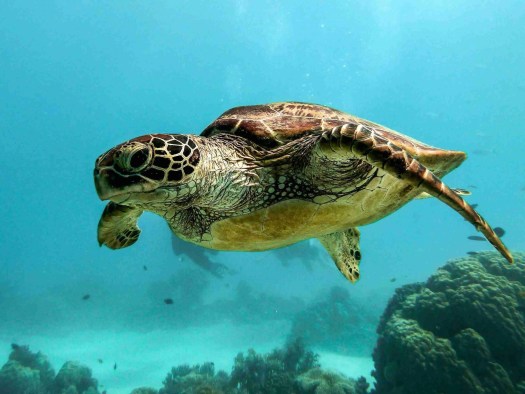
Green sea turtle
Photo by David Clode on Unsplash

Importance

“Sea turtles are a fundamental link in marine ecosystems.” -World Wildlife Fund

Sea turtles keep the natural ocean environment and the food chain balanced. Following are specific ways in which they provide this balance.

Balancing the Food Chain

The largest sea turtles, the leatherbacks, consume up to 440 pounds of jellyfish daily. Loggerheads and Green sea turtles also eat them. As sea turtle populations decline, jellyfish populations increase. This not only affects humans, but it affects fish populations. “Declining fish stocks leave jellyfish with less competition for food, resulting in proliferation of jellyfish around the world. The increase in jellyfish is already proving detrimental to the recovery of fish stocks since jellyfish prey on fish eggs and larvae.”

Certain fish “clean” the barnacles, algae, and epibionts (organisms that survive by living on other organisms) from sea turtles’ bodies and shells, sometimes providing their sole food source. Without turtles, these organisms would have to find another, potentially unsuccessful, food source. “Species associated with a host, such as sea turtles, are important to generating and maintaining diversity throughout the world’s oceans.”

Sea turtles also provide food to many other species as prey. Many predators eat eggs and hatchlings, and even juvenile sea turtles. Sharks and killer whales sometimes eat adult sea turtles.

Last, but not least, some species, such as loggerheads, consume crustaceans. While eating they break the shells into fragments and create trails in sediment along the ocean floor, practices that both contribute to what is known as ‘nutrient cycling.’

“If leatherbacks were to disappear from our oceans, the waters would be swamped with jellyfish, which would, in turn, over-consume fish larvae, therefore stripping fish populations from our oceans.” -Sung Hua Cheng

Green Sea Turtle grazing seagrass at Akumal bay.
“Green Sea Turtle grazing seagrass at Akumal bay.” Photo by P.Lindgren on Wikimedia, Creative Commons license (CC BY-SA 3.0)

Seagrass control

Sea turtles are one of the few animals that eat seagrass, especially Green sea turtles. It needs to be cut short constantly to stay healthy and to keep growing. Seagrass beds are important because they are the breeding and developmental grounds for many species of fish, shellfish, and crustaceans. Those species are consumed by many other species, so lower levels of seagrass impact the food chain, all the way up to humans.

Additionally, seagrass control provides balance to the ocean. “Without constant grazing, seagrass beds become overgrown and obstruct currents, shade the bottom, begin to decompose and provide suitable habitat for the growth of slime molds. Older portions of seagrass beds tend to be overgrown with microorganisms, algae, invertebrates and fungi.” The Caribbean has seen a sharp decrease in Green sea turtles and thus a loss of productivity in commercially fished species.

“All parts of an ecosystem are important, if you lose one, the rest will eventually follow.” -Sea Turtle Conservancy

Dune Protection and Prevention of Beach Erosion

Beaches and dunes do not get a lot of nutrients because sand doesn’t hold them. However, all of the sea turtle nests, eggs, and hatchlings don’t make it to the sea, leaving valuable nutrients behind, such as nitrogen, phosphorus, and potassium, that allow the dunes to thrive. Even the eggshells from hatched eggs provide some nutrients. This is called nutrient cycling. “Dune vegetation is able to grow and become stronger with the presence of nutrients from turtle eggs. As the dune vegetation grows stronger and healthier, the health of the entire beach/dune ecosystem becomes better. Stronger vegetation and root systems helps to hold the sand in the dunes and helps protect the beach from erosion.” But as sea turtles decline, nests decline, and the beaches start eroding.

Additionally, sea turtle eggs, shells, and even hatchlings provide food for other species, which then redistribute the nutrients through their feces. Those nutrients also feed the vegetation that provides stabilization to the dunes.

“As female turtles dig nests in the sand to lay their eggs, they inadvertently contribute to preventing beach erosion. By disturbing the sand and creating depressions, they stabilize the beaches, helping retain the integrity of coastal ecosystems.” -Stephen Larder 

Sea turtle swimming in the ocean.
Photo by Baptiste RIFFARD on Unsplash

Coral Reef Development

Hawksbill Sea Turtles, which eat a lot of sea sponges, help protect the coral reefs. “Sponges compete aggressively for space with reef-building corals. By removing sponges from reefs, hawksbills allow other species, such as coral, to colonize and grow.” Without sea turtles, sponges could start to dominate reef communities and limit the growth of corals, and altering the entire coral ecosystem.

“These amazing creatures are endangered by human interactions, both intentional and unintentional: fishing lines, nets, boat hulls, propellers, and plastic debris, which the turtles mistake for jellyfish and ingest.” -Joel Sartore

Sea turtle entangled in abandoned fishing netting.
Entangled green sea turtle. Photo by NOAA Marine Debris Program on Flickr, Creative Commons license (CC BY 2.0)

What You Can Do

There are so many things you can do to help protect sea turtles! Here’s a quick list, but you can check out my article “Sea Turtles are Endangered” for detailed information.

      • Avoid plastic bags. This is a big one because turtles, especially leatherbacks, mistake floating plastic shopping bags for jellyfish, and ingesting bags kills them.
      • Stop using disposable plastic straws; decline them at restaurants. If you really must have one, carry a metal or glass straw with you.
      • Keep beaches clean. Litter on beaches prevents hatchlings from reaching the sea.
      • Turn off the lights.
      • Use coral reef-friendly sunscreen.
      • Buy sustainable seafood.
      • Do your part to slow climate change.
      • Reduce the chemicals you use in your yard and dispose of others properly through the hazardous waste collection in your area.
      • Don’t buy products made from real turtle shells.
      • Make turtle cookies. I know that sounds funny, but if you have children, cookies are a great conversation starter. Even coworkers would give you a few minutes of listening while enjoying them.
      • Educate others. Try the cookie trick.
      • Stop releasing helium balloons.
      • Recycle, or better yet, don’t buy plastic as much as possible.
Plastic bag floating in ocean, looking similar to a jellyfish.
Photo by MichaelisScientists on Wikimedia, Creative Commons license (CC BY-SA 4.0)

Adopt-A-Turtle!

There are numerous programs that offer sea turtle nest “adoption” for donation. You can do a quick internet search to find one. I adopt a loggerhead sea turtle nest annually through the Coastal Discovery Museum on Hilton Head Island. For my donation, I receive a certificate, a car sticker, and regular email updates about the general nesting season, and information about the specific nest I’ve sponsored. The funds support their educational programs “which inspire people to care for the Lowcountry and all the plants, animals, and people who call this place home.”

Taped off with sign posted, Loggerhead sea turtle nest on the beach.
A loggerhead sea turtle nest on the beach on Hilton Head Island, May 2021. Photo by me

I hope this information was helpful, and thanks for reading. Please share and subscribe!

Additional Resources:

Article, “Information About Sea Turtles: Species of the World,”

Article, “World Sea Turtle Day: 10 Things you Never Knew About Sea Turtles,” World Wildlife Fund UK, June 16, 2018. This is a quick read and is a great way to introduce the topic to children.

Article, “Drone footage shows 64,000 green turtles migrating to Cairns rookery,” The Sydney Morning Herald, June 10, 2020. The article shows a migration map for Green Sea Turtles.

Article, “Information About Sea Turtles: Threats to Sea Turtles,”

Footnotes: