In Part 1, I covered the evolution of recycling efforts and touched on some of the huge problems impacting the planet as a result. In Part 2, I’d like to take a deeper dive into the damage caused by sending our plastic waste overseas to other countries, especially China.
Since the practice began, China has transformed into the western world’s main dumping ground for its recycling waste. So much so that, inevitably China became so overwhelmed and polluted that they were forced to implement strict policies to stop the flow of recyclables. “The impact of that decision is still being felt,” noted a report from the Global Alliance for Incinerator Alternatives. There is a constant search “for new destinations for the waste produced by world powers, with the United States at the forefront.”1
“There’s no single country that can replace China’s recycling capacity.” -Adam Minter2
Walmart gift card found in dump of e-waste residues, Guiyu, China. Photo by baselactionnetwork on Flickr, Creative Commons license (CC BY-ND 2.0).
Where Does Recycling Go Now?
With China effectively closing its doors to new plastic waste, large western countries have been forced to seek alternatives. Some recycling services have just stopped; others are landfilling recyclable materials. The United States and other western countries have resorted to sending their plastic waste to less developed countries that do not have the infrastructure to manage it. The U.S. exports tens of thousands of shipping containers full of plastic recycling to developing countries that mismanage more than 70% of their own plastic waste, because they do not have the infrastructure to handle the volumes. Imported recycling exacerbates the problem.3
These countries included Malaysia, Thailand, Indonesia, Vietnam, Bangladesh, India; but even countries in Latin America and Africa are now taking the West’s recycling waste.4 “The actual amount of U.S. plastic waste that ends [up] in countries with poor waste management may be even higher than 78% since countries like Canada and South Korea may reexport U.S. plastic waste.”5
“Ever since China stopped taking our ‘recyclables’ in 2018, the musical chairs game of waste from broker to broker inevitably leads to illegalities, bribes, and black-market importation. This is how our “recycling” comes to be dumped on developing countries lacking infrastructure to address it in Asia, Africa, and Latin America.” -Eve O. Schaub, author of Year Of No Garbage6
New Bans
A few countries, like Vietnam, Malaysia, and Thailand, started banning some imports because of pollution. So shipments began making their way to Cambodia, Laos, Ghana, Ethiopia, Kenya, and Senegal, which had previously handled almost no U.S. plastic. As of 2021, Mexico and Ecuador are among the most significant plastic importers, as they have less legislation regulating recycling imports. The West exports approximately 35 containers per day to that region.7
Photo by Marcello Casal Jr./Agência Brasil, Creative Commons license (CC BY 2.5 BR).
Recycling Systems Are Flawed
Most plastic is not recycled, though many do not know that because of how our recycling amounts are calculated. A major flaw in our system is that recycling rates are based on how much we divert from landfills, not on how much waste is actually reprocessed into new products. “Plastic waste has been exported and counted as ‘recycled’ by the U.S. Environmental Protection Agency…Without documented traceability of the final fate of the plastic waste, bales of waste plastic collected from municipal and commercial recycling systems were loaded onto trucks and shipped to buyers in foreign countries, many of which had inexpensive labor, no health and safety standards, few environmental regulations and no guarantee that the plastic waste would actually be recycled.”8
Local governments follow the lead of the EPA and calculate their recycling rates based on the volume of landfill diversion. “The practice artificially increased the volume of materials diverted away from U.S. landfills and helped municipalities hit their recycling goals.”9 But all it does is take up space and pollute other parts of the world. Worse, this has caused those countries to become major sources of plastic pollution to the ocean.
“Since exporting plastic waste is a convenient way for the United States (U.S.) and other industrialized countries to count plastic waste as ‘recycled’ and avoid disposal costs and impacts at home, there has been in a significant increase of plastic waste shipments to other countries instead of China.Unfortunately, most of our plastic waste is still shipped to countries that are not equipped to safely and securely manage it.“10
Image by Mumtahina Rahman from Pixabay.Close-up, similar to previous photo. Image by Mumtahina Rahman from Pixabay.
Polluting Other Countries
Our waste is now polluting other countries, especially in Southeast Asia, and harming the health of humans and wildlife in those areas. In the first half of 2018, western countries sent 754,000 tons of plastic waste to Malaysia alone.11 In Vietnam, more than half of the plastic imported into the country is sold to small household level recycling facilities and processed informally. As an article from The Conversation explained:
“Informal processing involves washing and melting the plastic, which uses a lot of water and energy and produces a lot of smoke. The untreated water is discharged to waterways and around 20% of the plastic is unusable so it is dumped and usually burnt, creating further litter and air quality problems. Burning plastic can produce harmful air pollutants such as dioxins, furans and polychlorinated biphenyls and the wash water contains a cocktail of chemical residues, in addition to detergents used for washing. Working conditions at these informal processors are also hazardous, with burners operating at 260-400℃. Workers have little or no protective equipment. The discharge from a whole village of household processors concentrates the air and water pollution in the local area.”12
Those who run informal facilities aren’t the ones we should blame, though. We need to point the finger at ourselves! We are creating the waste and it most often ends up in a developing country. The people who work in those facilities are poisoning themselves just to feed their families. We are the ones who should be ashamed.
Many of the countries receiving our recycling are unable to handle their own plastic waste, to begin with. Waste that comes from the packaging of imported Western products. Corporations have influenced most of the developing world that they, too, should buy disposable products. Our bad habits have influenced the entire world even though we aren’t taking responsibility for our own waste.
Harmful to Human Health
Recycling is not only an environmental issue. As attorney and sustainability expert, Jennie Romer, noted, it is also a humanitarian issue. “[The National Sword policy] brought to light that much of the plastic waste sent to China was not effectively recycled and was instead processed by low-wage workers without the health, safety, or environmental protections mandated in the U.S. We were simply outsourcing the problems associated with these materials.”13
The pollution from low-value recycling has left long-term problems in certain areas. In Wen’an, one of the plastic-recycling zones in China, “studies have shown that heavy metal pollution from plastic-waste recycling is high enough to cause risks associated with cancer in children.” In Shandong Province, chemicals from plastic processing have contaminated the groundwater and families must buy bottled drinking water now.14
The fumes from burning plastics are toxic and harmful, even potentially carcinogenic. People in nearby areas have respiratory problems, unexplained rashes, and other ailments. “Regular exposure can subject workers and nearby residents to hundreds of toxic substances, including hydrochloric acid, sulfur dioxide, dioxins and heavy metals, the effects of which can include developmental disorders, endocrine disruption, and cancer.”15
“To protect the health of humans and fellow creatures who share our planet, the urgent priority must be to eliminate single-use consumer plastic, and to invest in reusable, refillable and package-free approaches.”16
Image by Peggy und Marco Lachmann-Anke from Pixabay.
It’s Over
The market for recycling, especially regarding plastic, has not come back around and it likely never will. It costs more to import plastic recycling than companies can recover from selling it. We shouldn’t have been sending it away in the first place – we should have focused on reduction. It is difficult to fathom the sheer volumes of waste and ‘recycling’ because they are measured in the million tons! In fact, despite the challenges of having to send it to other countries, our plastic waste in the U.S. increased in 2020!
Solutions
We must change our thinking. We have to stop producing so much plastic waste immediately. Companies must redesign packaging to eliminate waste. “We need to look beyond collecting and sorting materials. If we consider how products are designed in the first place, and how we process them to maximize recycling, we can minimize the amount of low-value materials and packaging that we need to dispose of.”17
“Instead of pretending that the trillions of throwaway plastic items produced each year will be recycled or composted, we must stop producing so many of them in the first place.”18
Please spread the message about stopping the production and use of waste. We must demand that corporations stop producing so much plastic. We can’t ignore what is going on in other parts of the world, since we all share this planet. What happens to our plastic, whether it is the U.S. or Southeast Asia, affects us all. Check out my Resources page for leaders in the zero waste and plastic-free movements. Stop buying any disposable items you are able to live without. Though recycling looks dismal, keep trying and learn How to Recycle Better. Please share and subscribe! Thanks for reading.
Additional Resources:
Video, “Plastic Wars,” Frontline PBS, March 31, 2020.
Article, “Shrinking market, poor collection services have Hong Kong’s plastic recyclers struggling to stay afloat — and few are succeeding,” by Zoe Low, South China Morning Post, June 22, 2020.
Video, “The Plastic Problem,” PBS NewsHour, November 27, 2019.
Document, “Destination of U.S. and U.K. Plastic Waste Exports, Country Waste Mismanagement Rates and Evidence of Harms to Receiving Countries,” accessed February 19, 2022.
Article, “Material Recycling and the Myth of Landfill Diversion,” by Trevor Zink and Roland Geyer, Journal of Industrial Ecology, 23, August 2018.
Video, “Asia’s ocean pollution crisis,” SCMP Archive, July 6, 2020.
Article, “How A Picturesque Fishing Town Became Smothered In Trash,” by John Vidal, The Huffington Post, April 10, 2019.
Most of us drop our recycling into a blue bin, believing we are doing the right thing, and move on. This ‘out of sight, out of mind’ point of view is because most of us are so busy that we don’t have time to think about it. But where does our recycling actually go?
If you’ll recall from my article “How Our Recycling Systems Work,” just because recycling is accepted or collected does not automatically mean that it is recycled. If you read my article on why recycling is not the answer, then you also know that our volume of waste, even when recyclable, is out of control. We send most of our recycling away, out of our country, and into the landscapes and lives of people in other countries. Those countries pay workers very low wages to sort recycling and it exposes them to toxic conditions in the process.
“While recycling and the circular economy have been touted as potential solutions, upward of half of the plastic waste intended for recycling has been exported to hundreds of countries around the world.”4
Plastic Waste Trade Watch Newsletter. Graphic of the Month – September 2021. Image from baselactionnetwork on Flickr, Creative Commons license (CC BY-NC-ND 2.0)
How Recycling Grew
While municipal recycling in the U.S. began in the 1970s as a response to quickly filling landfills, it really took off in the 1990s. Back then, recycling services were inexpensive because recyclers could easily profit from the materials. The U.S. sought to increase the recycling of municipal solid waste to avoid landfilling and incineration. Often referred to as landfill diversion, it has become increasingly important as our volumes of waste exponentially increased over the last two decades. The types of plastics accepted in municipal systems grew from just PET #1 and HDPE #2 bottles and jugs to include other types of plastics as cities and states emphasized landfill diversion.
In addition, companies and corporations used ‘recycling’ as a way to increase their sales. Recycling makes it ok to use disposables. Companies branded more of their products as environmentally redeemable, which made consumers feel better about their purchases.5 In effect, this normalized buying increased amounts of packaging, plastic, and disposables.
Marketing campaigns for plastic started with organizations like the American Chemistry Council working to protect the interests of wealthy stockholders. They launched campaigns touting the recyclability of all plastics, and “many local governments took the bait, or were pressured to fall in line.”6 Further, since plastics are made from petroleum and chemicals, the petroleum industry strongly backs organizations like the American Chemistry Council. There is a lot of money behind all the plastics in our daily lives.
“The planet’s load of nearly indestructible plastics — more than 8 billion tons have been produced worldwide over the past six decades — continues to grow.”7
Image by zibik from Pixabay
U.S. Exportation of Recycling
As the volumes of recycling increased, the U.S. began reducing domestic recycling. We began exporting our waste to China because of cheaper labor and equipment costs. At the time, China’s economic growth and its demand for our materials were strong.8 “Shipping recyclables from the U.S. to China made economic sense due in large part to the trade deficit,” wrote attorney and sustainability expert, Jennie Romer. The U.S. buys more from China than China does from the U.S. Instead of returning empty shipping containers, the U.S. began shipping recyclables at a discount.
“Due to low cost shipping and labor, the U.S. became reliant on China to accept plastic materials collected by U.S. municipal systems.“9
Family working in a landfill in China, sifting through garbage in search of recyclables, 2007. Photo by Sheila on Flickr, Creative Commons license (CC BY-NC-ND 2.0)
China Becomes the World’s Dumping Ground
China handled almost half of the world’s recyclables for about 25 years. They have imported about half of the world’s plastic waste since 1992.10 Recyclables were one of the largest categories of exported materials to China between 2007 and 2016. By 2016, the U.S. transported about 1,500 shipping containers full of recyclables across the ocean to China every day.14
Their plastic scrap import business grew from a grassroots effort among poor villagers seeking to make livelihoods. “According to one estimate, roughly sixty thousand small family farms were converted into family-run plastics-recycling facilities.”15 This recycling economy grew correspondingly as our volumes of waste increased exponentially.
The U.S. was exporting 77.9% of its plastic waste by 2016. Japan exported 87.6%. Seven European countries (Germany, the U.K. Belgium, Spain, Italy, France, and the Netherlands) exported 57.5%.18 Up to 70% of Australia’s plastic waste was going to China. Can you imagine how much plastic that is?
“For other countries, China represented a convenient dumping ground for mixed waste. For China, accepting the world’s castoffs became too big a burden.” -Randy Miller, Miller Recycling Corporation19
Family working in a Jiangsu landfill, sifting through garbage in search of any valuable recyclables, 2007. Photo by Sheila on Flickr, Creative Commons license (CC BY-NC-ND 2.0)
Operation Green Fence
In addition to the insane volumes, the recycling China received was severely contaminated. Contamination refers to recyclables that are mixed with trash, food waste, and other non-recyclables. The quality of the recyclables started to decrease. Chinese manufacturers incurred large expenses to sort out and dispose of the non-recyclables in Chinese landfills.20 Contamination rates more than doubled between 2007 and 2013.21
The Chinese government passed the Green Fence policy (aka Operation Green Fence) in 2011 and implemented it in 2013. It was a direct response to the volume and contamination problems. It authorized an aggressive inspection effort and the goal was to limit the number of contaminated recyclables and waste that was flowing into China.22 Another goal was reducing illegal foreign smuggling.23
The policy lowered the contamination rate to 1.5%. That means that 98.5% of the contents of recycling bales had to be free of food waste, trash, non-recyclables, and other debris. This was a strict rate and difficult for Materials Recovery Facilities (MRFs) to manage through single-stream recycling systems.
In the policy’s first year, “almost 70 percent of all incoming containers loaded with recyclables were subjected to thorough inspections.” Recyclers and shippers both faced risks if caught shipping substandard materials. Shippers could have their licenses revoked; recyclers could face the costs of paying for the return of containers full of non-recyclable materials. Almost 22,000 large containers were unqualified and rejected.24 Rightfully so, China did not want to receive garbage from other countries. Though the Green Fence policy was temporary, it began to set off changes in the global trade of recycling waste, especially plastic.
Operation Green Fence “highlighted the fragility of global dependence on a single importer.”25
Too Much Plastic…And Trash
Despite the effects of the Green Fence policy, exports to China continued. While the policy reduced the contamination rate to 1.5%, plastic production, and thus plastic waste, steadily increased. “In 2016 alone, about half of all plastic waste intended for recycling (14.1 million [metric tons]) was exported by 123 countries, with China taking most of it (7.35 million [metric tons]) from 43 different countries.”26 The map below illustrates the countries with the largest exports of plastics to China, showing the U.S. as one of the highest.
“Sources of plastic waste imports into China in 2016 and cumulative plastic waste export tonnage (in million MT[Metric Ton]) in 1988–2016. Countries with no reported exported plastic waste values are white…Quantities for sources of Chinese imports include PE, PS, PVC, PP, and PET.” Source: “The Chinese import ban and its impact on global plastic waste trade,” by Amy L. Brooks, Shunli Wang, and Jenna R. Jambeck, Science Advances, June 20, 2018.
“There’s simply too much plastic for us to recycle away the problem.” -Greenpeace27
The National Sword Policy
Enacted in 2018, this policy banned “24 kinds of solid wastes, including plastics waste from living sources, vanadium slag, unsorted waste paper and waste textile materials.”28 China passed this even stricter policy in order to reduce pollution from low-value recycling, protect its people, and also reduce the smuggling of illegal goods.29 The ban included certain low-value plastics and mandated a 0.5% contamination rate, which is so strict that it almost functions as a ban on most recycling and almost all plastics.
“Before the policy was implemented, China would import huge quantities of waste from other countries, including the U.S.The country had fairly low standards for what it would accept, so recyclable waste would often be mixed with trash and contaminated items such as plastic containers with food debris.China’s processing facilities would then have to manage all that unusable waste.“30
The Human Cost
At the plastic scrap businesses, farmers and low-wage workers picked through low-value bales of scrap plastic for the best materials. They processed the best plastics, #1 and #2’s, into recycled plastic nurdles.31 China used to accept most of the #3, 4, 5, and 7 plastics. But most of these plastics were burned for fuel in people’s backyards or dumped in nearby waterways.32 The workers often even lived among the plastic scrap.
Plastics are made of chemicals and petroleum. Plastic in water breaks down into small particles and releases toxins. When humans drink or bathe with that water, they are ingesting or exposing their skin to those chemicals. Plastic releases those chemicals into the air when heated or burned. Using China as a dumping ground affected the lives and health of thousands of people, who were simply trying to earn enough to support their families.
Two workers on a burning and smoking garbage pile in Huaibei, Anhui, China, 2009. Photo by Philip McMaster on Flickr, Creative Commons license (CC BY-NC 2.0)
The Film, Plastic China
One impetus for the National Sword policy likely came from the 2014 documentary Plastic China.33 The film exposed the environmental and social harms caused by imported plastic waste. It showed the families living and working around toxic plastic materials, even a child washing her face in the wastewater. “Some waste experts believe that the documentary was a motivation for China’s strict National Sword regulations to end China’s unofficial role as the world’s ‘dumping ground’ for waste.”34. Here’s the trailer, which will give an idea of how bad things were:
It is a powerful exposé. As an article from 99% Invisible noted: “Plastic China made the film festival circuit and was even seen in China for a while before the government pulled it from Chinese Internet. Coincidence or causation, National Sword came shortly thereafter. China moved to crack down on informal recycling plants and build newer, better, safer and more efficient recycling systems. Beyond that, the country also shifted focus to recycling internally rather than taking on recyclables from the rest of the world.”35
But China still had to deal with the waste it had already accumulated. Unfortunately, a lot of it wasn’t recycled. “Since the documentary ‘Plastic China’ debuted in China in 2014, more than 60 investigations and articles have shown that millions of tons of exported plastic wastes have been dumped or burned rather than recycled.”36
National Sword Exposed a Broken System
The waste management system in the U.S. was broken before the policy was passed, but it wasn’t apparent. “The National Sword has exposed the fallacy and flaws of the international flow of plastic waste exports as a responsible method of recycling plastic and creating a so-called ‘circular economy’ of plastics.”37
Unfortunately, a circular economy for plastics was never a real thing. Secondary markets for recycled plastic were limited, at best.38 Since virgin plastic often costs less than recycled plastic, there has always been little market demand for it. Worse, plastic can only be recycled once or twice before it is no longer usable. It was never endlessly recyclable.
Negative Value
After National Sword, the recycling market for low-value plastics disappeared almost overnight. With no one to buy the recycling bales, some U.S. recycling facilities began paying for incineration or landfill costs. As Sandra Ann Harris wrote, “The world is unequipped to handle the onslaught of waste that would normally have been shipped to China for recycling. Private and municipal recycling programs that depended on [the] sale of discarded plastics to China have resorted to burying and burning the waste, with serious carbon emissions consequences. Others have gone out of business.”39
China strictly enforced the 0.5% contamination rate through regular inspections and by limiting the number of U.S. companies authorized to transport recycling to China. “Bales that do not meet inspection are either redirected to different end-markets in Southeast Asia or sent back to U.S. ports and placed in landfills, both of which are extremely expensive and consume considerable amounts of fossil fuels.”40
The types of recyclables that Materials Recovery Facilities (MRFs) in the U.S. accepted drastically changed. In some cases, MRFs have to pay to get rid of recycling rather than earn from it. So the demand for plastics is almost non-existent and the value is now negative. These markets are not likely to ever come back unless we make huge, sweeping changes to our entire system. It will become economically challenging to keep recycling facilities operational. Recycling can be part of the solution only if it is economical. Most major companies aren’t going to alter their bottom line just because it’s the right thing to do.
“Spawning the Recycling Crisis”
Some say that the National Sword policy ‘spawned the recycling crisis.’ While it’s true that we suddenly did not have anywhere to send our millions of tons of waste, the problems stemmed from our own creation. We have been producing millions of tons of waste for decades with exponential increases each year. Our corporations had the power to turn off the tap of single-use disposable items and we had the buying power to demand change. So China’s new policy didn’t ‘spawn the recycling crisis,’ it just exposed it. We had been using China as our dumping ground for years, and China became polluted from collecting the western world’s trash.
“While many commentators have blamed East Asian import restrictions for our current struggles, the U.S. is at fault for becoming dependent on exporting its recyclables. The United States failed to curb the rise of plastic, failed to build domestic demand for recycled material, and failed to ensure that product designers considered the end life of their products.” -The State of Recycling National Survey, U.S. PIRG Education Fund41
“Women sorting Plastics for melting. Outskirts of Guangzhou, China. Smashed cathode ray tubes ‘stored’ in back of processing shop, Dali, China,” 2013. Photo by baselactionnetwork on Flickr, Creative Commons license (CC BY-ND 2.0)
What Happens to Recyclable Items Now?
The long-term effects of National Sword will continue to be studied, likely for years. Scientists estimated that “111 million metric tons of plastic waste will be displaced with the new Chinese policy by 2030.”42 But where does will it all go?
In the U.S., we have had to landfill or incinerate a lot of recycling. Some recycling programs have shut down altogether. Others are burning recyclables in an incinerator or sending all of them to landfills.43 Worse, we have also started sending it to other countries, places that don’t necessarily have waste management infrastructure. Instead of China, are we now putting human health at risk in those other countries?
In Part 2, I’ll explore how our waste and recycling are affecting people in other parts of the world. Thank you for reading, please share and subscribe!
Additional Resources:
Article, “Why U.S. Cities Are Ending Single-Stream Recycling,” by Ryan Deer, Roadrunner Recycling, Inc., July 8, 2021.
I used to be an avid believer in recycling. When I was 11, my family began collecting and taking our recycling to the local center. Soon after, the county we lived in passed a recycling ordinance. I was hooked. I even wrote a paper in 9th grade about landfills and recycling, citing a study about mining landfills for recycling and resources that I’d found inspiring.15
Since then I’ve dutifully washed, separated, and toted my recycling, no matter where I’ve resided. If there was no recycling service, I tracked down the recycling centers. At parties or on vacations where recycling wasn’t available, I carted my recyclables all the way home so that I could recycle them. I have spent a great deal of time over my life teaching and educating others on the how’s and why’s of recycling.
Imagine my disappointment just a few years ago when I discovered that only 9% of plastics are recycled.
“Recycling is great, but unfortunately it is not enough. There’s simply too much recycling to process, and we’re still consuming way too many resources.” -Kathryn Kellogg, 101 Ways To Go Zero Waste
Compacted steel and aluminum recycling bales. Photo by Steven Penton on Flickr, Creative Commons license (CC BY 2.0)
The Notion of Recycling is Misleading
The reason that recycling is NOT the sole solution to our waste problem is the misconception that it IS the sole solution to our waste problem.
Many well-meaning people toss their once-used plastic bottle or container into a blue bin somewhere and think that they’ve done their part. But most do not know the real impact of what they are doing. This is because we’ve been fed the myth of recycling for decades. Plastic manufacturers carefully curated the message that we can use all of the plastic we want to because we can just recycle it. That’s a very convenient notion but not at all how it works.
Recycling actually increases consumption, because it gives consumers a false sense of taking care of the environment and doing the right thing. The fact that we think we can recycle something often drives our purchases. It is acceptable to us to buy single-serve plastic yogurt cups and plastic single drink bottles because we can justify the waste those things create with recycling. We pass these notions on to our children as well.
Additionally, companies push these falsehoods through marketing. They want us to think their products are recyclable or sustainable in some way, in order to drive up sales. Some will go as far as ‘greenwashing‘ their products.
“If the public thinks that recycling is working, then they’re not going to be as concerned about the environment.” -Larry Thomas, former head of Society of the Plastics Industry16
Photo by recycleharmony on Flickr, Creative Commons license (CC BY-NC-ND 2.0)
Recycling Myths
There are many recycling myths! Here are just a few of them.
An Endless Loop
First, recycling is not a clean, closed, endless loop where everything that goes in is remade and reused. Materials, especially plastics, degrade in quality. Many plastics are not recycled at all. Since plastics are polymers mixed with chemical additives, plastic products are typically downcycled. Downcycling means made into a lower-quality plastic. Therefore, new plastic from petroleum is often preferred by manufacturers in order to keep making equivalent-quality plastic products. Further, new plastic is often cheaper than recycled. “The current cost of virgin plastic nurdles is much cheaper than the cost of recycled plastic nurdles, so it doesn’t make economic sense to purchase recycled plastic – and much of our carefully sorted plastic ends up stuck in a landfill, incinerated, or shipped abroad.”17
So a plastic water bottle is not remade into another plastic water bottle. It may be downcycled into carpeting or synthetic fabric. After an item outlives its use as a lesser type of plastic container, carpet, or plastic lumber, it is still landfilled. So while technically recycled (downcycled) one time, it is not an endless loop of the same materials being used over and over again.
Recycled content
Further on the myth of reusing materials, have you ever noticed on something you purchased has a label that reads “made from 45% post-consumer” waste/content/plastics? This simply means that 45% of the product or packaging is made from recycled materials. While 100% post-consumer exists, most often, virgin materials must be mixed in with recycled materials to maintain a product’s durability. This is especially true with plastics, paper, and cardboard.
Recycling diverts waste from landfills
Another myth is that recycling automatically diverts waste from landfills. This is just not true. Many recyclables end up in landfills if recycling is contaminated. Contamination is simply the mixing of recyclables with dirty items and non-recyclables. The average resident may not want to spend time cleaning their recyclables or may not know it is necessary. They may not understand what is and is not accepted in their local recycling. They may also be “wish-cycling,” which is when someone attempts to recycle something they think should be recycled, like plastic bags, which are not recyclable. Plastic bags can get tangled in the machinery, and it contaminates the end product of recyclables. If recyclables have too many contaminates, or non-recyclable items, those bales are likely to be landfilled (or even incinerated) rather than sold to a company that will reuse them.
If it is collected, then it is recycled
Just because you put it in a blue bin that “accepts” something does not automatically mean those materials are recycled.
Plastics #3-#7 are often collected in municipalities across the country but they are sent to landfills or are incinerated. Some still export their mixed plastics to other countries. But collecting mixed plastics through single-stream recycling is a big part of the problem. “Acceptance of such a plastic item at a [Materials Recovery Facility (MRF)] alone is not sufficient and reasonable assurance to a customer that it will be manufactured into another item, as required by the FTC…Companies cannot legitimately place recycle symbols or “Check Locally” text on products made from plastics #3-7 because MRFs nationwide cannot assure consumers that valueless plastics #3-7 bales will actually be bought and recycled into a new product.”18
“Acceptance by a [Materials Recovery Facility] is Not Proof of Recycling.”19
Aerial view of paper bales at a recycling center. Image by WFranz from Pixabay.
Volume
The amount of waste and “recycling” humans create is ridiculous, and most people really don’t have any idea about the total volume. Waste and recycling go into a bin and we don’t think about it again. This further creates misconceptions surrounding recycling simply because we don’t understand the volumes of waste we create. If you combined the waste from just you and your neighbors, how much waste is that? Now imagine the amount from your entire neighborhood, city, state, and then nation.
The EPA estimates that of the 292.4 million tons of municipal solid waste (aka trash) generated in the U.S., approximately 69 million tons were recycled.22
Of this, 35,680,000 tons were plastic. Thus, an 800-pound bale of PET would be roughly 18,400 of the 16-ounce PET Bottles.23 Other estimates vary slightly, depending on the size and actual weight of each individual plastic bottle. Now I am not a mathematician. But if all plastics from the 35 million tons were plastic PET bottles, and one ton weighs 2,000 pounds, that would mean there are about 46,000 plastic bottles per ton. Then multiply 35,680,000 by 46,000, and that equals 1,641,280,000,000 individual plastic bottles. And that’s just plastics from one year!
A woman scavenges for survival in a mountain of plastic waste, Pakistan. Photo by baselactionnetwork on Flickr, Creative Commons license (CC BY-NC-ND 2.0)
Recycling is Important
Extracting natural resources is terrible for the environment, human health, wildlife, and directly affects climate change. Preventing the extraction of virgin materials is important, especially when it comes to fossil fuels. Both extracting and burning fossil fuels greatly contribute to global warming.
“Recycling consistently requires less resources and produces fewer greenhouse gases (GHGs) than production of new materials,” wrote Beth Porter.24 For example, recycling aluminum uses 95% less energy than extraction. Almost 75% of all aluminum that has ever been produced is still in use. Paper has a recycling rate of approximately 68.2% (in 2018), the highest compared to other materials in municipal solid waste.25
Bales of plastic ready for shipping. Photo by Larry Koester on Flickr, Creative Commons license (CC BY 2.0)
The Plastics Market
“Recycling depends on the idea that the cost of collecting and sorting certain materials is rational because somebody will want to buy them to make something else. In reality, many plastics have no such market.”-The State of Recycling National Survey, U.S. PIRG Education Fund26
Plastic production is complex and chemical. Worse, “most plastic is derived from oil drilling and/or fracking. Ethane cracker facilities turn ethane into ethylene, a building block of most common plastics.” We know that the oil industry, gas processing facilities, and ethane crackers are all associated with climate change and environmental problems.27“The massive expansion of plastic production in the U.S., fueled by at least $200 billion of investment in 340 petrochemical projects, is flooding the market and causing polyethylene [recycling] prices to decline to historic lows – below prices last seen during the 2008 financial crisis.”28
Since there is little market for recycled plastics, it exacerbates the waste crisis. Recycled plastic must be given some kind of economic value so that collecting it for recycling has a financial incentive.29
“The simple fact is, there is just too much plastic — and too many different types of plastics — being produced; and there exist few, if any, viable end markets for the material. Which makes reuse impossible.”30
Bales of recycling at the Strategic Materials recycling plant in South Windsor, Connecticut. Photo by CT Senate Republicans on Flickr, Creative Commons license (CC BY-NC-ND 2.0)
What Can You do?
“Somewhere along the way, key parts of the “reduce, reuse, recycle” mantra got lost. We have lost track of reducing and reusing.”31
PLEASE RECYCLE! This post is not intended to discourage you from recycling.
But recycling is not the answer to our waste crisis.
We must restructure the way we think about trash. We must change our goals surrounding waste. The goals should focus on refusing, reducing, and reusing long before recycling enters the picture – in that order! If you read my article on how recycling works, you’ll recall that recycling processes are very complex and recycling is easily contaminated.
It is also imperative that we move away from single-use disposables. That alone could help improve pollution, reduce ocean microplastics, and help climate change. Thank you for reading, please share this article and subscribe for future articles!
Plastics are made from chemicals and petroleum, which you read about in Part 1 of this series. Today, I want to tell you about the chemical contents of plastics according to resin code, the number on the bottom surrounded by a triangle. More importantly, I want to inform you of the ways they may be toxic to our health.
Resin Identification Codes (RICs)
Image by OpenIcons from Pixabay.
The plastics industry created RICs in 1988 as part of their campaign to boost plastic’s image. They even lobbied to have state legislatures adopt them. But this little symbol on almost all plastic packaging is misleading. Many assume that the recycling symbol or RIC means that a package is automatically recyclable. However, that is not true, it actually only refers to the type of plastic resin used.
To reduce confusion, ASTM, the organization that regulates the RIC system, updated the symbol from the chasing arrows to a solid triangle in 2013. “However, manufacturers aren’t required to change their equipment to incorporate the new symbol, which is why you still see the arrows on many plastic products,” according to an article on Oceano.org.24 So it’s still easy for people who don’t know to mistake the RIC as a recycling symbol versus an industry tag for the plastic.
Example of a plastic PET food container showing the updated symbol. Photo by Marie Cullis.
“Thanks to the intelligent strategy that the plastic industry came up with in the early 1980s of imprinting a recycling code on the most commonly consumed plastic items, a large majority of consumers think that the bulk of the plastics they consume are recyclable and actually do get recycled through their local curbside recycling program. In reality, only a small percentage of the contents of a recycling box is recycled.”26
The RICs / Types of Plastics
Please note: There are 7 resin identification codes, but that does not mean there are only 7 types of plastics. There are, in fact, tens of thousands of chemical combinations.27
Image courtesy of Wikimedia Commons.
Next, let’s look at the 7 RICs types, what they are used for, their characteristics, their chemical contents, and their potential toxicity. Note that this is not an exhaustive list; nor is each category exhaustive in the standard products or characteristics.
“Despite how useful these additives are in the functionality of polymer products, their potential to contaminate soil, air, water and food is widely documented…These additives can potentially migrate and undesirably lead to human exposure via e.g. food contact materials, such as packaging.”30
#1 PET/PETE: Polyethylene terephthalate
Standard products: Water bottles, soda bottles, salad dressing bottles, food containers such as cooking oil and peanut butter, wrinkle-proof clothing, fleece blankets, padding in pillows and comforters, carpeting, other polyester fabrics.
About: PET is the most valuable type of plastic and the most recycled. There are typically two types: one is made with a blow molding machine; the other is thermoform which is made by heating a plastic sheet until pliable and then molded into a specific shape. The main difference is in molecular weight. Higher molecular weight items, such as bottles and jugs made from blow molding, are more valuable than their thermoform counterparts. Thermoform, though more difficult to sell, is often recycled into carpeting.31
Chemical content: “A chemical called antimony trioxide is used as a catalyst and flame retardant in making PET, and this antimony additive is considered a possible carcinogen.” The amount in one single water bottle is minimal, but leaching increases with heat. Think of those water bottles stored in the car during the summer. “There is research showing that PET may leach phthalates too, even though the plastics industry says that phthalates are not required to make PET.”32 Regardless, think about switching to metal or glass containers whenever possible.
Image by pasja1000 from Pixabay.
#2 HDPE: High-density Polyethylene
Standard products: Milk jugs, water bottles, juice, bottles, bleach, dish and laundry detergent bottles, shampoo and conditioner bottles, cleaner containers, over-the-counter medicine bottles, cereal box liners, Tyvek home insulation, plastic-wood composites, snowboards, 3D printing filament, and wire covering. It is even used in some plastic surgery procedures.
About: This is one of the most widely used plastics because of its versatility. It is strong, flexible, cost-effective, moisture-resistant, and resistant to most chemical solvents. It has high tensile strength and has both a high-impact resistance and melting point. “The polyethylene polymer has the simplest basic chemical structure of any polymer, making it easy to process and thus extremely popular for low value, high volume applications.”33
Chemical content: While this is considered a ‘safer’ plastic for food and drink use, there is evidence that these release endocrine-disrupting chemicals, especially when exposed to UV. “The main leaching culprits are estrogen-mimicking nonylphenols and octylphenols, which are added to polyethylene as stabilizers and plasticizers.”34 Those chemicals disrupt the body’s hormones and can cause cancer, reproductive problems, birth defects, and other developmental disorders.
“Nearly four pounds of petroleum are required for every two pounds of #2 (HDPE) plastic produced.” -Tom Szaky, Terracycle36
Milk jugs are typically #2 HDPE. Photo by Marie Cullis.
#3 PVC: Polyvinyl Chloride
Standard products: Think all vinyl products. Shower curtains, medical bags, medical tubing, shrink wrap, children’s toys, binders, school supplies, plastic furniture, garden hoses, vinyl clothing and outerwear, wire and cable insulation, vinyl records, carpet backing, flooring, credit cards, clamshell packaging, plumbing pipes, vinyl siding, window frames, fences, decking, other construction materials.
About: “PVC can take on a staggering variety of personalities – rigid, filmy, flexible, leathery – thanks to the ease with which it can be blended with other chemicals.”37 PVC is versatile as it can be adapted to many applications depending on the plasticizing additives. It is strong and resistant to moisture and abrasion. It can be produced clear or colored. About three-quarters of all vinyl produced goes into construction applications.
Chemical content: PVC is known as the poison plastic because it leaches toxins for its entire life cycle and should be avoided whenever possible. Vinyl is manufactured by polymerizing a chemical called vinyl chloride, which causes impairment of the central nervous system and is a known human carcinogen (mainly liver cancer). It can contain up to 55% additives, mainly phthalates. The chemicals it may release during its lifetime include cancer-causing dioxins, endocrine-disrupting phthalates, bisphenol A (BPA), lead, mercury, cadmium, and other heavy metals. “The problem with PVC is that its base monomer building block is vinyl chloride, which is highly toxic and unstable, thus requiring lots of additives to calm it down and make it usable. But even in its final ‘stabilized’ form, PVC is not very stable.”38 The additives leach out and you can inhale and ingest them.
Note: PVC is commonly used for plastic water pipes. “During the PVC manufacturing process, it is common for some of the vinyl chloride to fail to be converted into plastic. The unconverted vinyl chloride remains embedded in the PVC. When the PVC comes into contact with water flowing through the pipe, some of the embedded vinyl chloride leaches into the water.”40
PVC pipes, photo by Dennis Hill on Flickr, Creative Commons license (CC BY 2.0).
#4 LDPE: Low-density Polyethylene
Standard products: Film applications like bags, such as those used for bread, shopping, dry-cleaning, newspapers, frozen foods, produce, and garbage. Also used for shrink wraps, linings for cartons and cups, container lids, some squeeze bottles, orthotics, and prosthetics.
About: LDPE is a soft, flexible, lightweight plastic material, known for its low-temperature flexibility, toughness, and corrosion resistance. But it is not recyclable in any practical sense. Citing data from the Environmental Protection Agency (EPA), one large recycling corporation noted that “the overwhelming majority of products made from LDPE end up in landfills…Dumping tons of LDPE in landfills can have devastating consequences…plastic buried in landfills can leach into the soil and introduce chemicals into the groundwater.” They can threaten marine life in coastal areas, and “lightweight plastic bags can be blown great distances by the wind, ending up in bodies of water where animals eat them or become tangled in them.”42 Plastic bags causes huge environmental problems.
Chemical content: These can leach some of the same chemicals as #2 HDPE plastic. It is a thermoplastic made from the polymerization of ethylene. Ethylene is considered a building block of plastic, but it is highly flammable and reactive. It is created by Ethane Cracker Plants, which use an environmentally questionable process to extract the ethane to make ethylene. While difficult to avoid, steer clear of this plastic whenever possible.
Bread bags are typically #4 LDPE. Photo by Marie Cullis.Blue plastic cap from a gallon water jug, #4 LDPE plastic. Photo by Marie Cullis.
#5 PP: Polypropylene
Standard products: Polypropylene is used in packaging, yogurt cups, sour cream and soft cheese containers, prescription bottles, butter/margarine containers, plastic to-go containers, leftover containers, freezer meal containers, the filter cases of some disposable home water filters, electrical wiring, and plastic bottle caps because polypropylene can withstand pressure. It is also used in vehicles for bumpers, carpets, and other parts. Polypropylene allows moisture to escape and stays dry, making it ideal for use in disposable diapers.
About: Polypropylene is sometimes referred to as the “safe” plastic, but there really is no safe plastic when it comes to food. All plastic has the capacity to poison us in certain circumstances. Polypropylene is a stronger plastic than other types, but it is generally not recyclable because there isn’t sufficient reprocessing capacity.Polypropylene is more stable and resists heat better than other plastics. So it is generally considered safer for foods and hot liquids because it leaches fewer chemicals (though it still does leach, which is why you should use glass or metal containers for your food).43 However, this is what many leftover and freezer meal containers are made from. Have you ever noticed rough patches or surface defects in your leftover containers? Any disruptions on the surface mean the polypropylene has been compromised, which increases the chances that it will leach chemicals into your food, especially when heating it.
If you have polypropylene leftover containers from before 2013, replace them. These contained phthalates and bisphenol A (BPA). And if you do replace them, please buy stainless steel or glass containers and just avoid the chemicals in plastic altogether.
Chemical content: Polypropylene is a rigid and crystalline thermoplastic made from the polymerization of the propene monomer. There is ongoing research about the health effects of certain additives leaching from polypropylene, such as oleamide, a polymer lubricant and a bioactive compound. Oleamide does occur naturally in the human body, but the long-term effects of synthetic oleamide are not yet known. In a 2021 study entitled “Plastic additive oleamide elicits hyperactivity in hermit crabs,” scientists found that it may be perceived as a feeding cue by marine species, thus increasing the consumption of microplastics.44
Yogurt and other dairy containers are typically #5 polypropylene. Photo by Marie Cullis.
#6 PS: Polystyrene
“Most recognizable when puffed up with air into that synthetic meringue known technically as expanded polystyrene and popularly by the trademark Styrofoam.” -Susan Freinkel, author of Plastic: A Toxic Love Story45
Standard products: The foam form, called Expanded Polystyrene (EPS), also known as Styrofoam, is used in egg cartons, meat trays, single-use food and take-out containers, coffee cups, vehicles, bike helmets, packing peanuts, and home insulation. The rigid form is used for single-use food containers, cutlery, CD and DVD cases, disposable razors, etc. “It is also combined with rubber to create an opaque high impact polystyrene used for model assembly kits, coat hangers, electronic housings, license plate frames, aspirin bottles and medical and lab equipment, including test tubes and petri dishes.”46
About: It may be difficult to avoid this stuff in home insulation, vehicles, and bike helmets, but it should be avoided at all costs when it comes to food and beverages. I wrote a lot about polystyrene in my series on Styrofoam and polystyrene food containers. These containers and cups leach styrene into food and beverages and thus enter your body. Styrene is known to likely be carcinogenic. It is considered a brain and nervous system toxicant and causes problems in the lungs, liver, and immune system.
Chemical content: Polystyrene is a synthetic polymer made from the polymerization of styrene. It is a chemically produced plastic that can be made into a hard or foam plastic. The foam is created by expanding the styrene by blowing various chemical gases into it. Polystyrene is made from ethylene and benzene, both hydrocarbons derived from by-products of petroleum and natural gas (also known as petrochemicals).
Image by albedo20 on Flickr, Creative Commons license (CC BY-NC-ND 2.0).
#7: OTHER Plastics
This is the catch-all category for all ‘other plastics.’ Any plastic items not made from the above six plastic RICs are grouped together as #7’s. These include acrylic, nylon, polycarbonate, epoxy resins, polylactic acid (PLA), and multilayer combinations of different plastics. These are never recyclable except through a few rare and expensive take-back programs, because of the vast array of resins and chemicals mixed together. Below are some of the individual plastic types that fall under #7.
Acrylic: This is a rigid thermoplastic that is strong, diverse, and resilient; and it can be clear or solid colored. Acrylics are used to make bulletproof windows, LEGOs, dental fillings and dentures, airplane windows, aquariums, shower doors, vehicle parts, helmets, and even textiles such as clothing, tents, and sails. This is a stable plastic and is considered a ‘safer’ plastic, except for certain ones used in dental applications. Those, specifically acrylic methacrylate resins, are suspected to be cytotoxic (toxic at the cellular level) because they leach chemicals such as formaldehyde and methyl methacrylate.47 That being said, keep those LEGOs out of your toddler’s mouth.
Photo by Alexas_Fotos on Pixabay.
Nylon: This belongs to a group of plastic resins called polyamides that include Kevlar and Velcro. Invented by DuPont in the 1930s, nylon was originally invented to be a synthetic alternative for silk, for example, stockings. Nylon can be fiber, solid, or film. Items made from it include clothing, toothbrush and hairbrush bristles, rope*, instrument strings, tents, parachutes, carpets, tires, food packaging, boat propellers, skateboard wheels, and mechanical and automotive parts.
DuPont advertisement for Nylon from 1949. Image by clotho98 on Flickr, Creative Commons license (CC BY-NC 2.0).
*NOTE: Most rope and nets used in commercial fishing are made from nylon and present a huge problem in the oceans. The rope and nets break away from the fishing vessels and become threats to fish, sea turtles, and marine mammals who get entangled in them. Since nylon is plastic, it will not decompose and will remain in the ocean for decades or longer.
Nylon fishing net entangled around the neck of a seal. Image by Noutch from Pixabay.
Polycarbonate:Originally designed as an engineering plastic to compete with die-cast metal and substitute glass because it is lightweight, strong, transparent, and shatter-proof. Polycarbonate is very toxic, as it is produced through the reaction of bisphenol A (BPA) with phosgene COCl and can leach chemicals into water or food.48 In the past, it was used in reusable water bottles and baby bottles until bisphenol A (BPA) was ruled toxic. “It is still a favorite for rigid products including CDs and DVDs, eyeglass lenses, dental sealants, lab equipment, snowboards, car parts and housing for cell phones, computers and power tools.” It is also still used in the large, blue water containers common in offices.49 This type of plastic is good for items not related to food or beverage. However, we should use it less overall in other applications when possible to reduce waste, because when polycarbonate breaks it cannot be recycled.
Epoxy resins: Known for high strength, low weight, temperature and chemical resistance. Used in many applications: high-performance adhesives, coatings, paint, sealant, insulators, wind turbine blades, fiber optics, electrical circuit boards, and parts for carts, boats, and planes. They are also used on the interior lining of most canned goods. Avoid these when possible, especially with food and beverage containers because they contain chemicals such as bisphenol A (BPA) and epichlorohydrin. The latter likely causes blood, respiratory, and liver damage and is a probable carcinogen.50
Polylactic Acid (PLA): This is a bio-based plastic made from lactic acid, which is a fermentation product of corn or cane sugar. This is the most common bioplastic, used in a variety of products including clothing, bottles, weed cloth, gift and credit cards, food packaging, diapers, wipes, and disposable dishes. PLA is advertised as compostable but it is only biodegradable under industrial composting conditions, which is still largely unavailable.51
Polyurethanes
This large family of plastics was introduced in 1954. Polyurethanes do not have an assigned RIC, but they are worth mentioning because they are so common. They come in foamed versions that are soft and flexible for uses in mattresses, cushioning in furniture, cars, and running shoes, spray foam insulation, and carpet underlay. They can take on a flexible form for hoses, tubing, gaskets, seals; and they can be tough and rigid for items such as insulating lining for buildings and refrigerators. Polyurethane can also be made into thin films or coatings, such as adhesives for food packaging and waterproof coatings for wood. When it is spun into fibers, it makes Spandex, Lycra, and even latex-free condoms.52
Polyurethane is made from isocyanates, a chemical that is potentially toxic, as it is the leading cause of occupational asthma. “As for our day-to-day use, polyurethanes have also been linked to a skin irritation known as contact dermatitis through direct contact with such polyurethane items as a toilet seat, jewelry and Spandex tapes sewn into underwear.” It is highly flammable and may contain flame retardant additives that go in mattresses and spray foam insulation. Flame retardants are full of chemical combinations that are considered trade secrets, so the public does not know what potential toxins are present in their items. Spray foam insulation, even once cured, can off-gas isocyanate methylene diphenyl diisocyanate (MDI), which has been linked to asthma and lung damage.53
Image by justynkalp from Pixabay.
What You Can Do
The best thing you can do is to keep learning, which you’re already doing if you’re reading this article. Stay informed and be aware of what chemicals you’re exposed to through plastics, packaging, and additives. Avoid those which are documented as toxic or even potentially toxic. Additionally, remember that few plastics are actually recycled, so reducing the plastics you purchase is essential to the environment and your health. Thank you for reading, please share and subscribe!
“We all need to separate the hopeful and increasingly fantastical act of recycling from the reality of plastic pollution. Recent data indicates that our recycling wishes, hopes, and dreams – perhaps driven in part by myths surrounding RICs – will not stop plastic from entering our oceans. Instead, if we truly want to protect the environment and marine life, we need to campaign for more plastic-free choices and zones, and for the reduction of plastic production and pollution.”54
Article, “An overview of chemical additives present in plastics: Migration, release, fate and environmental impact during their use, disposal and recycling,” by John N.Hahladakis et al., Journal of Hazardous Materials, Volume 344, February 15, 2018.
I have found that most people don’t know that, or don’t care to know. Many plastics are full of potentially toxic chemical concoctions, and knowing what makes up plastics is key to understanding how dangerous those chemicals are. Once you know that, it’s hard to understand why would the FDA, EPA, and other government regulatory agencies allow them to be used in, well…everything.
The short answer is, they just don’t regulate that many chemicals.
But plastics are all around us in everyday life, and thus we are regularly exposed to these chemicals. This is one reason I’m anti-plastic, at least in the way we overuse and overconsume it in daily life.
How Plastic is Made
Plastic nurdles. Image by feiern1 from Pixabay.
“Most plastic is derived from oil drilling and/or fracking.” -Jennie Romer, sustainability expert and attorney1
Plastics are derived from fossil fuels, such as crude oil and natural gas. It is then processed at a refinery into ethane and propane. Next, they go to what are called cracker facilities that “crack” or break down these molecules. They turn ethane into ethylene, which is a building block of most common plastics. Propane becomes propylene. They are mixed with a catalyst, or chemical additive, that links the molecules together and forms polymers. Polymers are long, repeating chains of molecules that are chemically linked, or bonded, together. Harken back to chemistry class and this process is called polymerization.
But “polymers alone rarely have the physical qualities to be of practical value, so most plastics contain a multitude of chemical additives to facilitate the manufacturing process or produce a particular desirable property, such as flexibility, toughness, color or resistance to UV light.”2 This process forms different resins, or types of plastics, and are generally categorized by Resin Codes (those little numbers on plastics with the recycling symbol around it).
Image by John R Perry from Pixabay
Plastic is Toxic
These chemical additives are usually what is most harmful to our health and the environment, as they leach over time and under certain conditions such as heat or UV exposure. Additives include dyes, “fragrances” or phthalates, plasticizers such as bisphenol A (BPA), fillers, fluffers, hardeners, stabilizers, lubricants, fire retardants, blowing agents, antistatic chemicals, and even fungicides and antibacterial agents. “Imagine that, plastics eerily designed to repel insects and bacteria, just like genetically modified cotton or corn!” wrote Chantal Plamondon and Jay Sinha, founders of Life Without Plastic.3
Many chemicals are not even regulated. For example, the FDA banned BPA from infant formula packaging, baby bottles, and sippy cups in 2013 because of its toxic leaching. But, there is a whole family of other bisphenols and most of those are still in active and legal use.
Plastic is often intended for single use only because the toxins leach out over time into your water, food, or product. As Chantal Plamondon and Jay Sinha noted: “We would wash and reuse single-use water bottles over and over, thinking we were being super eco-aware by preventing them from being recycled after a single use or heading straight into the trash and, ultimately, a landfill. We didn’t realize each use and wash was breaking down the cheap, unstable plastic more and more, and increasing the potential for chemicals and microscopic bits of plastic to leach into our drinks.”4I used to reuse my plastic water bottles too – and I stored mine in the car, where the plastics were exposed to intense heat and sunlight, both factors that accelerate plastic chemical leaching.
Plastic Marketing
Image by anncapictures from Pixabay.
Facing changing public opinion about the harmfulness of plastic in the 1980s, the plastics industry “launched a $50M-a-year ad campaign to improve plastic’s image. Part of the message was ‘recycling is the answer.’ Within the plastics industry, however, it was later revealed that even then there was serious doubt that widespread plastic recycling could ever be made economically viable.”5 They knew then, and they certainly know now, that we cannot recycle all of the plastic. Despite the pollution and toxicity, the plastics industry continues to push, market, and produce excessive plastic products and packaging.
“If the public thinks that recycling is working, then they’re not going to be as concerned about the environment.” -Larry Thomas, former head of the Society of the Plastics Industry, now called the Plastics Industry Association6
There are many advocates for plastic production, including the chemical, trade, and petroleum organizations. The global plastics industry is worth between $500 and $800 billion dollars. The plastics industry is not going away while there is that much money at stake.
The American Chemistry Council (ACC) is one of the biggest supporters of plastics, and they spend millions each year contributing to political parties in order to fight legislation that would regulate plastic production. Other organizations protective of plastics include (but are not limited to) the Plastics Industry Association, the American Chemical Society, the Manufacturers Association for Plastic Processors, the International Association of Plastics Distribution, the Vinyl Institute, the American Fuel & Petrochemical Manufacturers, and the Society Of Plastics Engineers.
Plastics Make it Possible Logo, an American Chemistry Council initiative.
“We are not out to destroy the plastics industry, but we must embrace change.”7
“Many of these products, such as plastic bags and food wrappers, have a lifespan of mere minutes to hours, yet they may persist in the environment for hundreds of years.”31
There are a few plastics that have an important place on our planet and in our lives, but most do not. Single-use disposable plastics are the major culprits of our plastic pollution problem. The companies we purchase products from are now producing it at such a high rate that we cannot recycle the problem away. Plastic production increased exponentially, from 2.3 million tons in 1950 to 448 million tons by 2015, and it is expected to double by 2050.32 “Plastic is too microscopically dispersed around the world to try and clean it all up at this point…Prevention and avoidance should be engraved in our minds,” wrote Chantal Plamondon and Jay Sinha in Life Without Plastic.33 Companies and manufacturers must stop producing so much of it!
“Half of all plastics ever manufactured have been made in the last 15 years.”34
Watch this short film about plastic from The Story of Stuff Project:
“We have polluted the planet with indestructible plastic to such a degree that plastic may serve as a fossil marker in our strata to indicate a new era – the way dinosaurs indicate the Mesozoic one – until Big Oil digs the last of those reptiles up to produce more Coke bottles.” -Anne-Marie Bonneau, author of The Zero-Waste Chef43
What To Do
Whatever it takes to slow or stop the neverending barrage of chemical toxicity and plastic pollution being perpetrated on our planet by profit-driven entities, you can start at home and start small. You can avoid and refuse single-use plastic, changing your habits surrounding it one step at a time. I offer many ways to eliminate plastic on my site in my articles such as “14 Ways To Go Plastic-Free With Food,” and under Resources, where there are lists of books, films, and other websites that offer good information.
You have to eliminate plastics in your life in small manageable chunks, because there’s just so much of it. As the founders of Life Without Plastic wrote, “As excited as you may be to embark on this journey, be careful about fully embracing plastic-free living cold turkey, and trying to do it all at once. Once you start noticing the plastic around you, it could overwhelm and discourage you quickly…Take it one step at a time. This is all about changing habits, and that takes time, effort and patience.”44 This will protect you and your family from potentially toxic products entering your body and harming your health.
Contact companies whose products you consume and ask them to switch to responsible packaging. Switch the products you use with items that don’t have plastic. Support legislation like the Break Free From Plastic Pollution Act.45 Getting manufacturers and companies to stop the overproduction of plastics will be key, and to do so we will have to force them through purchase power and legislation.
“We are surrounded by the toxic polluting conundrum that versatile convenient plastic has become. But . . . there are lots of ways to avoid plastics in everyday life – wherever you are, whatever you do. All it takes is a little awareness and initiative. Educated actions, we like to call it.” –Chantal Plamondon and Jay Sinha, Life Without Plastic46
Thank you for reading, and please share and subscribe!
Additional Resources:
Video, “Plastics 101,” National Geographic, May 18, 2018.
In my last article, I wrote about Extended Producer Responsibility (EPR) and Take-back programs. It’s hard to talk about packaging without addressing two giant corporations that sell the most goods to consumers and thus the most packaging, Walmart and Amazon. These are huge companies that can make a big difference in packaging waste. There are thousands of companies that follow the practices of these businesses, so they are also influential. I’ll cover Walmart in this post and Amazon in the next.
Walmart started looking at packaging early
The company has made some positive changes in the packaging world over the last 15 years. From redesigning shoeboxes to use less paper, to lightweighting wine bottles to use less fuel, and to reducing the number of wire ties in toy packaging, Walmart has made some differences. In some ways, they’ve led the way in packaging innovations.
“When we first began in product sustainability, one of the first things we started on was packaging, because packaging cuts through every category.” -Laura Phillips, Senior Vice President of Sustainability, Walmart
Walmart’s vision for sustainability began in 2005 when the company partnered with suppliers to improve packaging on its private-label toy line. “By reducing the packaging on fewer than 300 toys, Wal-Mart saved 3,425 tons of corrugated materials, 1,358 barrels of oil, 5,190 trees, 727 shipping containers and $3.5 million in transportation costs, in just one year,” according to the 2006 press release.32 The company took what it learned from that and developed its Packaging Scorecard in 2006. That was later embedded in the company’s Sustainability Index.
The Sustainability Index, developed by The Sustainability Consortium34 collects and analyzes information about a product’s life cycle. This includes sourcing, manufacturing and transporting, selling, customer usage, and end of life. Walmart uses the data to identify key social and environmental issues. Suppliers can view their scores, see how they rank relative to the field, and gain insight into opportunities for improvement.
“Wal-mart sparked much of the interest in packaging sustainability with the introduction of its Packaging Scorecard in 2006.” – Lisa McTigue Pierce46
New sustainability model
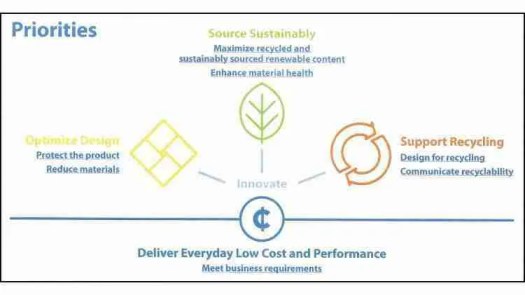
Today, Walmart has three tiers in its sustainability model for its brands, suppliers, manufacturers, and package designers to develop more efficient and sustainable packaging.47 These tiers are optimizing packaging design, sourcing packaging materials sustainably, and supporting recycling in packaging. They encourage the suppliers and brands they work with to follow this model for their packaging.
How2Recycle label
Walmart argues that consumers are confused about recycling. This is because recycling systems are inconsistent, the packaging is not correctly labeled, and there’s too much of it. So Walmart encourages its suppliers to use the How2Recycle label. This is a consistent labeling program that clearly shows consumers what is and is not recyclable. How2Recycle’s “mission is to get more materials in the recycling bin by taking the guesswork out of recycling.”48 While this labeling does help with recycling confusion, it shifts the responsibility of disposal to the consumer.
Walmart’s aspiration is Zero Plastic Waste
Walmart’s goal is zero plastic waste, and they acknowledge the challenges of this on their sustainability website.49 They recognize that around 35% of plastic produced is used in packaging and that most of that is thrown away after a single-use. While plastic packaging can protect products, it is mostly a means of transporting products. But then it becomes waste. Project Gigaton is the “Walmart initiative to avoid one billion metric tons (a gigaton) of greenhouse gases from the global value chain by 2030.”50 Walmart believes that sometimes plastic is the most practical solution for packaging in terms of overall carbon footprint. But they want to find end-of-life solutions.
Walmart shifts responsibility
Photo by Hanson Lu on Unsplash
Walmart has shifted some of the responsibility of packaging waste to the consumer and municipal recycling systems. The company claims, “Society’s ability to collect and recycle plastic waste has failed to keep up with exponential increases in plastic production.” The company recognizes that there are huge challenges in the recycling industry. But they claim that recycling infrastructure is weak and that less than half of US households have access to recycling. While the latter part is absolutely true, the recycling industry simply can’t keep up.
The overproduction of plastic for the last four decades has been perpetuated by companies and corporations, manufacturers, the American Chemistry Council, and the petroleum industry. They produced so much at such an exponential rate and then shifted the burden of that waste to municipalities and the recycling industry. The U.S. was so overwhelmed that they had to ship that waste to foreign countries, like China, which has since banned the practice due to human health concerns from plastic pollution. Recycling is not the answer. We cannot possibly recycle all of the plastic away.
Walmart can do better
Walmart is in a unique position as a global top retailer. They began looking at packaging sustainability earlier than many companies and made early changes in packaging. But they’ve continued to promote single-use disposable items and other cheap “throw-away” merchandise. I viewed this month’s Walmart ad and it promotes picnic season items. Sale items include single-use items like polystyrene plates, plastic cups, packages of plastic forks, as well as cookies, chips, soda, and water in single-use plastic containers. Of the approximately 119 items pictured in the sales ad, about 82 had plastic packaging or were made of plastic.
The company could do so much more, and they even acknowledge that on their sustainability page:
“We recognize that these aren’t challenges we can solve alone and we want to open our doors to a more collaborative approach within the industry. We want to look for and share new solutions to reducing the use of ‘avoidable’ plastic as well as improving recyclability and the use of recycled plastic in our Private Brand packaging.”
This gives me the impression that they want to do better. While I respect the company’s initiatives, I know that the environment will always come second to profit. Remember that Walmart is a global top retailer and profit is always going to be their first priority. Walmart wants to be sustainable IF they can still turn a profit; IF they can get consumers to pay for it; and IF it will encourage more buying. Overall, I think Walmart can do more to prevent plastic waste.
“No need to recycle something that doesn’t exist in the first place!” -Dougie Poynter51
Walmart (Sam’s Club) water bottle on the beach in South Carolina. Photo by me
Thanks for reading, and please subscribe. In my next post, we will look at the packaging practices of the world’s largest online retailer, Amazon.
“If you want to eliminate waste in your life – and in the world – the answers will always come down to one simple thing: consume differently.” -Tom Szaky
In my first article, I introduced the topic of packaging – its history, the current problems with packaging, and I introduced greenwashing. In my second article, I wrote about the terms biodegradable and compostable, and how those terms are often misused. Now we will explore bioplastics.
Bioplastics
Bioplastics are used in packaging which is then marketed as sustainable, and even as biodegradable. “Most biodegradable and compostable plastics are bioplastics, made from plants rather than fossil fuels.” Mike Manna of Organic Recycling Solutions explained just that in his appropriately titled essay, “The Myth of Biodegradability” in The Future of Packaging: From Linear to Circular.
But biodegradability hinges on two key factors. First, raw materials used in bioplastics are more sustainably sourced than petroleum-based plastic. “Many bioplastics are not 100 percent made of natural biomass. To be called a bioplastic, they generally have to be at least 20 percent derived from natural sources. What about the other 80 percent? Excellent question. Many bioplastics contain fossil fuel-based plastic resins and numerous synthetic additives – such as fillers, softeners and flame retardants – just like conventional plastics.”1
Image by Foulon Richard from Pixabay.
The second key factor is there would be less concern about pollution since these items would naturally degrade. But that is not how it works. “The latter factor, however, has mobilized a torrent of misinformation, misplaced optimism, consumer confusion, and headaches for recyclers and composters alike,” Manna wrote. They must be sent to an industrial compost facility to break down. As you know from my previous article, these facilities are few and far between. So bioplastics that require industrial composters are far from guaranteed to make it to one. Biodegradable plastics that do make it to an industrial compost facility will not create usable soil. It lacks the macro and micronutrients of regular compost. “It just doesn’t make environmental sense to take a plant, turn that pant into a highly refined petrochemical, only to then use it once and have it turn into something effectively worse than soil,” wrote Manna.
Bioplastics are made of either polylactic acid (PLA) or polyhydroxyalkanoates (PHA), both of which are #7 plastics. These cannot be recycled and therefore contaminate single-stream recycling systems, making entire loads of recycling unrecyclable. In many ways, bioplastics are worse for single-use disposable items than traditional fossil fuel plastics.
“Often omitted is the amount of energy that goes into, and the negative effects related to, the growing, harvesting, and transportation of bioplastics. Also, in a world full of hungry people, do we really want to be pushing agricultural lands into production of plastics rather than food?” -Michael SanClements, author of Plastic Purge52
Bioplastics will not break down in nature or water. Image by Foulon Richard from Pixabay.
“Sadly, bioplastics do not present a solution for plastic soup or for reducing plastic litter.” -Michiel Roscam Abbing53
Renewable Sources?
Bioplastics are plastics made from natural, renewable sources, such as corn, sugar cane, or potatoes. “The thought is that plastics made with plants, as opposed to fossil fuels, will sustain the unstoppable trajectory of the world’s consumption with a more sustainable material,” Manna wrote. But bioplastics only have to be composed of as little as 20 percent of renewable material to be marketed (or greenwashed) as such, and can still contain a majority of fossil fuel-based plastic.54
Most importantly, renewable sources have to be grown and produced, and agriculture requires a ton of energy. “The corn that is used to make the bio-plastics is not organic,” so there are a lot of pesticides used. “The end result is that valuable agricultural land was used to create something that just gets thrown away,” said Céline Jennison, the founder of Plastic Tides.55
“As of now, turning plants into plastic remains more energy-intensive than recycling used plastic.”56
Corn is a crop used to supplement lots of resources such as gasoline (ethanol), agricultural feed, paper goods, and now plastics. While corn is not a fossil fuel, critics of it suggest that corn creates more problems by contributing to global warming, chemical pollution, and energy waste. It demands more nitrogen fertilizer and pesticides than other crops, and which are made from natural gas and oil. “Runoff from these chemicals finds its way into the groundwater and, in the Midwestern corn belt, into the Mississippi River, which carries it to the Gulf of Mexico, where it has already killed off marine life in a 12,000-square-mile area,” wrote author Michael Pollan.57
“America’s corn crop might look like a sustainable, solar-powered system for producing food, but it is actually a huge, inefficient, polluting machine that guzzles fossil fuel—a half a gallon of it for every bushel.” -Michael Pollan
Photo by Jesse Gardner on Unsplash.
“Corn is hardly sustainable, not the way it’s grown in this country. Farmed at an industrial scale, corn requires vast amounts of herbicides and fertilizer. With heavy rain, these inputs run into waterways and pollute drinking water.” -Elizabeth Royte58
Example: Coca-Cola Plant Bottle
Coca-Cola introduced the PlantBottle in 2009.
“We replaced up to 30% of the petroleum used to make PET plastic bottles with material from sugar canes and other plants. The result? You’d have to take nearly 1 million vehicles off the road to achieve the same reduction in CO2 emissions that PlantBottle™ has achieved since 2009.”59
These claims are questionable. Supposedly, this particular alternative to traditional PET (#1) plastic can be recycled with regular PET plastics. However, how much petroleum does it take to produce sugarcane? As for the CO2 reduction, how did they come up with this calculation?
Photo by Maria Mendiola on Unsplash.
The company has vowed to “use at least 50% recycled material in our packaging by 2030.”60 Why haven’t they been doing this all along? Coca-Cola released an advertisement about a “Coke Bottle Made With Plastic From The Sea,” which was made with plastics picked up by volunteers on beaches on the Mediterranean Sea.61 Volunteers who used their free time to pick up trash on beaches because it’s the right thing to do. Coca-Cola easily has enough money to pay employees to do the same thing. A true solution would be to stop pollution by eliminating this type of packaging.
What about other real solutions, like reverting back to glass bottles? We know that glass is 100% recyclable and does not leach toxins and chemicals. Glass can also be managed through a container deposit system, and can truly be a part of a circular economy.
Example: Procter & Gamble
Procter & Gamble designed a shampoo bottle using recycled beach plastic. They partnered with TerraCycle and SUEZ, a waste management firm. Again, it was using volunteer labor for the collection of plastic polluting beaches. “Sourced through partnerships with beach cleanup organizations already picking up litter on the shores of oceans and other waterways, ocean plastic originally headed for landfills was used to establish a new supply chain,” wrote Virginie Helias at Procter & Gamble. But ‘plastic originally headed for landfills’ is misleading. Much of this plastic had likely already been sent to the landfill or recycling center before and then ended up in the ocean anyway! “Ocean plastic products are seen by many as a distraction that takes attention and resources away from source reduction, while only cleaning up a tiny fraction of ocean plastic,” wrote Jennie Romer, lawyer and sustainability expert.62
Procter & Gamble’s goal is to make 100% of its packaging recyclable and reusable by 2030. While this is a respectable goal, it should focus on reusable packaging since recycling is not the answer. If we stop the disposable stream at the source, that would be far more impactful than all of the recycling systems combined. P&G can do better and have the resources to do much more.
Are there other solutions?
“The key takeaway about bioplastics: They are NOT the solution to plastic pollution and toxicity problems. They will likely play a role, but given their mixed character and the chemical additives most of them contain, relying on them is not a replacement for making a concerted effort to reduce all plastic use at the source.” –Chantal Plamondon and Jay Sinha63
Plastic substitutes are not the answer, just as synthetic biodegradable materials and recycling are not the answers. We also cannot possibly recycle all the plastic away at this point. We know that only 9% of plastic sent to recycling facilities is recycled.
But there are other packaging innovations out there. We’ll explore those in my next post, Part 4. Please subscribe and share, and thanks for reading!
“If you want to eliminate waste in your life – and in the world – the answers will always come down to one simple thing: consume differently.” -Tom Szaky
Additional Resources:
Article, “What you need to know about plant-based plastics,” by Sarah Gibbens, National Geographic, November 15, 2018.
Post, “The Truth & Consequences of Bioplastics,” EcoLunchbox.com, accessed July 5, 2021.
Article, “Why biodegradables won’t solve the plastic crisis,” by Kelly Oakes, BBC Future, November 5, 2019.