The Packaging Industry and How We Can Consume Differently, Part 2

Last updated on May 21, 2023.

Plastic bottles and bags (trash) in a variety of clear, white, blue, yellow and greens together.
Photo by Magda Ehlers from Pexels.

In my last article, I introduced the topic of packaging and the environmental crisis it has created. I left off with an explanation of greenwashing (read here about how to avoid greenwashed products), and in this article, I’m going to describe two terms that are often misused in advertising.

Remember: the answer to packaging is to reduce our reliance on it; to stop using it.

Styrofoam cup floating in water with plantlife
Photo by Jesse Gardner on Unsplash.

“Biodegradable” and “Compostable”

If only these words were the solutions to our global packaging problem! Unfortunately, they are two of the most abused terms in greenwashed advertising. Biodegradable refers to any material that decomposes in the environment. Compostable means that the material is organic matter that will break down and turn into soil. These words do not always mean what we think when it comes to sustainable packaging. In fact, if biodegradable and compostable items go into the trash and then a landfill, they do not biodegrade. Nothing in a landfill breaks down. Worse, the contents of landfills release methane gas, a major contributor to global warming.

But misleading marketing makes us believe that biodegradable plastics are better. “According to the Federal Trade Commission’s Green Guides, it is deceptive to market a product as biodegradable if the item does not completely decompose within one year after customary disposal, so items that are customarily disposed of in landfills cannot be marketed as ‘biodegradable in landfills.'”1 Regardless, the term is often misused.

Biodegradable plastics will only break down under the right conditions, such as in an industrial composting facility, not in a backyard composting system. But commercial composting facilities don’t all accept even certified compostable plastic products because the chemicals in the plastic hurt the final value of the compost.

Industrial Composting Facilities

There are several types of composting systems. A home compost system is mainly food and yard waste that you can set up yourself. Commercial composting refers to a municipal or city composting facility that accepts food and/or yard waste. An industrial composting facility requires precise processing conditions under a controlled biotechnological process. In order to be effective, these conditions include a certain high temperature, moisture level, aeration, pH, and carbon/nitrogen ratio.

Industrial composting facilities are not available in many places. There are about 200 in the US, serving less than 5% of the population. If there is notince

If there is a facility in your area, it still does not guarantee the items will be composted. The reality is that many facilities cannot tell the difference between compostable plastics from regular plastics other than by carefully reading the label on each item. This is not practical with the number of disposables we currently discard, so many items go to the landfill.

“Industrially compostable (also known as commercially compostable) items are those that will likely not break down in your home compost, but will break down under specifically controlled temperatures and pressures designed to create compost at a large scale…If a plastic-resembling item is labeled ‘compostable,’ it is probably industrially compostable only.” -Eve O. Schaub, author of Year Of No Garbage2

Examples

Let’s look at four examples of greenwashed and problematic products.

Wincup polystyrene disposable cups

I saw this single-use disposable coffee cup that a colleague had purchased, and the images of green leaves and biodegradable claims drew my interest. The company, called WinCup and based out of Stone Mountain, Georgia, claims to be a leading manufacturer of disposable polystyrene products.

First, these cups will not biodegrade unless they are put into biologically active landfills, which are far and few between. On their website, they claim that their “cups biodegrade 92% over 4 years” and “under conditions that simulate a wetter, biologically active landfill.”3 What is this type of landfill? My understanding is that it is similar to an industrial composting facility, in the facility adds moisture to assist with breakdown.

Most people toss these cups into the regular trash, which then goes to landfills. These cups will not break down in a landfill. Additionally, if these cups end up in the ocean, they will likely not break down and will also leach toxins. When marine life ingests those toxins, they make their way up through the food chain to us.

BASF ecovio line

BASF, a major chemical corporation, claims to “combine economic success with environmental protection and social responsibility.”4 I found some greenwashed marketing on their website about compostable plastic:
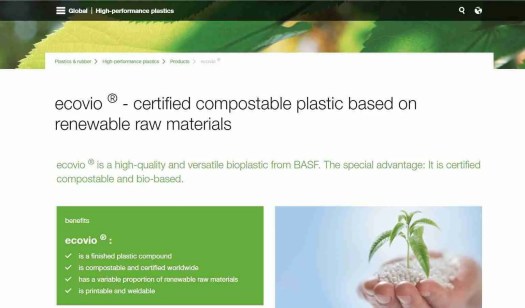
BASF website screenshot for "compostable" plastic

BASF used Ecovio film applications to make organic waste bags, fruit and vegetable bags, carrier bags, agricultural films, etc. Their claim is that the product is compostable, but the fine print indicates it is compostable “under the conditions of an industrial composting plant.”5

Screenshot from BASF's website about their compostable bags

This picture is misleading, as it shows a person putting a bag of compost into a compost bin. This gives the impression that these bags will break down in any compost collection when that is not the case. BASF’s compostable certification is the ASTM D6400, which is specifically for industrial composting facilities.6 Those are not available in most municipalities or states. If these products go into a landfill, it makes no environmental impact whatsoever. They also cause the same pollution problems as regular plastic.

A person holding 'compostable' plastic cups found at Jones Beach State Park, Long Island, New York.
‘Compostable’ plastic cups found at Jones Beach State Park, Long Island, New York. Don’t buy these! Photo by Brian Yurasits on Unsplash.

“So let me make sure I understand this. I’m supposed to get my one-use, takeaway cup, and as the name indicates, I take it away. And then when I’m done I . . . bring it to the nearest industrial composting facility? Oh sure, I think there’s one of those at the mall in between the Hallmark Store and the movie theater.” -Eve O. Schaub, author of Year Of No Garbage7

World Centric products

World Centric brand cups.
World Centric brand cups. Photo by Marie Cullis.
World Centric brand spoons in package.
World Centric brand spoons. Photo by Marie Cullis.

This seems like a great company: they are a Certified B company, they donate 25% of their profits, and they participate in carbon offsets. Their products, “Made from plants, not petroleum,” are made from renewable plants. Specifically, the spoons are made from 70% non-GMO corn and 30% talc. While this is technically better for the environment, these are still single-use disposable items that are only compostable in a “commercial composting facility.” The likelihood that these products will make it into a commercial composting facility after their single use is low. If they go to the landfill, they will likely not break down at all. At least this company isn’t using fossil fuels to make its products.

Molded fiber take-out packaging

molded fiber take out container

These “compostable” and “plastic alternative” molded fiber take-out containers seemed like a magnificent alternative to plastic until they were discovered to contain PFOAs (per- and poly-fluoroalkyl substances). These chemicals, protect the fibers from becoming wet and soggy. The same compounds are in most nonstick cookware. They cause cancer, thyroid disease, reproductive problems, and immunotoxicity in children.

Though marketed as compostable, these chemicals do not disappear. They get into the soil from the compost, and potentially into whatever is grown in that soil. Worse, these chemicals make it into the waterways and eventually into our drinking water.

My family ate out of these types of containers multiple times. Of course, I had no idea at the time that these contained PFOAs. Many major eateries have stopped using these.

Solution

In general, we must consume less. We must end the production and use of single-use disposable items. Most importantly, being aware of these problems is key because we can all make a difference.

In my next article about packaging, I’ll explain bioplastics, which are often advertised as biodegradable or compostable. Thank you for reading, and please subscribe to get the next post in your inbox!

“If you want to eliminate waste in your life – and in the world – the answers will always come down to one simple thing: consume differently.” -Tom Szaky

Additional Resources:

Article, “The bowls at Chipotle and Sweetgreen are supposed to be compostable. They contain cancer-linked ‘forever chemicals,'” by Joe Fassler, TheCounter.org, August 5, 2019. Read this excellent article for more information on molded fiber food containers.

Article, “The breakdown of biodegradable plastic, broken down,” by Sarah DeWeerdt, Anthropocene Magazine, May 7, 2019.

Article, “Will compostable packaging ever be able to solve our waste problem?” by Adele Peters, fastcompany.com, September 3, 2019.

Footnotes:

The Packaging Industry and How We Can Consume Differently, Part 1

Last updated on December 11, 2021.

Yellow excavator on mounds of waste, Indonesia
Waste pile in Indonesia. Photo by Tom Fisk from Pexels.

“Most types of plastic packaging are economically impossible to recycle now and will remain so in the foreseeable future.”7

Waste. We have so much of it that we require large machinery to move it around for us. There’s so much waste that our landfills are overfilling; the ocean is polluted with plastic and toxins; and in parts of the world, people have to spend their days living and working surrounded by large amounts of waste.  This article is the first in a series about the impact of packaging and the packaging industry.

Most packaging comes from items we buy regularly. I recently purchased a bottle of Zyrtec. Almost all medicines come in plastic bottles, but I had to buy a plastic bottle of Zyrtec inside of more plastic packaging! I emailed the company to ask why and if they would consider ending the practice of overpackaging. Unfortunately, Johnson & Johnson, the owner of Zyrtec, sent a generic response: “We appreciate you reaching out to us with your concern. We always value the views and opinions of our consumers…We will make certain your feedback is shared with the appropriate management of our company.” This is the typical response I receive from companies but I keep trying nonetheless.

Zyrtec packaging.
Zyrtec packaging surrounded the small plastic bottle of tablets. Photo by Marie Cullis.

“Recyclable labels on..consumer plastic products do not provide truthful advertising to American consumers and are a cause of contamination and inefficiency plaguing America’s municipal collection and plastics recycling/reprocessing systems.”8

Packaging is Everyone’s Responsibility

I am a recycler and I encourage you to recycle. But unfortunately, recycling isn’t the answer. Globally only about 9% – 13% of plastics are actually recycled. Since recycling doesn’t work in our current systems, we must find better solutions. Less packaging is one idea.

Corporations and companies are not doing enough to prevent plastic pollution, especially through the packaging industry. They have the power to stop producing packaging with disposable plastics and the resources to create more sustainable packaging. But we consumers have power too, to convince those companies to change.

“As consumers, we don’t give ourselves enough credit for how powerful we really are…View your purchases as having a direct impact on the goods and services companies choose to make.” -Tom Szaky, TerraCycle

I recently read The Future of Packaging: From Linear to Circular by Tom Szaky and 15 packaging industry leaders. The book exposed me to more information about packaging and the packaging industry than I knew existed. Then I read other books and several articles about the packaging industry. So I decided to share what I’ve learned with you, in several posts.

Single baking potato sold in plastic packaging for microwavable "convenience".
Single-baking potato sold in plastic packaging for microwavable “convenience”. Photo by Marie Cullis.

“And then there’s the ubiquitous plastic packaging, which envelops practically every product imaginable, from apples to eggs, foam bath to lipstick, toy cars to printer cartridges.”9

Packaging history

How did we get to today, where we have packaging for every single item? Packaging inside of packaging? So much packaging, often made from either mixed materials or unrecyclable materials, that we now have a waste crisis? How did we get here?

Packaging used to be sustainable and reusable with very little waste. Glass bottles held soft drinks, milk, medicine, etc. Consumers returned these and the companies sanitized and refilled them. During World War II citizens collected scrap metal, paper, rubber, and even cooking waste. Cities sometimes issue quotas for recycling.

Beginning in the post-war era, packaging increased to make life more “convenient” and “easier” for women running households. At the same time, the global population was growing at a higher rate than ever before – tripling between 1950 and 2010. Consumerism grew along with increased wealth and disposable income in the Western world. Plastic packaging in all forms became cheaper to create and ship while increasing convenience for consumers.

Life Magazine article of August 1, 1955 about "throwaway living".
Life Magazine article of August 1, 1955.

The False Notion that Plastic is More Sanitary

Plastic also became the “sanitary” way to serve and sell food, a somewhat false notion that persists even today. While plastic can prevent foods from cross-contamination and spoilage, it is not the only material that can do so. There are many options but sadly, plastic has become the standard.

DuPont advertising for cellophane wrapped produce
“Clean and fresh” advertising of DuPont cellophane to increase convenience.

“The spreading fear of a contaminated environment has spawned legions of buyers of bottled water, pasteurized egg and dairy products, and irradiated meats and seafood. Packaging can be highly misleading, however.” -Daniel Imhoff, Paper or Plastic

For a full history of plastic packaging and plastic in general, I recommend  Susan Freinkel’s Plastic: A Toxic Love Story.

Cover of Plastic: A Toxic Love Story

The Current Situation

“Packaging and containers are the largest segment of municipal solid by waste by product category.” -Beth Porter, author of Reduce, Reuse, Reimagine

Packaging today is out of control. Despite solutions, ideas, and innovations, there is far too much packaging in everything, made of all material types. “Today, the average American throws out at least three hundred pounds of packaging a year,” according to Susan Freinkel. In 2017, nearly 30% of U.S. municipal solid waste was from containers and packaging according to the Environmental Protection Agency (EPA).10 This amounted to 80.1 million tons. The EPA estimated that about 50% of that was recycled but only 13% of plastics were recycled (but the number is most likely under 10%).

“About half of all goods are now contained, cushioned, shrink-wrapped, blister-packed, clamshelled, or otherwise encased in some kind of plastic.” -Susan Freinkel, Plastic: A Toxic Love Story

Many types of packaging are not recyclable. Even the ones that are recyclable are often not recycled. One solution is to avoid purchasing as many products in packaging as possible, something I often write about. You can read my article on going plastic-free with food consumption.

The sad truth is that branding and marketing often drive packaging design, rather than environmental issues. This is beginning to change, but not at a fast enough pace to keep up with the rate of consumer packaging disposal.

“More often than not, the perceived value of being ‘green’ is trumped by bottom-line costs.” -Daniel Imhoff, Paper or Plastic

What is Greenwashing?

Greenwashing is advertising or promotions in which green marketing is deceptively used to persuade the public that an organization’s products, aims, and policies are environmentally friendly when they are not. Let’s call this what it is: this is false advertising. Here’s a video with excellent explanations:

I encourage you to read up on greenwashing because it’s everywhere!  Many companies participate in this practice. Remember the Volkswagen scandal? Volkswagen intentionally advertised low emissions vehicles but they actually equipped those vehicles with software that cheated emissions testing. Those vehicles emitted as much as 40 times the allowed amount of pollutants. While that’s an extreme example, this happens often and is so subtle that you aren’t aware of it.

Please see my page on how to identify and avoid greenwashing.

Consumers expect companies to dedicate themselves to making a positive social or environmental impact…they want to be able to trust them to prioritize ethics. – KoAnn Vikoren Skrzyniarz, founder and CEO of Sustainable Life Media, “Consumers Care,” The Future of Packaging

In my next article, I’ll detail some of these greenwashing terms, such as “biodegradable,” “compostable,” and “bioplastics”.

Thank you for reading! Please watch for future parts of this series by subscribing.

“If you want to eliminate waste in your life – and in the world – the answers will always come down to one simple thing: consume differently.” -Tom Szaky


Additional resource:

Article, “The cost of plastic packaging,” by Alexander H. Tullo, Chemical & Engineering News, October 17, 2016.

Footnotes: