Polystyrene food container from Popeyes, sitting on the bank of the Tennessee River. Photo by me
In Part 1 and Part 2 of this series, I told you about polystyrene (Styrofoam) food containers, how and what it they are made with, and how polystyrene is harmful and toxic to human health. Today I’ll explain its poor recyclability and its environmental impact.
“The irrefutable evidence and research has been mounting over decades from various federal agencies, city staff reports, state staff reports, environmental clubs, and nonprofits,” pertaining to the negative effects of Expanded Polystyrene (EPS). -Jeff Lewis, environmentalist writer1
Polystyrene container showing the #6 recycling symbol. Photo by me
Recyclability
In practice, polystyrene food packaging is not recycled. Despite misconceptions, most municipalities do not accept it for recycling, even with the #6 recycling symbol. If it is collected, it often goes to the landfill instead of a recycling facility. Polystyrene is often contaminated with food residue which makes recycling impractical. Additionally, most establishments that use polystyrene food packaging do not provide separate recycling bins, so customers have no choice but to throw them in the regular trash. Nothing is recycled when it is thrown in the trash.
Photo by Chris Caravello on Flickr, Creative Commons license (CC BY 2.0)
Even when you do find a place that accepts polystyrene, there’s no guarantee that the meat trays and egg cartons that you wash, save, and cart back to the supermarket actually get recycled, if you’ll recall from Part 6 of my Packaging Series. Often, those collection sites are simply to draw you into the store and keep local recycling streams free from those materials.
“Styrofoam, despite the #6 plastic composition and the misleading recycling symbol it often carries, cannot be recycled easily or cost-effectively – less than 1% of Styrofoam is recycled in the USA.” -Green Dining Alliance of St. Louis
Cheaper to Produce New Polystyrene
Unfortunately, it is also easier and cheaper to produce new polystyrene than it is to collect, sort, and clean it for the recycling process. Thus, the market for recycled polystyrene is small and unlikely to grow. Companies such as BASF and Dart Container Corporation would have you believe otherwise. Both advocate for polystyrene recycling because they are producers of it as well. Many of the companies that do recycle polystyrene don’t accept food containers, they only accept polystyrene shipping materials. There are a few companies that do recycle used polystyrene food containers and have ways to clean them. But because food contamination makes food containers very costly to sort, clean, and recycle, those companies are rare.
New York City’s Department of Sanitation studied recycling polystyrene food containers and determined that recycling them is not economically feasible. “The report found that the majority of Styrofoam collected for recycling ended up in landfill anyway—but at a higher economic cost and carbon footprint compared to being directly landfilled.” This includes the cost of collection, recycling separation and contamination, and ultimately hauling it a second time to the landfill.2 The conclusion, as always, is to stop relying on recycling and focus on ending the use of single-use disposable items.
“The reason for the decline in price is that crude oil prices are so low that it is cheaper for companies to produce new Styrofoam products than to clean and reuse postconsumer products. This economic reality discourages other companies from getting into the market of recycling the polystyrene.” -Real Cost of Styrofoam3
The Volume of Polystyrene is Overwhelming
The sheer volume of discarded polystyrene is a problem as well. The world produces about 14 million tons of polystyrene annually. As with any type of plastic, we cannot recycle away the problem of single-use disposable items. We must stop it at the source; refusing to use them whenever possible.
Image by Nik Stanbridge on Flickr, Creative Commons license (CC BY-NC-ND 2.0)
“25 billion Styrofoam coffee cups are used for just a few minutes and thrown away every year.” -Green Dining Alliance of St. Louis
Environmental Impacts
Since polystyrene is not recyclable, most of it goes to landfills and some inevitably makes its way into the environment. According to the Environmental Protection Agency (EPA), Styrofoam production is the fifth largest creator of toxic waste in the United States. Polystyrene products break down into smaller and smaller pieces and eventually become microplastics. Birds and marine life ingest small pieces because they mistake the pieces for food. Additionally, after the ingested polystyrene kills an animal, it can go on to kill again after that animal decomposes and the pieces reenter the environment.
“80% of Styrofoam ends up in landfills, and much of the remaining 20% in waterways.” -Green Dining Alliance of St. Louis
Polystyrene does not biodegrade, even the alleged biodegradable and compostable polystyrene, as I wrote about in Part 2 of my Packaging Series. Again, most take-out packaging is thrown away. Polystyrene foam litter is common as it is lightweight and breaks apart easily, making smaller pieces that become windswept. The Clean Water Action organization noted important facts about polystyrene’s environmental harm:4
Expanded polystyrene (EPS) products and their associated chemicals (such as styrenes) are widespread in the marine environment.
Polystyrene is in the digestive tracts of marine invertebrate and vertebrate wildlife.
Polystyrene is one of the most common types of debris on shorelines and beaches worldwide.
A large piece of a polystyrene container found near the bank of the Tennessee River. Photo by me
“Why is such a toxic material in use? Polystyrene is cheaper than some alternatives. However, the environmental expense of polystyrene far exceeds the cost restaurants and grocery stores are currently paying to provide them.” -Massachuesetts Sierra Club5
Solution
After considering the costs to human health, wildlife, and the environment, the solution is to end the use of polystyrene food packaging. Many reports have a similar conclusion and call for banning polystyrene or finding alternatives (see Additional Resources below). We must call for businesses to stop using these products and for local governments to ban their use. Moreover, we need to greatly reduce the amounts of all single-use disposable products we use. In my next article, I’ll explore alternatives to polystyrene food containers, the role of companies in their use of it, and municipal bans on polystyrene. Thank you for reading, and please subscribe!
Additional resources:
Video, “Plastic Recycling, Inc. recycles foam #6 from a MRF,” Plastic Recycling, Inc., March 25, 2016. This video shows the process for one of the rare companies that actually recycles polystyrene food packaging.
Article, “Now and forever: The Styrofoam dilemma,” by Catherine Solyom, Canwest News Service, Accessed October 20, 2020.
Report from cleanwateraction.org, “Greenhouse Gas Impacts of Disposable vs Reusable Foodservice Products,” January 2017.
In my last article, I introduced the topic of packaging and the environmental crisis it has created. I left off with an explanation of greenwashing (read here about how to avoid greenwashed products), and in this article, I’m going to describe two terms that are often misused in advertising.
Remember: the answer to packaging is to reduce our reliance on it; to stop using it.
Photo by Jesse Gardner on Unsplash.
“Biodegradable” and “Compostable”
If only these words were the solutions to our global packaging problem! Unfortunately, they are two of the most abused terms in greenwashed advertising. Biodegradable refers to any material that decomposes in the environment. Compostable means that the material is organic matter that will break down and turn into soil. These words do not always mean what we think when it comes to sustainable packaging. In fact, if biodegradable and compostable items go into the trash and then a landfill, they do not biodegrade. Nothing in a landfill breaks down. Worse, the contents of landfills release methane gas, a major contributor to global warming.
But misleading marketing makes us believe that biodegradable plastics are better. “According to the Federal Trade Commission’s Green Guides, it is deceptive to market a product as biodegradable if the item does not completely decompose within one year after customary disposal, so items that are customarily disposed of in landfills cannot be marketed as ‘biodegradable in landfills.'”6 Regardless, the term is often misused.
Biodegradable plastics will only break down under the right conditions, such as in an industrial composting facility, not in a backyard composting system. But commercial composting facilities don’t all accept even certified compostable plastic products because the chemicals in the plastic hurt the final value of the compost.
Industrial Composting Facilities
There are several types of composting systems. A home compost system is mainly food and yard waste that you can set up yourself. Commercial composting refers to a municipal or city composting facility that accepts food and/or yard waste. An industrial composting facility requires precise processing conditions under a controlled biotechnological process. In order to be effective, these conditions include a certain high temperature, moisture level, aeration, pH, and carbon/nitrogen ratio.
Industrial composting facilities are not available in many places. There are about 200 in the US, serving less than 5% of the population. If there is not an industrial composting facility in your area, the only option is to throw compostable plastics in the trash, since they cannot be recycled.
If there is a facility in your area, it still does not guarantee the items will be composted. The reality is that many facilities cannot tell the difference between compostable plastics from regular plastics other than by carefully reading the label on each item. This is not practical with the number of disposables we currently discard, so many items go to the landfill.
“Industrially compostable (also known as commercially compostable) items are those that will likely not break down in your home compost, but will break down under specifically controlled temperatures and pressures designed to create compost at a large scale…If a plastic-resembling item is labeled ‘compostable,’ it is probably industrially compostable only.” -Eve O. Schaub, author of Year Of No Garbage7
Examples
Let’s look at four examples of greenwashed and problematic products.
Wincup polystyrene disposable cups
I saw this single-use disposable coffee cup that a colleague had purchased, and the images of green leaves and biodegradable claims drew my interest. The company, called WinCup and based out of Stone Mountain, Georgia, claims to be a leading manufacturer of disposable polystyrene products.
WinCup disposable polystyrene cup. Photos by Marie Cullis.
First, these cups will not biodegrade unless they are put into biologically active landfills, which are far and few between. On their website, they claim that their “cups biodegrade 92% over 4 years” and “under conditions that simulate a wetter, biologically active landfill.”8 What is this type of landfill? My understanding is that it is similar to an industrial composting facility, in the facility adds moisture to assist with breakdown.
Most people toss these cups into the regular trash, which then goes to landfills. These cups will not break down in a landfill. Additionally, if these cups end up in the ocean, they will likely not break down and will also leach toxins. When marine life ingests those toxins, they make their way up through the food chain to us.
BASF ecovio line
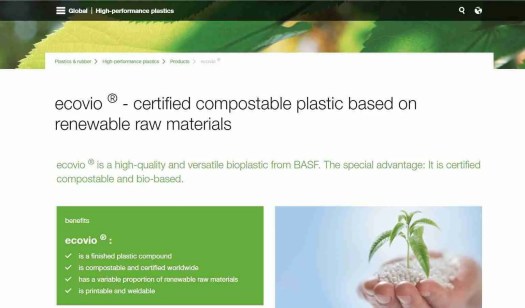
BASF, a major chemical corporation, claims to “combine economic success with environmental protection and social responsibility.”9 I found some greenwashed marketing on their website about compostable plastic:
BASF used Ecovio film applications to make organic waste bags, fruit and vegetable bags, carrier bags, agricultural films, etc. Their claim is that the product is compostable, but the fine print indicates it is compostable “under the conditions of an industrial composting plant.”10
This picture is misleading, as it shows a person putting a bag of compost into a compost bin. This gives the impression that these bags will break down in any compost collection when that is not the case. BASF’s compostable certification is the ASTM D6400, which is specifically for industrial composting facilities.11 Those are not available in most municipalities or states. If these products go into a landfill, it makes no environmental impact whatsoever. They also cause the same pollution problems as regular plastic.
‘Compostable’ plastic cups found at Jones Beach State Park, Long Island, New York. Don’t buy these! Photo by Brian Yurasits on Unsplash.
“So let me make sure I understand this. I’m supposed to get my one-use, takeaway cup, and as the name indicates, I take it away. And then when I’m done I . . . bring it to the nearest industrial composting facility? Oh sure, I think there’s one of those at the mall in between the Hallmark Store and the movie theater.” -Eve O. Schaub, author of Year Of No Garbage12
World Centric products
World Centric brand cups. Photo by Marie Cullis.World Centric brand spoons. Photo by Marie Cullis.
This seems like a great company: they are a Certified B company, they donate 25% of their profits, and they participate in carbon offsets. Their products, “Made from plants, not petroleum,” are made from renewable plants. Specifically, the spoons are made from 70% non-GMO corn and 30% talc. While this is technically better for the environment, these are still single-use disposable items that are only compostable in a “commercial composting facility.” The likelihood that these products will make it into a commercial composting facility after their single use is low. If they go to the landfill, they will likely not break down at all. At least this company isn’t using fossil fuels to make its products.
Molded fiber take-out packaging
These “compostable” and “plastic alternative” molded fiber take-out containers seemed like amagnificent alternative to plastic until they were discovered to contain PFOAs (per- and poly-fluoroalkyl substances). These chemicals, protect the fibers from becoming wet and soggy. The same compounds are in most nonstick cookware. They cause cancer, thyroid disease, reproductive problems, and immunotoxicity in children.
Though marketed as compostable, these chemicals do not disappear. They get into the soil from the compost, and potentially into whatever is grown in that soil. Worse, these chemicals make it into the waterways and eventually into our drinking water.
My family ate out of these types of containers multiple times. Of course, I had no idea at the time that these contained PFOAs. Many major eateries have stopped using these.
Solution
In general, we must consume less. We must end the production and use of single-use disposable items. Most importantly, being aware of these problems is key because we can all make a difference.
In my next article about packaging, I’ll explain bioplastics, which are often advertised as biodegradable or compostable. Thank you for reading, and please subscribe to get the next post in your inbox!
“If you want to eliminate waste in your life – and in the world – the answers will always come down to one simple thing: consume differently.” -Tom Szaky
Additional Resources:
Article, “The bowls at Chipotle and Sweetgreen are supposed to be compostable. They contain cancer-linked ‘forever chemicals,'” by Joe Fassler, TheCounter.org, August 5, 2019. Read this excellent article for more information on molded fiber food containers.
Article, “The breakdown of biodegradable plastic, broken down,” by Sarah DeWeerdt, Anthropocene Magazine, May 7, 2019.
Article, “Will compostable packaging ever be able to solve our waste problem?” by Adele Peters, fastcompany.com, September 3, 2019.
Recently, we went to the Hazardous Waste facility in Chattanooga, Tennessee, to drop off used alkaline batteries (aka single-use, dry cell, or primary cell) that we’ve been saving for almost a year. However, hazardous waste would not accept them, informing us that “they were fine to put in the regular trash.” I’ve been taking them there since 2016, perhaps twice per year, and they always accepted them. Did they used to accept them, and now they don’t? Did they never accept them, and just put them in the landfill instead of properly informing me? I don’t know the answer but either way, I was shocked and disappointed.
I believed alkaline batteries were recyclable for many years. Years ago, I used to bring them to Batteries Plus (now Batteries+Bulbs) for recycling. But in the last decade, they stopped taking them. The store clerks told me several times that the recommendation has been to place them in the trash because they are “safe” for landfills. I’ve even been told that alkaline batteries are “good” for landfills because the alkalinity balances out the acidic environment of landfills.
Is any of this true?
No, it isn’t. Those are myths.
According to Consumer Reports: “If your old batteries end up in a landfill, pollutants like these can leak out into the environment and contaminate groundwater, damage fragile ecosystems, and even make their way into the food chain.”12
The argument is that mercury, a highly toxic metal, is no longer a threat. Mercury content in batteries has decreased significantly since the passage of the 1996 Battery Act, which also changed their classification from hazardous waste to non-toxic or non-hazardous.13 Some argue that naturally occurring metals in batteries pose no threat to the environment.
But why take the chance while the experts argue it out? Any single-use disposable item is now a threat anyway because of the sheer volume of items we throw away.
Image by acunha1973 on Pixabay.
So can alkaline batteries be recycled?
Technically, yes. But practically, no.
While the recycling of alkaline batteries does exist, they are more expensive to process and they don’t contain valuable materials like other types of batteries do. Thus there is no financial incentive to recycle them, so they are only recycled when mandated by law.
Are there laws about battery disposal/recycling?
In some places, yes. More than twenty states have laws about battery disposal. But most are concerned with rechargeable type batteries, which are much more recyclable. In Tennessee, there are no battery recycling requirements. California has the most strict laws – not surprising since California is always in the lead when it comes to laws regarding unsafe, toxic, and dangerous products.
A few states require some retailers to collect batteries for recycling. Others require that battery manufacturers fund or organize battery collection programs.14 Making the manufacturers responsible is one solution. This model is called Extended Producer Responsibility.
Image by StockSnap from Pixabay.
What do the manufacturers recommend?
I checked with three large battery manufacturers for their recommendations on alkaline battery disposal. Overall, I was displeased.
Duracell: “Our alkaline batteries are composed primarily of common metals—steel, zinc, and manganese—and do not pose a health or environmental risk during normal use or disposal…Therefore, alkaline batteries can be safely disposed of with normal household waste, everywhere but California.”15 They encourage customers to contact the local government for disposal options in their area.
Vermont passed a law that implements Extended Producer Responsibility. A state law passed in 2016 law that requires primary battery producers, such as Duracell, to fund a free statewide collection and recycling program. Yay for Vermont!
Energizer contends that “unless you live in California, you’ve been tossing non-rechargeable batteries safely in the trash for at least 19 years.”16 Well, if it’s not safe in California, it’s probably not safe anywhere. Toxins don’t change by crossing a border.
Energizer shucks responsibility on the website. They also take credit for an effort to which they did not contribute. “Since its inception in 1994, Call2Recycle has recycled over 100 million pounds of used rechargeable batteries. This national mindset to recycle has enabled Energizer® to pioneer technology that reuses battery material to create new batteries. So already we’re helping to make a difference.”17 No, they’re not. If these statements were true, they’d take responsibility for the afterlife of disposable batteries.
Rayovac: “Batteries can be disposed of with normal household waste in most US states.”18 They, too, refer consumers to Call2Recycle. They offer information on their commitment to sustainable production but offer no real solutions for disposable alkaline batteries.
Image by Photoshot from Pixabay.
Where can you recycle batteries?
Call2Recycle is a good resource for recycling in general. The latter, a leading battery stewardship program, has collection sites for batteries in different parts of the nation. There are no battery recycling laws in Tennessee, Georgia, or Alabama. But maybe your state does have a battery recycling law. Check out this map from Call2Recycle:
Image courtesy of call2recycle.org.
There are a few places you can pay to recycle alkaline batteries, but it’s very costly for us as consumers:
TerraCycle offers alkaline battery recycling buckets starting at $39 and up to $151.
Call2Recycle sells a box for $68 for battery recycling and other items.
BigGreenBox also sells one for $71.95.
Solutions
There are several solutions at the consumer level that we can implement.
Stop buying alkaline or single-use disposable batteries, and switch to rechargeable batteries. They are reusable and much more recyclable! This is what I am planning to do effective immediately. I read reviews on rechargeable batteries and decided to order a Panasonic Eneloop rechargeable battery set. Read my review Eneloop batteries.
Panasonic Eneloop Power Pack.
Reduce your overall dependence on batteries. I know this is not always feasible, especially with children’s toys and remote controls, but opt for plugging in whenever possible. You can also buy smarter in the future, purchasing items that don’t require alkaline batteries.
Recycle the ones you can through one of the above-mentioned services, or by checking Call2Recycle’s website for free battery recycling near you. (As of March 2024, there are still no options offered in my area.)
Write to the battery manufacturers and request that they do more to improve recycling and awareness about disposal. This probably won’t do much, but it’s worth a try!
Photo by Hilary Halliwell from Pexels.
I hope this was helpful, and thank you for reading! Leave me a comment or question below! Keep trying to be the change, and please share and subscribe!
Hi everyone, July is almost here! What does that mean for you? Hotter weather, fireworks, and barbecue?
Well, did you know it also means PLASTIC FREE JULY?!
What is Plastic Free July?
“Plastic Free July is a global yearly challenge where millions of people give up single use plastic during the month of July. It aims to raise awareness of the amount of single-use disposable plastic items in our lives and challenges people to do something about it.” 1millionwomen.com.au14
I wanted to write a short post to introduce you to this annual challenge. It was created by the organization plasticfreejuly.org.
Why Go Plastic-Free and Not Just Recycle?
Because only 9% of plastic sent to recycling actually gets recycled.
Because plastic has entered every ecosystem across the planet.
Plastic is embedded in our culture, especially surrounding convenience foods. Photo by Marie Cullis.
Let go of Shame
Are you just discovering the ramifications of disposable plastics? Or are you still struggling to take your first step toward eliminating disposable plastic from your house and life? Or have you already gone plastic-free?
Whichever situation you find yourself in, the first thing you need to do is let go of any guilt or shame. I don’t want you to feel those emotions when it comes to your habits surrounding plastics, because negative feelings won’t propel you to action.
I want you to feel enlightened, hopeful, enthusiastic. If you’re just starting and you’ve already thought about these issues then you’ve already consciously taken the first step. Go you!
There are many organizations, websites, films, and social media groups dedicated to the plastic crisis and going plastic-free. I’ve listed my favorites on my Recommended Websites page. Please check out some of my other articles related to plastic here and here.
Image by Amanda Martino on Pexels.
Beyond July
July is a great month to become aware of the problems and to start. However, once July is over you can keep going! You can help prevent the plastic crisis from getting worse. Be the change!
Before you go, if you have four minutes, please watch this video from The Story of Stuff Project:
“Every year, more than 20,000 species tragically disappear from our planet.”-Jeff Corwin
Jeff Corwin has hosted many television shows about animals. But he’s so much more than a popular television show host. He’s a biologist, wildlife conservationist, educator, advocate, and voice for endangered species across the planet.
This book caught my eye at the local used bookstore and I had to buy it. This is a very intelligible book meant for all audiences. Corwin did not write it academically but he does cite an immense amount of research and scientific studies. I honestly had a hard time putting it down even though it deals with a depressing subject matter. But Corwin countered much of the sorrowful information with stories of progressive movements and hope. And all of it is so important for us to know.
The Title
The title comes from the most critically endangered species we are about to lose which has fewer than 100 individual living members left. All are direct consequences of the actions and behaviors of humans. Here, Jeff Corwin talks about the film and book:
I have not been able to find the companion documentary they referred to yet, but if I do I will update this post.
The Contents
Corwin explained the story of each species delicately yet methodically. I read one review where Corwin was criticized for jumping around from one species to the next in different regions of the world. But one glance at the table of contents reveals that he was clearly dividing his book into thematic sections about the major human causes of endangered species. The sections were:
Global warming and habitat loss
The introduction of non-native species, pollution, and disease
The exploitation of animals for products and economy
I will say that that same review applauded Corwin for his genuineness and for highlighting how we can motivate people around the world to change.
“If you’ve ever doubted that a small group of people can make a big difference in the face of a tide that seems inexorable, organizations like the WWF and the IRF are proof that such a change is possible.” -Jeff Corwin
The Endangered Species list is vast
At the time this book was written, there were 16,928 endangered species in the world. I was hoping that that number had decreased since 2009, but I figured it probably increased at least slightly.
But I was devastated to discover that as of 2024, there are 44,000 endangered species, according to the International Union for the Conservation of Nature (IUCN). They are the global authority on endangered species. Corwin cited the IUCN heavily in this book. If you’re not familiar with the IUCN, please check out this 3-minute video that will help you learn about them:
Corwin explained that there were 3,246 critically endangered species (the highest risk category for endangerment of extinction by the IUCN) in 2009. He wrote: “Whether we realize it or not, we need them…We’re inextricably bound with nature. When we put the survival of the natural world in jeopardy, we simultaneously put our survival in jeopardy.” We’ve harmed landscapes and habitats and entire ecosystems, and it’s going to hurt every species, ourselves included.
“We can’t fall back on letting nature take its course when we’ve changed the land and its inhabitants in ways that nature never intended.” -Jeff Corwin
Habitat Destruction
Habitat destruction is the number one cause of species extinction worldwide. It makes sense – as the human population increases, human activities spread and drive the land to a state in which the land can no longer support the indigenous species. Urban sprawl, logging, mining, and commercial fishing are all culprits, but agriculture is the main source of habitat destruction.
Deforestation and habitat destruction is the number one cause of species endangerment. Image by Robert Jones from Pixabay.
Oil & Drilling
We all know oil spills are bad. When animals try to lick off oil from their fur or feathers, “the effect is toxic and can induce kidney failure.” They also rely on their fur or feathers for warmth, but when they’re coated in oil, the animal can freeze to death. “Unless they’re rescued – a monumental feat in remote regions – animals affected by oil spills typically die of hypothermia.” This makes me want to stop driving immediately. How do we stop supporting this global need and greed for oil?
Image by David ROUMANET from Pixabay.
Poaching, Slaughter & the Exotic Pet trade
Poaching is another major cause of species endangerment and extinction, although it is not always defined as just the slaughter of wild animals. It often includes animals captured for the exotic pets trade, for which there is a huge demand on the black market. Humans remove those animals from their habitats, affecting the ecosystem. This reduces the populations in more ways than one – since they do not reproduce in that ecosystem, their numbers obviously decline further.
Slaughter for commercial profit is most visible from the slaughter of elephants and rhinoceroses. Humans kill these large animals for only one body part, the tusks or the horns. They leave the rest of the animal to rot. My family and I recently visited the Nashville Zoo and I was impressed with their exhibits about critically endangered species. I took a photo of one about the rhinos because the image so shocked me that it moved me to tears:
Exhibit from the Nashville Zoo. Photo by me.
We must do better.
“While the dinosaurs disappeared as the result of a natural but catastrophic event, the current causes of extinction are largely the result of human behavior.” -Jeff Corwin
African elephant. Image by Christine Sponchia from Pixabay.
Inspiration
Even though the book made me quite depressed about the state of species across the Earth, the book was very inspiring. It inspired me to feature this review of the book, to read more on the topics, and to write future posts on the subject. Corwin offered hope at every turn.
“We’re not powerless, though. As demonstrated by the success story of the American bald eagle, great strides can be made through compassion and dedication.” -Jeff Corwin
Image by skeeze from Pixabay.
I found the dedication Corwin wrote to his daughters particularly inspiring. Here’s part of it:
“To my daughters…you are both so very precious to your mother and me; your optimism and trust, reflected through a lovely lens of innocence, inspires us…While at present the creatures who share Earth with us are in jeopardy, I have faith that my generation will make things right so you and your children will have the opportunity to thrive upon a rich, healthy, and diverse planet. We will not fail you.“
That’s beautiful, and it’s exactly how I feel about my own child. My son is precious to me and I do not want to leave a devastated planet behind for him to deal with. I want to be part of the change!
I read this article and was thoroughly confused at first. Why on Earth would anyone vote for such legislation?
Front page article from the Chattanooga Times Free Press, March 8, 2019.
The physical copy’s headline is “Protecting Plastic” and is on the front page of the newspaper. The first sentence summarizes:
A surprise amendment to a state bill would make it illegal for municipalities to regulate, prohibit or charge a fee for many single-use plastic items that have polluted Tennessee waterways at an alarming rate.
This ridiculous measure was added on at the last minute. “The bill is being passed as an amendment to a totally unrelated bill, which pertains to county district boundary maps.”17
The article, “Amendment to Tennessee bill would make it illegal for cities to regulate, prohibit or charge a fee for single-use pollutants,” explains that House Bill 1021 is just that.19 This would mean that there could be no single-use disposable plastic ban in Chattanooga, Tennessee. There could be no plastic bag ban in Knox or Davidson County. No city or county would be able to lead the way for the rest of the state with a ban. And the State of Tennessee, so far, has no interest in producing legislation banning these types of materials.
They are called “single-use pollutants” for a reason
Often made of plastic, single-use items are created specifically to be purchased and used only one time by the consumer. The consumer then disposes of the item. Even if the consumer recycled that item, we know that only 9% of plastics are actually recycled.
Many single-use items surround food, convenience foods specifically. Here, I define convenience foods like fast foods, processed and packaged foods, convenience store foods, and take-out foods.
Single-use items made of plastic include:
Straws
Disposable drink cups
Fast-food or take-out containers
Plastic utensils for take-out or fast food
Single drink bottles (soda, water, juice)
Coffee cups and plastic cups from coffee and juice bars
Photo of single-use disposal trash, mostly from food and beverages. Image by filmbetrachterin on Pixabay.
In addition to those, think of single-use plastic bags. Feel free to read my posts on the film Bag Itor on one southern coastal town that took measures in 2018 to ban single-use plastic bags to protect the environment. I think we should be thinking the same thing, and I know many agree.
I found this plastic bag in a parking lot not far from the Tennessee River. Photo by Marie Cullis.
“Shortly after the [City of San Jose] imposed its Bring Your Pwn Bag Ordinance in 2012, single-use plastic bag debris decreased by 89 percent in storm drains and 60 percent in creeks and rivers. Bag bans work.” -Anne-Marie Bonneau20
The Tennessee River is already polluted with microplastics
In a study published late last year, a German scientist revealed at the Tennessee Aquarium’s Conservation Institute that there is an extreme amount of plastics and microplastics in the Tennessee River.21 More than other large rivers with larger populations. And that river leads straight to the Gulf, dumping those plastics into the ocean as well. So why would we stop local governments from trying to do the right thing by protecting the environment, along with human health? Why are we protecting plastic?
Plastic Powerade bottle floating in the Tennessee River across from the Tennessee Aquarium. I was able to fish it out. Photo by Marie Cullis.
“Single use plastics clog our stormwater systems, pollute our waterways, kill wildlife and eventually result in microplastics in our water system,” the Tennesse chapter of the Sierra Club wrote. “Local communities know best how to handle their unique challenges with single-use plastics, and unless the state wants to enact a ban across Tennessee, the General Assembly should stay out of their way.”22
Politics
Regardless of political party, if you’re a Tennessean, you are most likely connected to the outdoors. Whether it’s fishing, hiking, biking, climbing, or boating, Tennesseans love our outdoor activities. And we like to share them with the tourists who visit here. We want to protect tourism in large and small cities in Tennessee, many of which are connected to the Tennessee River. So what sense does it make to jeopardize our beautiful outdoor spaces by proposing legislation to make the environmental problems worse?
State Representative Susan Lynn explained that regulations and bans surrounding single-use pollutants should only be implemented at the state level. Local governments should not because they “stand to create a patchwork of very confusing local regulations that make it really hard to run a business and very expensive.”23 Obviously, I completely disagree. That leaves no place for one municipality to lead the way for the rest.
Tennessee Senator Mike Bell supports the bill as well. He advocates for uniform state regulations regarding business. He claimed in that article that Tennessee was rated “Number 1” in the nation for small businesses in recent years. I searched the internet to verify this information and was unable to find information. I did not that find a source that even places Tennessee in the top 5, including reputable sources such as Forbes and Fortune.
Another supporter of banning plastic bans
Grant Kidwell, the Director of energy, environment, and agriculture task force at the American Legislative Exchange Council (ALEC), said he does not believe bans are the right way to deal with the pollutants. ALEC is a non-partisan voluntary membership organization of state legislators “dedicated to the principles of limited government.” However, placing a ban on bans at the state level is not limited government – isn’t that over-governing?
Kidwell’s work has focused mainly on energy, although he’s written at least one article before arguing that there are too many bad food and plastic bag policies. Even so, he wrote that “the type of container people use to buy food, clothes, or any other items is a decision that should be made by businesses and their consumers.”24 Great, let the people decide. But don’t stop them from advocating for a local ban through state legislation.
“We believe it’s better to try to improve public waste collection.,” Kidwell also said. Clearly, he does not understand that our waste management systems are broken. Or that single-stream recycling systems are inherently dysfunctional.
Photo of a Chick-fil-A fast food meal I had last year while traveling. I no longer eat at Chick-fil-A, and I now also try to avoid any restaurants that serve plastic and more plastic. Photo by Marie Cullis.
Oil
The real worry is that those protecting plastics are really trying to protect oil and natural gas interests. Plastics are made from both materials, petroleum and natural gas. Companies producing petroleum and plastic products will protect their interests, and often over any environmental or human health concern. The United States is the largest consumer of oil by nation, consuming nearly 913.3 million metric tons of oil in 2017.25 We are also the largest natural gas consumers in the world.
What can you do?
I called both of my representatives’ offices to oppose the bill, and my messages were “passed along.” However, I am sad to report that House Bill 1021 passed the House and Senate and Governor Bill Lee signed it into law on April 12, 2019.26 Tennessee is clearly interested in protecting the oil and chemical industries.
But you can ban single-use disposable plastics from your own life. Avoid purchasing single-use products!
Feel free to leave me a comment below, and don’t forget to subscribe. Thank you for reading.
In 2015, I began doing homeschool pre-k lessons with my son. I would put together little thematic lesson plans that we would do together one morning per week. Each lesson would usually incorporate art activities, sensory activities, books, play activities, and writing, all related to the topic of the week. I mixed these up with the occasional musical component, educational video, trips to a related museum/zoo/aquarium, and/or nature adventure.
In late 2016, I decided to introduce the topic of environmental issues and pollution. Even though he was only 3, I thought my son would get something out of it, and in retrospect, he did! So I thought I’d share some of the activities we did. Feel free to use or share any of these ideas!
Oil Spills
My son still recalls the activity where we put toy animals into blue water polluted by an oil spill. I was inspired by a blog post where they used feathers in their experiment.22 I added toy animals and showed how oil in the water stayed on the animals. Here’s what we did:
We started with plain blue water to represent the ocean. I used Sargent watercolor magic to dye the water but you can use blue food coloring too. Place a towel under your container – it’s going to be messy and oily!
Next, I mixed cocoa powder with vegetable oil, as recommended by Almost Unschoolers. We started with feathers but then I quickly realized that he’d love playing with his toy animals even more.
We added a few more animals as we continued to play and experiment. He observed several times that the oil wouldn’t simply rinse off the animals or his hands.
My son had so much fun that he asked me to do it again several months later!
Recycling & Composting
I bought a sticker set from Dollar Tree which included four cardboard recycling cans with stickers. The cans represented plastic, paper, aluminum, and compost. My son took the stickers and placed them on the appropriate can and he only needed a little help. It was a fun activity to do together! You can find similar games or activities online.
Pollution Jar
The last activity we did was to create a pollution jar. I got the idea from Pinterest but cannot credit the blog because it no longer exists. I asked my son to help me choose pieces of trash of various types of materials. We chose different types of plastics, paper, string, etc. We did not use any food waste.
Then we filled the jar with tap water and put the lid on.
We kept this jar for over a year. Over time the materials did not break down, especially the plastics. While that may be obvious to an adult, this was new and interesting information for a preschooler. He thought it was cool. I will say that when I disposed of it, the smell of chemicals from that jar was disturbing.
Other Ideas
We took a walk along the Tennessee River for that lesson as well, just to notice our surroundings. What sounds did we hear? What animals did we see? Did we notice any litter along the river? We talked about how the rivers and oceans are connected; that oceans are full of life; that water and air are our most precious resources. Even if a young child doesn’t understand everything you’re explaining, know that they are absorbing some of it and admiring your knowledge.
We went to the Tennessee Aquarium!
If you search “pollution lesson preschool” on Pinterest or Google, you’ll find a ton of additional great ideas!
I hope you can use some of these ideas with your little one. Feel free to ask questions or leave your ideas in the comments below! Thanks for reading, and please subscribe below!
All the photos in this article, except for the top one, were taken by me.




 I bought a sticker set from Dollar Tree which included four cardboard recycling cans with stickers. The cans represented plastic, paper, aluminum, and compost. My son took the stickers and placed them on the appropriate can and he only needed a little help. It was a fun activity to do together! You can find similar games or activities online.

