The Packaging Industry and How We Can Consume Differently, Part 7

Last updated on August 23, 2021.

Bell pepper and green beans in convenient plastic packaging
These food items do not require this much packaging. Photo by me

In my last article, I introduced take-back programs. Today we will continue that topic and look at programs that are a bit more successful, meaning that the rate of recycling is high.

Snack bag found on the beach in South Carolina. Photo by me

“Plastic packaging for food makes up the majority of municipal waste in America.” -A Plastic Ocean

TerraCycle programs

I love TerraCycle’s entire concept of making new things from waste, and I think its mission of recycling everything and eliminating waste is brilliant. Many companies sponsor take-back programs through TerraCycle at no cost to the consumer.1 These are awesome for waste streams in which there is no recycling option. There’s one for instrument strings, pens and writing tools  (which has a waiting list), and Brita filters. I participate in Bausch + Lomb’s free program to recycle contact lenses and their blister packs (and they accept all brands, not just Bausch + Lomb).2 This particular program has drop-off sites all over the place, usually at eye care offices. I love this one because I have to wear contact lenses for vision correction.

Though these programs encourage recycling and keep waste from littering the environment, they actually discourage companies from exploring new packaging options. A company can sponsor a recycling stream, such as waste from applesauce packets, juice pouches, snack bags, cosmetic and personal care items, and pay TerraCycle to recycle the items. In this way, the companies can take a passive approach and not have to deal with the problem directly. It gives consumers the impression that those companies are taking sustainable actions, but it really makes waste the consumer’s problem. It takes a lot of time and effort to clean, save, and ship the items; and even if the program is free, not everyone can or will voluntarily do it. These programs are a band-aid for the gushing wound of pollution.

“These programs are often funded by consumer product brands and are usually just a mechanism for the company to claim their non-recyclable products are recyclable.” -Jennie Romer, attorney and sustainability expert3

Again, I love what TerraCycle is doing! But I think it gives companies a reason to not be more active in their sustainability efforts. I think it’s a way for companies to take a NIMBY (“not in my back yard”) approach but not have to do much more than cover the minor costs. TerraCycle should be used for things people cannot avoid using, such as Brita filters, contact lenses, laundry detergent waste, shoes, and school supplies. But there are alternatives for things like snack bags, applesauce pouches, and coffee pods. Consumers should seek alternatives for those rather than trying to recycle them.

Image by WikimediaImages from Pixabay

Glass Bottle Exchange

Homestead Creamery returnable milk bottles
This type of milk bottle used to be commonplace. Photo from Homestead Creamery

Historically, the bottled beverage industry used take-back programs during the twentieth century. This system of using returnable glass bottles for milk and soft drinks was better than recycling because it was truly a circular economy system. It is also the most sustainable type of container deposit program. Bottles were washed and refilled as many as 20-50 times. While a few companies use this system today through a deposit program, like Homestead Creamery (sold at some Kroger’s grocery stores), this system of glass bottle exchange has largely disappeared in the United States. However, you can check Drink Milk In Glass Bottle’s website to see if there are any options in your region.4

Glass Coca-Cola bottles in red carry cases
Remember these? Image by SatyaPrem from Pixabay

Container Deposit Programs

A very successful type of take-back program is the container deposit program. While sometimes controversial, they reduce litter and environmental pollution and improve recycling rates. The consumer is charged a deposit fee of 5 or 10 cents per bottle or can. When the consumer returns that item for recycling, they get their deposit money back. This can include glass, plastic, and aluminum bottles and cans. Some call this system a tax, but it is clearly a deposit – when you return the container you get your money back, unlike with taxes.

Soda can with container deposit information engraved.
Many cans and bottles feature container deposit information as shown here. Photo by me

Benefits

The Container Recycling Institute (CRI) promotes the bottled beverage deposit system internationally.5 There are so many benefits to this system, as CRI President Susan Collins noted:6

      • Dramatic reductions in litter and marine debris
      • Reductions in energy use and greenhouse gas emissions due to fewer containers that need to be made from virgin materials
      • Additional jobs in recycling
      • More high-quality scrap for manufacturers
      • Extra income for consumers, charities, and community groups

Here’s a great short video from CRI explaining the system:

These systems are not meant to replace curbside recycling, but to supplement them to increase overall recycling. Curbside recycling is still not available to 50% of the American population, and curbside doesn’t address away-from-home consumption. Even where it is available, recycling rates have gradually dropped. “This decline is due in part to the increase in consumption of beverages away from home, and in public places where there are few available collection outlets for recycling. The drop in the recycling rate is also due to the shift away from aluminum to PET, which has a lower recycling rate,” according to Bottled Up: Beverage Container Recycling Stagnates (2000-2010).7

“Using only single-stream curbside recycling (blue bins) fails to achieve even half of the recycling rate of container deposit laws. While curbside programs should be part of the recycling equation, because 30 percent to 50 percent of beverage containers are consumed away from home, residential programs alone can’t possibly be expected to produce high recycling rates.” -Susan Collins, CRI President

Container Deposit Programs are Quantifiably Successful

The first US beverage container deposit laws were passed in the early 1970s in Oregon and Vermont. Currently, this program exists in 10 US states and Guam, and 30 other countries around the world. “States with container deposit laws capture beverage bottles for recycling at a significantly higher rate, and the quality of recycled materials (meaning the level of contamination) is superior to materials collected from curbside recycling programs.”8 The overall recycling rate for bottles and cans with a deposit is 59%, compared to only 22% for bottles and cans without a deposit. Clearly, this system works well. The graph below shows the rates:

Graph from the Container Recycling Institute (CRI)

The participating states are California, Connecticut, New York, Vermont, Michigan, Maine, Hawaii, Iowa, Massachusetts, and Oregon. Oregon’s bottle capture rate is 81%. Sadly, there are no states in the southeast or states that border the Gulf of Mexico that participate. These are missed opportunities to protect our oceans and rivers.

Examples

Oregon’s BottleDrop Refillables program is a successful, circular loop between the program and craft breweries. Consumers pay a deposit and return the bottles to get the deposit back. Bottles are sorted, washed, inspected, and delivered back to Oregon’s craft beverage producers. According to their website, 598,755 bottles have been saved from being crushed and recycled.9 An example in Europe is Germany, where almost 46% of all drinks are sold in reusable bottles which are refilled 40-50 times before being sent for recycling.

Container Deposit Programs as Law

Legislation for this system is commonly referred to as “Bottle Bills.” A national bottle bill could be implemented as part of the recently proposed Break Free From Plastic Pollution Act of 2020. This would make the collection, redemption, and recycling of bottles and cans regulated and consistent and could increase the recycling rate to 80%!

“For the sake of our climate, our oceans and our future generations, we must do more to collect high-quality recyclable bottles and cans that can be used to produce new products. A national container deposit-refund law can make that happen.” -Susan Collins, CRI President10

Unfortunately, bottlers are usually against such bills because they do increase costs for them, though only slightly. Elizabeth Royte, the author of Bottlemania, wrote that every time a new Container Deposit bill is introduced or an expansion is proposed for an existing one, “Coke, Pepsi, and other bottlers hire lobbyists and run ad campaigns designed to stop them. And they usually do.” But the companies making so many single-use disposable containers need to step-up and be part of the solution.

Containers as Litter

I personally grew up in a container deposit state that also had curbside recycling, and never even thought to question it. It was just what we did (in addition to curbside recycling). Our family brought back bottles and cans to the grocery store each week, and we’d receive either the cash or a credit on our grocery total. I continued this practice into my adulthood. I didn’t see as much litter on the sides of the roads. In Tennessee, I feel like I see trash on every street, playground, and parking lot; much of the litter is from single-use beverage containers. According to CRI, beverage containers comprise 40-60% of litter.

Image of plastic container art dolphin shaped to represent percentages of plastic containers recycled.
See this and additional plastic art projects by clicking on the image. Photo from CRI

“There are many quantifiable but just as important benefits of increased container recycling: the cleaner roadways, the healthier waterways, the growth in local jobs and green businesses and the satisfaction that we are doing what’s right not only for the planet but for future generations.” –Bottled Up: Beverage Container Recycling Stagnates (2000-2010)11

Solutions

Some companies use greenwashing and ‘sustainability’ to make consumers buy more. However, as long as packaging remains the responsibility of the consumer, we must consume less and buy more consciously. Companies must invest in better packaging and establish Extended Producer Responsibility programs. States must implement Container Deposit Programs to curb the impact of single-use disposable beverages. These systems reduce litter and increase recycling rates. Ultimately, though, ceasing the use of single-use disposable containers is one of the most impactful things we can do for the environment.

Thanks for reading! Here’s a link to the first post in this series in case you missed it. In my next post, I’ll explore companies that are already making recycling and reduction part of their mission.

“If you want to eliminate waste in your life – and in the world – the answers will always come down to one simple thing: consume differently.” -Tom Szaky

Note: There are no affiliate links in this post; all links are for informational purposes only.


Additional Resource:

Publications, Data Archive, Container Recycling Institute, accessed February 28, 2021.

Footnotes:

The Packaging Industry and How We Can Consume Differently, Part 2

Last updated on May 21, 2023.

Plastic bottles and bags (trash) in a variety of clear, white, blue, yellow and greens together.
Photo by Magda Ehlers from Pexels.

In my last article, I introduced the topic of packaging and the environmental crisis it has created. I left off with an explanation of greenwashing (read here about how to avoid greenwashed products), and in this article, I’m going to describe two terms that are often misused in advertising.

Remember: the answer to packaging is to reduce our reliance on it; to stop using it.

Styrofoam cup floating in water with plantlife
Photo by Jesse Gardner on Unsplash.

“Biodegradable” and “Compostable”

If only these words were the solutions to our global packaging problem! Unfortunately, they are two of the most abused terms in greenwashed advertising. Biodegradable refers to any material that decomposes in the environment. Compostable means that the material is organic matter that will break down and turn into soil. These words do not always mean what we think when it comes to sustainable packaging. In fact, if biodegradable and compostable items go into the trash and then a landfill, they do not biodegrade. Nothing in a landfill breaks down. Worse, the contents of landfills release methane gas, a major contributor to global warming.

But misleading marketing makes us believe that biodegradable plastics are better. “According to the Federal Trade Commission’s Green Guides, it is deceptive to market a product as biodegradable if the item does not completely decompose within one year after customary disposal, so items that are customarily disposed of in landfills cannot be marketed as ‘biodegradable in landfills.'”1 Regardless, the term is often misused.

Biodegradable plastics will only break down under the right conditions, such as in an industrial composting facility, not in a backyard composting system. But commercial composting facilities don’t all accept even certified compostable plastic products because the chemicals in the plastic hurt the final value of the compost.

Industrial Composting Facilities

There are several types of composting systems. A home compost system is mainly food and yard waste that you can set up yourself. Commercial composting refers to a municipal or city composting facility that accepts food and/or yard waste. An industrial composting facility requires precise processing conditions under a controlled biotechnological process. In order to be effective, these conditions include a certain high temperature, moisture level, aeration, pH, and carbon/nitrogen ratio.

Industrial composting facilities are not available in many places. There are about 200 in the US, serving less than 5% of the population. If there is notince

If there is a facility in your area, it still does not guarantee the items will be composted. The reality is that many facilities cannot tell the difference between compostable plastics from regular plastics other than by carefully reading the label on each item. This is not practical with the number of disposables we currently discard, so many items go to the landfill.

“Industrially compostable (also known as commercially compostable) items are those that will likely not break down in your home compost, but will break down under specifically controlled temperatures and pressures designed to create compost at a large scale…If a plastic-resembling item is labeled ‘compostable,’ it is probably industrially compostable only.” -Eve O. Schaub, author of Year Of No Garbage8

Examples

Let’s look at four examples of greenwashed and problematic products.

Wincup polystyrene disposable cups

I saw this single-use disposable coffee cup that a colleague had purchased, and the images of green leaves and biodegradable claims drew my interest. The company, called WinCup and based out of Stone Mountain, Georgia, claims to be a leading manufacturer of disposable polystyrene products.

First, these cups will not biodegrade unless they are put into biologically active landfills, which are far and few between. On their website, they claim that their “cups biodegrade 92% over 4 years” and “under conditions that simulate a wetter, biologically active landfill.”11 What is this type of landfill? My understanding is that it is similar to an industrial composting facility, in the facility adds moisture to assist with breakdown.

Most people toss these cups into the regular trash, which then goes to landfills. These cups will not break down in a landfill. Additionally, if these cups end up in the ocean, they will likely not break down and will also leach toxins. When marine life ingests those toxins, they make their way up through the food chain to us.

BASF ecovio line

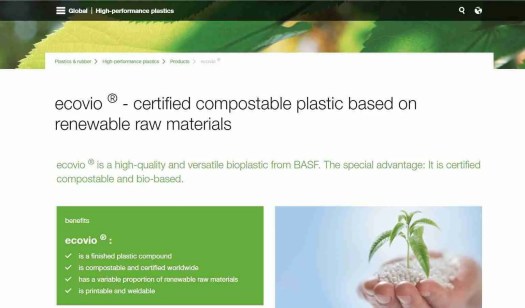
BASF, a major chemical corporation, claims to “combine economic success with environmental protection and social responsibility.”12 I found some greenwashed marketing on their website about compostable plastic:

BASF website screenshot for "compostable" plastic

BASF used Ecovio film applications to make organic waste bags, fruit and vegetable bags, carrier bags, agricultural films, etc. Their claim is that the product is compostable, but the fine print indicates it is compostable “under the conditions of an industrial composting plant.”13

Screenshot from BASF's website about their compostable bags

This picture is misleading, as it shows a person putting a bag of compost into a compost bin. This gives the impression that these bags will break down in any compost collection when that is not the case. BASF’s compostable certification is the ASTM D6400, which is specifically for industrial composting facilities.14 Those are not available in most municipalities or states. If these products go into a landfill, it makes no environmental impact whatsoever. They also cause the same pollution problems as regular plastic.

A person holding 'compostable' plastic cups found at Jones Beach State Park, Long Island, New York.
‘Compostable’ plastic cups found at Jones Beach State Park, Long Island, New York. Don’t buy these! Photo by Brian Yurasits on Unsplash.

“So let me make sure I understand this. I’m supposed to get my one-use, takeaway cup, and as the name indicates, I take it away. And then when I’m done I . . . bring it to the nearest industrial composting facility? Oh sure, I think there’s one of those at the mall in between the Hallmark Store and the movie theater.” -Eve O. Schaub, author of Year Of No Garbage15

World Centric products

World Centric brand cups.
World Centric brand cups. Photo by Marie Cullis.
World Centric brand spoons in package.
World Centric brand spoons. Photo by Marie Cullis.

This seems like a great company: they are a Certified B company, they donate 25% of their profits, and they participate in carbon offsets. Their products, “Made from plants, not petroleum,” are made from renewable plants. Specifically, the spoons are made from 70% non-GMO corn and 30% talc. While this is technically better for the environment, these are still single-use disposable items that are only compostable in a “commercial composting facility.” The likelihood that these products will make it into a commercial composting facility after their single use is low. If they go to the landfill, they will likely not break down at all. At least this company isn’t using fossil fuels to make its products.

Molded fiber take-out packaging

molded fiber take out container

These “compostable” and “plastic alternative” molded fiber take-out containers seemed like a magnificent alternative to plastic until they were discovered to contain PFOAs (per- and poly-fluoroalkyl substances). These chemicals, protect the fibers from becoming wet and soggy. The same compounds are in most nonstick cookware. They cause cancer, thyroid disease, reproductive problems, and immunotoxicity in children.

Though marketed as compostable, these chemicals do not disappear. They get into the soil from the compost, and potentially into whatever is grown in that soil. Worse, these chemicals make it into the waterways and eventually into our drinking water.

My family ate out of these types of containers multiple times. Of course, I had no idea at the time that these contained PFOAs. Many major eateries have stopped using these.

Solution

In general, we must consume less. We must end the production and use of single-use disposable items. Most importantly, being aware of these problems is key because we can all make a difference.

In my next article about packaging, I’ll explain bioplastics, which are often advertised as biodegradable or compostable. Thank you for reading, and please subscribe to get the next post in your inbox!

“If you want to eliminate waste in your life – and in the world – the answers will always come down to one simple thing: consume differently.” -Tom Szaky

Additional Resources:

Article, “The bowls at Chipotle and Sweetgreen are supposed to be compostable. They contain cancer-linked ‘forever chemicals,'” by Joe Fassler, TheCounter.org, August 5, 2019. Read this excellent article for more information on molded fiber food containers.

Article, “The breakdown of biodegradable plastic, broken down,” by Sarah DeWeerdt, Anthropocene Magazine, May 7, 2019.

Article, “Will compostable packaging ever be able to solve our waste problem?” by Adele Peters, fastcompany.com, September 3, 2019.

Footnotes:

The Packaging Industry and How We Can Consume Differently, Part 1

Last updated on December 11, 2021.

Yellow excavator on mounds of waste, Indonesia
Waste pile in Indonesia. Photo by Tom Fisk from Pexels.

“Most types of plastic packaging are economically impossible to recycle now and will remain so in the foreseeable future.”15

Waste. We have so much of it that we require large machinery to move it around for us. There’s so much waste that our landfills are overfilling; the ocean is polluted with plastic and toxins; and in parts of the world, people have to spend their days living and working surrounded by large amounts of waste.  This article is the first in a series about the impact of packaging and the packaging industry.

Most packaging comes from items we buy regularly. I recently purchased a bottle of Zyrtec. Almost all medicines come in plastic bottles, but I had to buy a plastic bottle of Zyrtec inside of more plastic packaging! I emailed the company to ask why and if they would consider ending the practice of overpackaging. Unfortunately, Johnson & Johnson, the owner of Zyrtec, sent a generic response: “We appreciate you reaching out to us with your concern. We always value the views and opinions of our consumers…We will make certain your feedback is shared with the appropriate management of our company.” This is the typical response I receive from companies but I keep trying nonetheless.

Zyrtec packaging.
Zyrtec packaging surrounded the small plastic bottle of tablets. Photo by Marie Cullis.

“Recyclable labels on..consumer plastic products do not provide truthful advertising to American consumers and are a cause of contamination and inefficiency plaguing America’s municipal collection and plastics recycling/reprocessing systems.”16

Packaging is Everyone’s Responsibility

I am a recycler and I encourage you to recycle. But unfortunately, recycling isn’t the answer. Globally only about 9% – 13% of plastics are actually recycled. Since recycling doesn’t work in our current systems, we must find better solutions. Less packaging is one idea.

Corporations and companies are not doing enough to prevent plastic pollution, especially through the packaging industry. They have the power to stop producing packaging with disposable plastics and the resources to create more sustainable packaging. But we consumers have power too, to convince those companies to change.

“As consumers, we don’t give ourselves enough credit for how powerful we really are…View your purchases as having a direct impact on the goods and services companies choose to make.” -Tom Szaky, TerraCycle

I recently read The Future of Packaging: From Linear to Circular by Tom Szaky and 15 packaging industry leaders. The book exposed me to more information about packaging and the packaging industry than I knew existed. Then I read other books and several articles about the packaging industry. So I decided to share what I’ve learned with you, in several posts.

Single baking potato sold in plastic packaging for microwavable "convenience".
Single-baking potato sold in plastic packaging for microwavable “convenience”. Photo by Marie Cullis.

“And then there’s the ubiquitous plastic packaging, which envelops practically every product imaginable, from apples to eggs, foam bath to lipstick, toy cars to printer cartridges.”17

Packaging history

How did we get to today, where we have packaging for every single item? Packaging inside of packaging? So much packaging, often made from either mixed materials or unrecyclable materials, that we now have a waste crisis? How did we get here?

Packaging used to be sustainable and reusable with very little waste. Glass bottles held soft drinks, milk, medicine, etc. Consumers returned these and the companies sanitized and refilled them. During World War II citizens collected scrap metal, paper, rubber, and even cooking waste. Cities sometimes issue quotas for recycling.

Beginning in the post-war era, packaging increased to make life more “convenient” and “easier” for women running households. At the same time, the global population was growing at a higher rate than ever before – tripling between 1950 and 2010. Consumerism grew along with increased wealth and disposable income in the Western world. Plastic packaging in all forms became cheaper to create and ship while increasing convenience for consumers.

Life Magazine article of August 1, 1955 about "throwaway living".
Life Magazine article of August 1, 1955.

The False Notion that Plastic is More Sanitary

Plastic also became the “sanitary” way to serve and sell food, a somewhat false notion that persists even today. While plastic can prevent foods from cross-contamination and spoilage, it is not the only material that can do so. There are many options but sadly, plastic has become the standard.

DuPont advertising for cellophane wrapped produce
“Clean and fresh” advertising of DuPont cellophane to increase convenience.

“The spreading fear of a contaminated environment has spawned legions of buyers of bottled water, pasteurized egg and dairy products, and irradiated meats and seafood. Packaging can be highly misleading, however.” -Daniel Imhoff, Paper or Plastic

For a full history of plastic packaging and plastic in general, I recommend  Susan Freinkel’s Plastic: A Toxic Love Story.

Cover of Plastic: A Toxic Love Story

The Current Situation

“Packaging and containers are the largest segment of municipal solid by waste by product category.” -Beth Porter, author of Reduce, Reuse, Reimagine

Packaging today is out of control. Despite solutions, ideas, and innovations, there is far too much packaging in everything, made of all material types. “Today, the average American throws out at least three hundred pounds of packaging a year,” according to Susan Freinkel. In 2017, nearly 30% of U.S. municipal solid waste was from containers and packaging according to the Environmental Protection Agency (EPA).18 This amounted to 80.1 million tons. The EPA estimated that about 50% of that was recycled but only 13% of plastics were recycled (but the number is most likely under 10%).

“About half of all goods are now contained, cushioned, shrink-wrapped, blister-packed, clamshelled, or otherwise encased in some kind of plastic.” -Susan Freinkel, Plastic: A Toxic Love Story

Many types of packaging are not recyclable. Even the ones that are recyclable are often not recycled. One solution is to avoid purchasing as many products in packaging as possible, something I often write about. You can read my article on going plastic-free with food consumption.

The sad truth is that branding and marketing often drive packaging design, rather than environmental issues. This is beginning to change, but not at a fast enough pace to keep up with the rate of consumer packaging disposal.

“More often than not, the perceived value of being ‘green’ is trumped by bottom-line costs.” -Daniel Imhoff, Paper or Plastic

What is Greenwashing?

Greenwashing is advertising or promotions in which green marketing is deceptively used to persuade the public that an organization’s products, aims, and policies are environmentally friendly when they are not. Let’s call this what it is: this is false advertising. Here’s a video with excellent explanations:

I encourage you to read up on greenwashing because it’s everywhere!  Many companies participate in this practice. Remember the Volkswagen scandal? Volkswagen intentionally advertised low emissions vehicles but they actually equipped those vehicles with software that cheated emissions testing. Those vehicles emitted as much as 40 times the allowed amount of pollutants. While that’s an extreme example, this happens often and is so subtle that you aren’t aware of it.

Please see my page on how to identify and avoid greenwashing.

Consumers expect companies to dedicate themselves to making a positive social or environmental impact…they want to be able to trust them to prioritize ethics. – KoAnn Vikoren Skrzyniarz, founder and CEO of Sustainable Life Media, “Consumers Care,” The Future of Packaging

In my next article, I’ll detail some of these greenwashing terms, such as “biodegradable,” “compostable,” and “bioplastics”.

Thank you for reading! Please watch for future parts of this series by subscribing.

“If you want to eliminate waste in your life – and in the world – the answers will always come down to one simple thing: consume differently.” -Tom Szaky


Additional resource:

Article, “The cost of plastic packaging,” by Alexander H. Tullo, Chemical & Engineering News, October 17, 2016.

Footnotes:

Plastic Free July!

Last updated on February 11, 2024.

Hi everyone, July is almost here! What does that mean for you? Hotter weather, fireworks, and barbecue?

Well, did you know it also means PLASTIC FREE JULY?!Choose to Refuse Single-Use Plastic logo, plasticfreejuly.org

What is Plastic Free July?

“Plastic Free July is a global yearly challenge where millions of people give up single use plastic during the month of July. It aims to raise awareness of the amount of single-use disposable plastic items in our lives and challenges people to do something about it.” 1millionwomen.com.au16

I wanted to write a short post to introduce you to this annual challenge. It was created by the organization plasticfreejuly.org.

Why Go Plastic-Free and Not Just Recycle?

Because only 9% of plastic sent to recycling actually gets recycled.

Recycling is NOT the answer.

Because plastic has entered every ecosystem across the planet.

Plastic containers of convenience food at the supermarket.
Plastic is embedded in our culture, especially surrounding convenience foods. Photo by Marie Cullis.

Let go of Shame

Are you just discovering the ramifications of disposable plastics? Or are you still struggling to take your first step toward eliminating disposable plastic from your house and life? Or have you already gone plastic-free?

Whichever situation you find yourself in, the first thing you need to do is let go of any guilt or shame. I don’t want you to feel those emotions when it comes to your habits surrounding plastics, because negative feelings won’t propel you to action.

I want you to feel enlightened, hopeful, enthusiastic. If you’re just starting and you’ve already thought about these issues then you’ve already consciously taken the first step. Go you!

Sign up to take the Challenge!

Resources

There are many organizations, websites, films, and social media groups dedicated to the plastic crisis and going plastic-free. I’ve listed my favorites on my Recommended Websites page. Please check out some of my other articles related to plastic here and here.

Sea turtle swimming in the ocean - an underwater view looking down.
Image by Amanda Martino on Pexels.

Beyond July

July is a great month to become aware of the problems and to start. However, once July is over you can keep going! You can help prevent the plastic crisis from getting worse. Be the change!

Before you go, if you have four minutes, please watch this video from The Story of Stuff Project:

Thanks for reading, Happy July!


Footnote:

What do you do with all that beautiful child art? A minimalist approach.

Last updated on February 9, 2025.

Is your child a budding artist? Does he or she create more pieces than you can keep up with? Maybe you have lots of school work or multiple science fair projects that you want to keep the memory of.

My son, who is now almost 6, is a budding little artist and makes A LOT of art! He has been creating art since he was under 2, and I am guilty of saving almost all of it. I did not realize how quickly it would all accumulate. And if you’re a mom, you’ll understand when I say I think that all my child’s art is beautiful!

Painting by my son at age 2 and a half, abstract colors on paper.
Scan of a painting by my son at age two and a half.

Do you have tons of art that you think is lovely and you can’t let go of? That’s perfectly normal, so don’t feel bad about it. But what do you do with all of that art – especially if you’re trying to reduce clutter or even striving for minimalism?

If you search Google or Pinterest you will find many great ideas! I was inspired by other bloggers and people searching for a solution to the same problem. Marie Kondo would say I should keep only the pieces that spark joy. I was also inspired by The Minimalists, who recommend scanning your photos and documents and letting go of the hard copies – so why not child art as well? I opted to scan and photograph the majority of my son’s art and make a Shutterfly photo book – and it came out beautiful!

So how did I do it? I managed to do it while working full-time, after bedtime. I’ll explain my process next.

White clay Thanksgiving turkey sculpture made by my son at age 3, with beads, googly eyes, and colorful feathers stuck in it.
Photo of a Thanksgiving turkey sculpture made by my son at age three.

“Nothing a child ever does is trash. It is practice.” -Naomi Shihab Nye, Cast Away: Poems For Our Time

Organizing

First I had to organize everything. The art pieces accumulated quickly over just a few years and I had stored it all in three bins. Over the years, I had managed to write information on the backs of most art pieces, such as the date and what my son said about the piece or titled it. I did this because a colleague advised me to document those things. That was great advice!

So for several nights, I sorted the art by year. Next, I sorted the stacks into the months of each year, in order. As I sorted, I selected my very favorite pieces – the ones that spark joy! – and set those aside, as I plan to put those together in a scrapbook later this summer.

Stack of sorted art pieces.

Digitizing

Once I had everything organized, I started photographing and scanning the art, working on just a month’s worth at a time. I have an Epson scanner and I scanned all of the art pieces I could. Some of the art was larger than the scanning bed, and other pieces were three-dimensional. For those, I set up a basic background using a folded black poster board on a table next to a lamp with two light sources. I simply set up each piece in the best light I could and photographed those pieces using my iPhone on the HDR setting.

"Foil fish" art piece that my son and I made together.
“Foil fish” that my son and I made together.

Making the Photo Book

I put the images into folders divided by year and as I went through each month, I uploaded them into Shutterfly and designed my photo book. You can use any online photo service, I just already had an account with Shutterfly. I do recommend a larger-sized photo book. I chose 12 x 12 which is the same size as a standard scrapbook, and I’m super happy with it.

Cover of the photo book with rainbow heart background.
Cover of the photo book, featuring a photo of my son painting. I removed his name and pixelated his face for privacy. The backside is a similar background with additional photos of my son working on various art projects.
Interior page of the photo book.
Interior pages of the photo book.

Most online photo services offer a large variety of backgrounds, colorful embellishments, fonts, layouts, and many other design options included in the price. This book ended up being about 90 pages. I also opted for the hardcover version with the lay-flat option, both of which cost slightly more. After applying a few coupon codes at the end, this book still cost quite a bit, almost $75. Without the coupons, the retail price would have been over $200. Always wait for Shutterfly’s “Unlimited Photo Book Pages” sale or coupon to place your order. You can design the book ahead of time, place in your cart, and wait for the sale to trigger the order.

I will cherish this book forever!

What will I do with the art pieces now?

Since I’m going to let them go, I’m of course going to separate all of the recyclables (mostly paper) and recycle them. Some of the non-recyclables (beads, buttons, pipe cleaners) can be reused and put back into our art supply cart. I’ve now made my son’s art organized and accessible. The art book is so easy to pull out and look through, whereas the art in storage bins was not.

Strict minimalism would probably suggest just tossing everything, keeping the memory of the art, and saving the money. But if you’re like me and feel that your child’s art is just too dear to part with, you might find this a good compromise.

I am currently working on a second book because this book only went up through 2017. I’m enjoying putting it together.

UPDATE February 11, 2024: Since writing this, I’ve put together several photo books of my son’s art (he’s made a lot of art over the years). I physically kept only the most special pieces. I hung some on the walls and the rest I put into a scrapbook. Everything else I scanned or photographed and put in the photo books. For me, this is still the best way to preserve my child’s art. I enjoy getting the books out and paging through them.

UPDATE February 9, 2025: Alternatively, here is a more economical way to put something together: Buy a blank scrapbook when it goes on sale at your local craft store. They’ll often either come with blank white scrapbook paper, or you can buy packs of scrapbook paper at a discount. You’ll still scan the art pieces, and when Shutterfly or Google runs a sale on prints (such as “100 free prints” or “101 prints for 4 cents per print”), buy prints and adhere them onto the scrapbook pages! This creates a scrapbook of your child’s art that is less expensive than the photo books.

I hope this post inspires you to do something fun and creative with your child’s art! Please subscribe and leave me a comment below about your project!

All photos in this post were taken by Marie Cullis. This post contains no affiliate links, nor was I paid to review Shutterfly’s product.

Homeschool Pre-K Lesson on Pollution & Environment

Last updated on February 3, 2024.

Colored pencils, writing workbooks, flashcards, and Brainquest game on a table. Preschool materials.
Photo by Taylor Heery on Unsplash.

In 2015, I began doing homeschool pre-k lessons with my son. I would put together little thematic lesson plans that we would do together one morning per week. Each lesson would usually incorporate art activities, sensory activities, books, play activities, and writing, all related to the topic of the week. I mixed these up with the occasional musical component, educational video, trips to a related museum/zoo/aquarium, and/or nature adventure.

In late 2016, I decided to introduce the topic of environmental issues and pollution. Even though he was only 3, I thought my son would get something out of it, and in retrospect, he did! So I thought I’d share some of the activities we did. Feel free to use or share any of these ideas!

Oil Spills

My son still recalls the activity where we put toy animals into blue water polluted by an oil spill. I was inspired by a blog post where they used feathers in their experiment.19 I added toy animals and showed how oil in the water stayed on the animals. Here’s what we did:

We started with plain blue water to represent the ocean.

We started with plain blue water to represent the ocean. I used Sargent watercolor magic to dye the water but you can use blue food coloring too. Place a towel under your container – it’s going to be messy and oily!

Next, I mixed cocoa powder with vegetable oil, as recommended by Almost Unschoolers. We started with feathers but then I quickly realized that he’d love playing with his toy animals even more.

My son experimenting with toy animals in the "oil spill."

We added a few more animals as we continued to play and experiment. He observed several times that the oil wouldn’t simply rinse off the animals or his hands.

My son experimenting with toy animals in the "oil spill."

My son experimenting with toy animals in the "oil spill."

My son experimenting with toy animals in the "oil spill."

My son had so much fun that he asked me to do it again several months later!

Recycling & Composting

Recycling sticker game from the Dollar Tree.I bought a sticker set from Dollar Tree which included four cardboard recycling cans with stickers. The cans represented plastic, paper, aluminum, and compost. My son took the stickers and placed them on the appropriate can and he only needed a little help. It was a fun activity to do together! You can find similar games or activities online.


Pollution Jar

The last activity we did was to create a pollution jar. I got the idea from Pinterest but cannot credit the blog because it no longer exists. I asked my son to help me choose pieces of trash of various types of materials. We chose different types of plastics, paper, string, etc. We did not use any food waste.

Our pollution jar.

Then we filled the jar with tap water and put the lid on.

Our pollution jar.

We kept this jar for over a year. Over time the materials did not break down, especially the plastics. While that may be obvious to an adult, this was new and interesting information for a preschooler. He thought it was cool. I will say that when I disposed of it, the smell of chemicals from that jar was disturbing.

Other Ideas

We took a walk along the Tennessee River for that lesson as well, just to notice our surroundings. What sounds did we hear? What animals did we see? Did we notice any litter along the river? We talked about how the rivers and oceans are connected; that oceans are full of life; that water and air are our most precious resources. Even if a young child doesn’t understand everything you’re explaining, know that they are absorbing some of it and admiring your knowledge.

Photo of my son at the Tennessee Aquarium.
We went to the Tennessee Aquarium!

If you search “pollution lesson preschool” on Pinterest or Google, you’ll find a ton of additional great ideas!

I hope you can use some of these ideas with your little one. Feel free to ask questions or leave your ideas in the comments below! Thanks for reading, and please subscribe below!

All the photos in this article, except for the top one, were taken by me.


Footnote:

Recycling: TerraCycle Toys Zero Waste Box

Last updated on February 1, 2024.

TerraCycle toy waste boxes, 3 sizes, with outset circle showing a rubber duck, legos, toy cars, and other toys.

For Christmas, I asked for a TerraCycle Toys Zero Waste box. They’re almost $100, so I didn’t expect that I’d actually get one, but I did (and thank you)!

I was super excited because in 2017 I’d signed up for a free broken toy recycling program through TerraCycle, sponsored by Tom’s of Maine. I sent what I had but for the next full year, I saved every broken toy I found. I asked friends to give me their broken toys too. However, Tom’s of Maine stopped sponsoring this program in 2018. I emailed them to ask why, and they responded that they had “decided not to re-run this promotion” with no further details.

I was disappointed. By then I had a huge box of broken toys, and I continued to add to the box, refusing to throw them in a landfill. So I added the TerraCycle Toys Zero Waste Box to my Christmas list.

Large brown cardboard box of broken toys. I collected and save broken toys for about 20 months.
I collected and saved broken toys for almost 2 years. Photo by Marie Cullis.
Broken toy contents.
Broken toy contents. Photo by Marie Cullis.
Damaged green, plastic baseball bat.
We had tried to extend the life of this plastic baseball bat by duct-taping it. But it was time to let it go. We got this before we understood how acutely broken plastic toys contribute to the waste crisis and ocean pollution. Photo by Marie Cullis.

Receiving my box

The box arrived in a large plastic wrap, which I was able to repurpose as a garbage bag (I stopped buying garbage bags in 2018). This is what the TerraCycle box looks like unassembled:

TerraCycle Toys Zero Waste box, flat on a hardwood floor.
TerraCycle Toys Zero Waste box. Photo by Marie Cullis.

Since the box is meant to be placed in an area for collection, such as at an office or a daycare center, it is equipped with handles on the sides, perforations at the top to drop items in, and a plastic bag inside.

I removed the plastic bag because it was preventing me from being able to fit everything (and I did repurpose that bag as well). I asked my husband, who is a master at packing, to assist because I was having trouble fitting everything, including that plastic green bat. We were able to fit 95% of it.

My husband helping me pack the box, sitting on the floor with toys and two boxes.
My husband helped me pack the box. Photo by Marie Cullis.
Full TerraCycle box with colorful plastic toys at the top.
We managed to get 95% of it in the box! Photo by Marie Cullis.

The few items that didn’t fit I placed in a bin in my garage, marked “Plastic Recycling.” It contains plastic items that are not normally recyclable. I plan to save up for an All-In-One Zero Waste Box from TerraCycle.

Ready to ship

The whole process was easy, including shipment. The purchase of the box includes the cost of shipping and comes with the label already on it. So I dropped it off at FedEx! It felt good to ship those items off after having collected and saved them for so long.

Thoughts on TerraCycle

I admire this company, its mission, and its founder. I like that they take non-recyclable items and make them into cool, useful, new products. I am grateful that they are creating great, visionary, and intelligent solutions!

While TerraCycle is only a small percentage of recycling options, you can purchase zero-waste boxes on their website. There are many types and sizes available. It is costly, but sometimes we have to pay now or pay environmentally later. Remember, we can all be the change in small ways.

You can also participate in their free programs by signing up through their website. I’ve participated in several of the free programs including contact lens product recycling; Brita filter recycling; and oral care products recycling. I had to save those things up for a long time, but I have a designated shelf in my garage for such items. I label bins with the name of the recycling or donation program. You can make a designated space too!

Image of my designated shelf for recycling items - white metal open shelves with bins and boxes and cans with labels on them.
My designated “transient” shelf in the garage. I collect items I can recycle or donate locally until I have enough to take or ship. In this image, there are a few unlabeled bins but they are all in use now. I’ve added a place for thrift store donations, the used book store, and a couple of TerraCycle programs. Photo by Marie Cullis.

But recycling is not the answer

It helps, sure, but Refusing certain products made of plastic and/or sold in plastic packaging is the key. We all must refuse these items, reduce the use of what we cannot refuse, and then recycle. So recycling should be the third option.

Only 9% of our plastics are actually recycled! That means 91% of our plastics are NOT recycled.

I love TerraCycle because it is a step in the right direction. However, using their programs does not discourage consumers from buying plastic products. In turn, it does not send the message to the corporations that they need to alter their plastic production and packaging.

So keep trying to REFUSE. Use TerraCycle and similar programs when you can’t refuse.

Landscape with rolling hills and mountains, a pond, green grass, and blue sky with white clouds. Wild flowers in foreground.
Earth is beautiful. Let’s keep it that way, image by Free-Photos on Pixabay.

I hope this was informative and I would love to hear about your experiences with TerraCycle recycling, or how you’ve stopped buying certain plastic items. Thanks for reading!

This post does not contain any affiliate links nor was I paid to review TerraCycle products.