The Chemicals in Plastic and Why it Matters, Part 2

Last updated on June 30, 2024.

Colorful plastic litter organized by color on a beach.
Image by Filmbetrachter from Pixabay

Plastics are made from chemicals and petroleum, which you read about in Part 1 of this series. Today, I want to tell you about the chemical contents of plastics according to resin code, the number on the bottom surrounded by a triangle. More importantly, I want to inform you of the ways they may be toxic to our health.

Resin Identification Codes (RICs)

Resin symbol for #1 plastic, or PET.
Image by OpenIcons from Pixabay.

The plastics industry created RICs in 1988 as part of their campaign to boost plastic’s image. They even lobbied to have state legislatures adopt them. But this little symbol on almost all plastic packaging is misleading. Many assume that the recycling symbol or RIC means that a package is automatically recyclable. However, that is not true, it actually only refers to the type of plastic resin used.

To reduce confusion, ASTM, the organization that regulates the RIC system, updated the symbol from the chasing arrows to a solid triangle in 2013. “However, manufacturers aren’t required to change their equipment to incorporate the new symbol, which is why you still see the arrows on many plastic products,” according to an article on Oceano.org.1 So it’s still easy for people who don’t know to mistake the RIC as a recycling symbol versus an industry tag for the plastic.

Graphic comparing the types of recycling symbols used with RICs.

A clear plastic PET food container showing the updated symbol, a numbe 1 inside of triangle.
Example of a plastic PET food container showing the updated symbol. Photo by Marie Cullis.

“Thanks to the intelligent strategy that the plastic industry came up with in the early 1980s of imprinting a recycling code on the most commonly consumed plastic items, a large majority of consumers think that the bulk of the plastics they consume are recyclable and actually do get recycled through their local curbside recycling program. In reality, only a small percentage of the contents of a recycling box is recycled.”2

The RICs / Types of Plastics

Please note: There are 7 resin identification codes, but that does not mean there are only 7 types of plastics. There are, in fact, tens of thousands of chemical combinations.3

Resin Identification Coding System graphic
Image courtesy of Wikimedia Commons.

Next, let’s look at the 7 RICs types, what they are used for, their characteristics, their chemical contents, and their potential toxicity. Note that this is not an exhaustive list; nor is each category exhaustive in the standard products or characteristics.

“Despite how useful these additives are in the functionality of polymer products, their potential to contaminate soil, air, water and food is widely documented…These additives can potentially migrate and undesirably lead to human exposure via e.g. food contact materials, such as packaging.”4

#1 PET/PETE: Polyethylene terephthalate

Standard products: Water bottles, soda bottles, salad dressing bottles, food containers such as cooking oil and peanut butter, wrinkle-proof clothing, fleece blankets, padding in pillows and comforters, carpeting, other polyester fabrics.

About: PET is the most valuable type of plastic and the most recycled. There are typically two types: one is made with a blow molding machine; the other is thermoform which is made by heating a plastic sheet until pliable and then molded into a specific shape. The main difference is in molecular weight. Higher molecular weight items, such as bottles and jugs made from blow molding, are more valuable than their thermoform counterparts. Thermoform, though more difficult to sell, is often recycled into carpeting.5

Chemical content: “A chemical called antimony trioxide is used as a catalyst and flame retardant in making PET, and this antimony additive is considered a possible carcinogen.” The amount in one single water bottle is minimal, but leaching increases with heat. Think of those water bottles stored in the car during the summer. “There is research showing that PET may leach phthalates too, even though the plastics industry says that phthalates are not required to make PET.”6 Regardless, think about switching to metal or glass containers whenever possible.

Close-up of clear blue water bottles
Image by pasja1000 from Pixabay.

#2 HDPE: High-density Polyethylene

Standard products: Milk jugs, water bottles, juice, bottles, bleach, dish and laundry detergent bottles, shampoo and conditioner bottles, cleaner containers, over-the-counter medicine bottles, cereal box liners, Tyvek home insulation, plastic-wood composites, snowboards, 3D printing filament, and wire covering. It is even used in some plastic surgery procedures.

About: This is one of the most widely used plastics because of its versatility. It is strong, flexible, cost-effective, moisture-resistant, and resistant to most chemical solvents. It has high tensile strength and has both a high-impact resistance and melting point. “The polyethylene polymer has the simplest basic chemical structure of any polymer, making it easy to process and thus extremely popular for low value, high volume applications.”7

Chemical content: While this is considered a ‘safer’ plastic for food and drink use, there is evidence that these release endocrine-disrupting chemicals, especially when exposed to UV. “The main leaching culprits are estrogen-mimicking nonylphenols and octylphenols, which are added to polyethylene as stabilizers and plasticizers.”8 Those chemicals disrupt the body’s hormones and can cause cancer, reproductive problems, birth defects, and other developmental disorders.

“Nearly four pounds of petroleum are required for every two pounds of #2 (HDPE) plastic produced.” -Tom Szaky, Terracycle9

Angled photo of plastic milk jugs at the supermarket.
Milk jugs are typically #2 HDPE. Photo by Marie Cullis.

#3 PVC: Polyvinyl Chloride

Standard products: Think all vinyl products. Shower curtains, medical bags, medical tubing, shrink wrap, children’s toys, binders, school supplies, plastic furniture, garden hoses, vinyl clothing and outerwear, wire and cable insulation, vinyl records, carpet backing, flooring, credit cards, clamshell packaging, plumbing pipes, vinyl siding, window frames, fences, decking, other construction materials.

About: “PVC can take on a staggering variety of personalities – rigid, filmy, flexible, leathery – thanks to the ease with which it can be blended with other chemicals.”10 PVC is versatile as it can be adapted to many applications depending on the plasticizing additives. It is strong and resistant to moisture and abrasion. It can be produced clear or colored. About three-quarters of all vinyl produced goes into construction applications.

Chemical content: PVC is known as the poison plastic because it leaches toxins for its entire life cycle and should be avoided whenever possible. Vinyl is manufactured by polymerizing a chemical called vinyl chloride, which causes impairment of the central nervous system and is a known human carcinogen (mainly liver cancer). It can contain up to 55% additives, mainly phthalates. The chemicals it may release during its lifetime include cancer-causing dioxins, endocrine-disrupting phthalates, bisphenol A (BPA), lead, mercury, cadmium, and other heavy metals. “The problem with PVC is that its base monomer building block is vinyl chloride, which is highly toxic and unstable, thus requiring lots of additives to calm it down and make it usable. But even in its final ‘stabilized’ form, PVC is not very stable.”11 The additives leach out and you can inhale and ingest them.

Note: PVC is commonly used for plastic water pipes. “During the PVC manufacturing process, it is common for some of the vinyl chloride to fail to be converted into plastic. The unconverted vinyl chloride remains embedded in the PVC. When the PVC comes into contact with water flowing through the pipe, some of the embedded vinyl chloride leaches into the water.”12 

White PVC pipes stacked at a manufacturer or store.
PVC pipes, photo by Dennis Hill on Flickr, Creative Commons license (CC BY 2.0).

#4 LDPE: Low-density Polyethylene

Standard products: Film applications like bags, such as those used for bread, shopping, dry-cleaning, newspapers, frozen foods, produce, and garbage. Also used for shrink wraps, linings for cartons and cups, container lids, some squeeze bottles, orthotics, and prosthetics.

About: LDPE is a soft, flexible, lightweight plastic material, known for its low-temperature flexibility, toughness, and corrosion resistance. But it is not recyclable in any practical sense. Citing data from the Environmental Protection Agency (EPA), one large recycling corporation noted that “the overwhelming majority of products made from LDPE end up in landfills…Dumping tons of LDPE in landfills can have devastating consequences…plastic buried in landfills can leach into the soil and introduce chemicals into the groundwater.” They can threaten marine life in coastal areas, and “lightweight plastic bags can be blown great distances by the wind, ending up in bodies of water where animals eat them or become tangled in them.”13 Plastic bags causes huge environmental problems.

Chemical content: These can leach some of the same chemicals as #2 HDPE plastic. It is a thermoplastic made from the polymerization of ethylene. Ethylene is considered a building block of plastic, but it is highly flammable and reactive. It is created by Ethane Cracker Plants, which use an environmentally questionable process to extract the ethane to make ethylene. While difficult to avoid, steer clear of this plastic whenever possible.

Angled photo of the bread aisle at the supermarket.
Bread bags are typically #4 LDPE. Photo by Marie Cullis.
Blue plastic cap from a gallon milk or water jug, #4 LDPE plastic.
Blue plastic cap from a gallon water jug, #4 LDPE plastic. Photo by Marie Cullis.

#5 PP: Polypropylene

Standard products: Polypropylene is used in packaging, yogurt cups, sour cream and soft cheese containers, prescription bottles, butter/margarine containers, plastic to-go containers, leftover containers, freezer meal containers, the filter cases of some disposable home water filters, electrical wiring, and plastic bottle caps because polypropylene can withstand pressure. It is also used in vehicles for bumpers, carpets, and other parts. Polypropylene allows moisture to escape and stays dry, making it ideal for use in disposable diapers.

About: Polypropylene is sometimes referred to as the “safe” plastic, but there really is no safe plastic when it comes to food. All plastic has the capacity to poison us in certain circumstances. Polypropylene is a stronger plastic than other types, but it is generally not recyclable because there isn’t sufficient reprocessing capacity. Polypropylene is more stable and resists heat better than other plastics. So it is generally considered safer for foods and hot liquids because it leaches fewer chemicals (though it still does leach, which is why you should use glass or metal containers for your food).14 However, this is what many leftover and freezer meal containers are made from. Have you ever noticed rough patches or surface defects in your leftover containers? Any disruptions on the surface mean the polypropylene has been compromised, which increases the chances that it will leach chemicals into your food, especially when heating it.

If you have polypropylene leftover containers from before 2013, replace them. These contained phthalates and bisphenol A (BPA). And if you do replace them, please buy stainless steel or glass containers and just avoid the chemicals in plastic altogether.

Chemical content: Polypropylene is a rigid and crystalline thermoplastic made from the polymerization of the propene monomer. There is ongoing research about the health effects of certain additives leaching from polypropylene, such as oleamide, a polymer lubricant and a bioactive compound. Oleamide does occur naturally in the human body, but the long-term effects of synthetic oleamide are not yet known. In a 2021 study entitled “Plastic additive oleamide elicits hyperactivity in hermit crabs,” scientists found that it may be perceived as a feeding cue by marine species, thus increasing the consumption of microplastics.15

Angled photo of the yogurt shelves at the supermarket.
Yogurt and other dairy containers are typically #5 polypropylene. Photo by Marie Cullis.

#6 PS: Polystyrene

“Most recognizable when puffed up with air into that synthetic meringue known technically as expanded polystyrene and popularly by the trademark Styrofoam.” -Susan Freinkel, author of Plastic: A Toxic Love Story16

Standard products: The foam form, called Expanded Polystyrene (EPS), also known as Styrofoam, is used in egg cartons, meat trays, single-use food and take-out containers, coffee cups, vehicles, bike helmets, packing peanuts, and home insulation. The rigid form is used for single-use food containers, cutlery, CD and DVD cases, disposable razors, etc. “It is also combined with rubber to create an opaque high impact polystyrene used for model assembly kits, coat hangers, electronic housings, license plate frames, aspirin bottles and medical and lab equipment, including test tubes and petri dishes.”17

About: It may be difficult to avoid this stuff in home insulation, vehicles, and bike helmets, but it should be avoided at all costs when it comes to food and beverages. I wrote a lot about polystyrene in my series on Styrofoam and polystyrene food containers. These containers and cups leach styrene into food and beverages and thus enter your body. Styrene is known to likely be carcinogenic. It is considered a brain and nervous system toxicant and causes problems in the lungs, liver, and immune system.

Chemical content: Polystyrene is a synthetic polymer made from the polymerization of styrene. It is a chemically produced plastic that can be made into a hard or foam plastic. The foam is created by expanding the styrene by blowing various chemical gases into it. Polystyrene is made from ethylene and benzene, both hydrocarbons derived from by-products of petroleum and natural gas (also known as petrochemicals).

Take-out in polystyrene containers
Image by albedo20 on Flickr, Creative Commons license (CC BY-NC-ND 2.0).

#7: OTHER Plastics

This is the catch-all category for all ‘other plastics.’ Any plastic items not made from the above six plastic RICs are grouped together as #7’s. These include acrylic, nylon, polycarbonate, epoxy resins, polylactic acid (PLA), and multilayer combinations of different plastics. These are never recyclable except through a few rare and expensive take-back programs, because of the vast array of resins and chemicals mixed together. Below are some of the individual plastic types that fall under #7.

Acrylic: This is a rigid thermoplastic that is strong, diverse, and resilient; and it can be clear or solid colored. Acrylics are used to make bulletproof windows, LEGOs, dental fillings and dentures, airplane windows, aquariums, shower doors, vehicle parts, helmets, and even textiles such as clothing, tents, and sails. This is a stable plastic and is considered a ‘safer’ plastic, except for certain ones used in dental applications. Those, specifically acrylic methacrylate resins, are suspected to be cytotoxic (toxic at the cellular level) because they leach chemicals such as formaldehyde and methyl methacrylate.18 That being said, keep those LEGOs out of your toddler’s mouth.

Red, blue, white, yellow, and black Legos in a small pile.
Photo by Alexas_Fotos on Pixabay.

Nylon: This belongs to a group of plastic resins called polyamides that include Kevlar and Velcro. Invented by DuPont in the 1930s, nylon was originally invented to be a synthetic alternative for silk, for example, stockings. Nylon can be fiber, solid, or film. Items made from it include clothing, toothbrush and hairbrush bristles, rope*, instrument strings, tents, parachutes, carpets, tires, food packaging, boat propellers, skateboard wheels, and mechanical and automotive parts.

DuPont advertisement for Nylon from 1949, showing woman pulling up her Nylon stockings.
DuPont advertisement for Nylon from 1949. Image by clotho98 on Flickr, Creative Commons license (CC BY-NC 2.0).

*NOTE: Most rope and nets used in commercial fishing are made from nylon and present a huge problem in the oceans. The rope and nets break away from the fishing vessels and become threats to fish, sea turtles, and marine mammals who get entangled in them. Since nylon is plastic, it will not decompose and will remain in the ocean for decades or longer.

Seal on beach with nylon fishing net entangled around its neck.
Nylon fishing net entangled around the neck of a seal. Image by Noutch from Pixabay.

Polycarbonate: Originally designed as an engineering plastic to compete with die-cast metal and substitute glass because it is lightweight, strong, transparent, and shatter-proof. Polycarbonate is very toxic, as it is produced through the reaction of bisphenol A (BPA) with phosgene COCl and can leach chemicals into water or food.19 In the past, it was used in reusable water bottles and baby bottles until bisphenol A (BPA) was ruled toxic. “It is still a favorite for rigid products including CDs and DVDs, eyeglass lenses, dental sealants, lab equipment, snowboards, car parts and housing for cell phones, computers and power tools.” It is also still used in the large, blue water containers common in offices.20 This type of plastic is good for items not related to food or beverage. However, we should use it less overall in other applications when possible to reduce waste, because when polycarbonate breaks it cannot be recycled.

Epoxy resins: Known for high strength, low weight, temperature and chemical resistance. Used in many applications: high-performance adhesives, coatings, paint, sealant, insulators, wind turbine blades, fiber optics, electrical circuit boards, and parts for carts, boats, and planes. They are also used on the interior lining of most canned goods. Avoid these when possible, especially with food and beverage containers because they contain chemicals such as bisphenol A (BPA) and epichlorohydrin. The latter likely causes blood, respiratory, and liver damage and is a probable carcinogen.21

Polylactic Acid (PLA): This is a bio-based plastic made from lactic acid, which is a fermentation product of corn or cane sugar. This is the most common bioplastic, used in a variety of products including clothing, bottles, weed cloth, gift and credit cards, food packaging, diapers, wipes, and disposable dishes. PLA is advertised as compostable but it is only biodegradable under industrial composting conditions, which is still largely unavailable.22

Polyurethanes

This large family of plastics was introduced in 1954. Polyurethanes do not have an assigned RIC, but they are worth mentioning because they are so common. They come in foamed versions that are soft and flexible for uses in mattresses, cushioning in furniture, cars, and running shoes, spray foam insulation, and carpet underlay. They can take on a flexible form for hoses, tubing, gaskets, seals; and they can be tough and rigid for items such as insulating lining for buildings and refrigerators. Polyurethane can also be made into thin films or coatings, such as adhesives for food packaging and waterproof coatings for wood. When it is spun into fibers, it makes Spandex, Lycra, and even latex-free condoms.23

Polyurethane is made from isocyanates, a chemical that is potentially toxic, as it is the leading cause of occupational asthma. “As for our day-to-day use, polyurethanes have also been linked to a skin irritation known as contact dermatitis through direct contact with such polyurethane items as a toilet seat, jewelry and Spandex tapes sewn into underwear.” It is highly flammable and may contain flame retardant additives that go in mattresses and spray foam insulation. Flame retardants are full of chemical combinations that are considered trade secrets, so the public does not know what potential toxins are present in their items. Spray foam insulation, even once cured, can off-gas isocyanate methylene diphenyl diisocyanate (MDI), which has been linked to asthma and lung damage.24

Person in white Hazmat suit applying purple spray foam insulation.
Image by justynkalp from Pixabay.

What You Can Do

The best thing you can do is to keep learning, which you’re already doing if you’re reading this article. Stay informed and be aware of what chemicals you’re exposed to through plastics, packaging, and additives. Avoid those which are documented as toxic or even potentially toxic. Additionally, remember that few plastics are actually recycled, so reducing the plastics you purchase is essential to the environment and your health. Thank you for reading, please share and subscribe!

“We all need to separate the hopeful and increasingly fantastical act of recycling from the reality of plastic pollution. Recent data indicates that our recycling wishes, hopes, and dreams – perhaps driven in part by myths surrounding RICs – will not stop plastic from entering our oceans. Instead, if we truly want to protect the environment and marine life, we need to campaign for more plastic-free choices and zones, and for the reduction of plastic production and pollution.”25

Additional Resources:

14 Ways to Go Plastic-Free with Food

To learn more about Bioplastics: The Packaging Industry and How We Can Consume Differently, Part 3

The different types of plastics used in packaging: Guide to my Packaging Industry Series

More about polystyrene #5: Guide to my Styrofoam and Polystyrene Containers are Poisoning Your Food Series

Article, “An overview of chemical additives present in plastics: Migration, release, fate and environmental impact during their use, disposal and recycling,” by John N.Hahladakis et al., Journal of Hazardous  Materials, Volume 344, February 15, 2018.

Footnotes:

The Chemicals in Plastic and Why it Matters, Part 1

Colorful plastic bottles, from products such as shampoo and household cleaners.
Image by ds_30 from Pixabay.

Plastics are made from chemicals and petroleum.

I have found that most people don’t know that, or don’t care to know. Many plastics are full of potentially toxic chemical concoctions, and knowing what makes up plastics is key to understanding how dangerous those chemicals are. Once you know that, it’s hard to understand why would the FDA, EPA, and other government regulatory agencies allow them to be used in, well…everything.

The short answer is, they just don’t regulate that many chemicals.

But plastics are all around us in everyday life, and thus we are regularly exposed to these chemicals. This is one reason I’m anti-plastic, at least in the way we overuse and overconsume it in daily life.

How Plastic is Made

Colorful plastic nurdles close-up.
Plastic nurdles. Image by feiern1 from Pixabay.

“Most plastic is derived from oil drilling and/or fracking.” -Jennie Romer, sustainability expert and attorney1

Plastics are derived from fossil fuels, such as crude oil and natural gas. It is then processed at a refinery into ethane and propane. Next, they go to what are called cracker facilities that “crack” or break down these molecules. They turn ethane into ethylene, which is a building block of most common plastics. Propane becomes propylene. They are mixed with a catalyst, or chemical additive, that links the molecules together and forms polymers. Polymers are long, repeating chains of molecules that are chemically linked, or bonded, together. Harken back to chemistry class and this process is called polymerization.

But “polymers alone rarely have the physical qualities to be of practical value, so most plastics contain a multitude of chemical additives to facilitate the manufacturing process or produce a particular desirable property, such as flexibility, toughness, color or resistance to UV light.”2 This process forms different resins, or types of plastics, and are generally categorized by Resin Codes (those little numbers on plastics with the recycling symbol around it).

Oil pump with bright blue sky and white clouds background
Image by John R Perry from Pixabay

Plastic is Toxic

These chemical additives are usually what is most harmful to our health and the environment, as they leach over time and under certain conditions such as heat or UV exposure. Additives include dyes, “fragrances” or phthalates, plasticizers such as bisphenol A (BPA), fillers, fluffers, hardeners, stabilizers, lubricants, fire retardants, blowing agents, antistatic chemicals, and even fungicides and antibacterial agents. “Imagine that, plastics eerily designed to repel insects and bacteria, just like genetically modified cotton or corn!” wrote Chantal Plamondon and Jay Sinha, founders of Life Without Plastic.3

Many chemicals are not even regulated. For example, the FDA banned BPA from infant formula packaging, baby bottles, and sippy cups in 2013 because of its toxic leaching. But, there is a whole family of other bisphenols and most of those are still in active and legal use.

Plastic is often intended for single use only because the toxins leach out over time into your water, food, or product. As Chantal Plamondon and Jay Sinha noted: “We would wash and reuse single-use water bottles over and over, thinking we were being super eco-aware by preventing them from being recycled after a single use or heading straight into the trash and, ultimately, a landfill. We didn’t realize each use and wash was breaking down the cheap, unstable plastic more and more, and increasing the potential for chemicals and microscopic bits of plastic to leach into our drinks.”4 I used to reuse my plastic water bottles too – and I stored mine in the car, where the plastics were exposed to intense heat and sunlight, both factors that accelerate plastic chemical leaching.

Plastic Marketing

Plastic toy cash register, plastic coins and pretend bills.
Image by anncapictures from Pixabay.

Facing changing public opinion about the harmfulness of plastic in the 1980s, the plastics industry “launched a $50M-a-year ad campaign to improve plastic’s image. Part of the message was ‘recycling is the answer.’ Within the plastics industry, however, it was later revealed that even then there was serious doubt that widespread plastic recycling could ever be made economically viable.”5 They knew then, and they certainly know now, that we cannot recycle all of the plastic. Despite the pollution and toxicity, the plastics industry continues to push, market, and produce excessive plastic products and packaging.

“If the public thinks that recycling is working, then they’re not going to be as concerned about the environment.” -Larry Thomas, former head of the Society of the Plastics Industry, now called the Plastics Industry Association6

There are many advocates for plastic production, including the chemical, trade, and petroleum organizations. The global plastics industry is worth between $500 and $800 billion dollars. The plastics industry is not going away while there is that much money at stake.

The American Chemistry Council (ACC) is one of the biggest supporters of plastics, and they spend millions each year contributing to political parties in order to fight legislation that would regulate plastic production. Other organizations protective of plastics include (but are not limited to) the Plastics Industry Association, the American Chemical Society, the Manufacturers Association for Plastic Processors, the International Association of Plastics Distribution, the Vinyl Institute, the American Fuel & Petrochemical Manufacturers, and the Society Of Plastics Engineers.

Plastics Make it Possible Logo, an American Chemistry Council initiative.

“We are not out to destroy the plastics industry, but we must embrace change.”7

The Overproduction of Plastic

Greenpeace scuba diver holding up a Coca-Cola bottle and sign: "Coca-Cola is this yours?" Found in the Great Pacific Garbage Patch.
A Greenpeace diver holds a banner reading “Coca-Cola is this yours?” and a
Coca-Cola bottle found adrift in the garbage patch. The crew of the Greenpeace ship MY Arctic Sunrise voyage into the Great Pacific Garbage Patch document plastics and other marine debris. CREDIT: © Justin Hofman / Greenpeace, October 1, 2018. Image used with written permission from Greenpeace media.

“Many of these products, such as plastic bags and food wrappers, have a lifespan of mere minutes to hours, yet they may persist in the environment for hundreds of years.”8

There are a few plastics that have an important place on our planet and in our lives, but most do not. Single-use disposable plastics are the major culprits of our plastic pollution problem. The companies we purchase products from are now producing it at such a high rate that we cannot recycle the problem away. Plastic production increased exponentially, from 2.3 million tons in 1950 to 448 million tons by 2015, and it is expected to double by 2050.9 “Plastic is too microscopically dispersed around the world to try and clean it all up at this point…Prevention and avoidance should be engraved in our minds,” wrote Chantal Plamondon and Jay Sinha in Life Without Plastic.10 Companies and manufacturers must stop producing so much of it!

“Half of all plastics ever manufactured have been made in the last 15 years.”11

Watch this short film about plastic from The Story of Stuff Project:

“We have polluted the planet with indestructible plastic to such a degree that plastic may serve as a fossil marker in our strata to indicate a new era – the way dinosaurs indicate the Mesozoic one – until Big Oil digs the last of those reptiles up to produce more Coke bottles.” -Anne-Marie Bonneau, author of The Zero-Waste Chef14

What To Do

Whatever it takes to slow or stop the neverending barrage of chemical toxicity and plastic pollution being perpetrated on our planet by profit-driven entities, you can start at home and start small. You can avoid and refuse single-use plastic, changing your habits surrounding it one step at a time. I offer many ways to eliminate plastic on my site in my articles such as “14 Ways To Go Plastic-Free With Food,” and under Resources, where there are lists of books, films, and other websites that offer good information.

You have to eliminate plastics in your life in small manageable chunks, because there’s just so much of it. As the founders of Life Without Plastic wrote, “As excited as you may be to embark on this journey, be careful about fully embracing plastic-free living cold turkey, and trying to do it all at once. Once you start noticing the plastic around you, it could overwhelm and discourage you quickly…Take it one step at a time. This is all about changing habits, and that takes time, effort and patience.”15 This will protect you and your family from potentially toxic products entering your body and harming your health.

Contact companies whose products you consume and ask them to switch to responsible packaging. Switch the products you use with items that don’t have plastic. Support legislation like the Break Free From Plastic Pollution Act.16 Getting manufacturers and companies to stop the overproduction of plastics will be key, and to do so we will have to force them through purchase power and legislation.

“We are surrounded by the toxic polluting conundrum that versatile convenient plastic has become. But . . . there are lots of ways to avoid plastics in everyday life – wherever you are, whatever you do. All it takes is a little awareness and initiative. Educated actions, we like to call it.” –Chantal Plamondon and Jay Sinha, Life Without Plastic17

Thank you for reading, and please share and subscribe!

Additional Resources:

Video, “Plastics 101,” National Geographic, May 18, 2018.

Guide to My Packaging Industry Series.

Footnotes:

You Don’t Need to Spend Money on Trash Bags

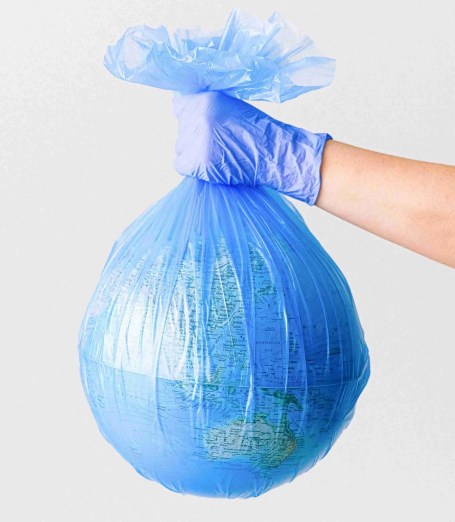
Earth globe in a blue plastic bag
Photo by Anna Shvets from Pexels

I haven’t bought trash bags in more than four years.

How on Earth is that possible? I can’t wait to tell you!

Paying for trash

Garbage bag, Image by cocoparisienne on Pixabay.
Image by cocoparisienne on Pixabay

We are intentionally paying for something we are going to throw away.

We all pay for garbage removal in some form, whether through municipal or property taxes or through a waste management service. On top of that, the traditionally accepted way of containing this trash is single-use plastic trash bags. We pay for new plastic bags, made from fossil fuels, to deposit and remove waste from our homes.

Every time consumers purchase plastic, we are supporting the plastics industry and fueling the effort to harvest more fossil fuels. Then we take those bags we paid for and put them in the ground. We are paying to throw stuff away.

“The first plastic garbage bag was produced in 1950. Globally, these bags collect 7.4 million tons of waste each day.”6

I’ve saved quite a bit of money by not buying trash bags. Trash bags range from $4 per box up to $12 per box depending on size, strength, flexibility, and even scent. Advertisers want you to believe that the most expensive trash bags will keep your home clean and sanitary. This is not a new trend, but one that has been accelerated by companies such as Glad Products (owned by Clorox) who conducted surveys and discovered that many Americans believe any bad smell means their home is dirty (or rather, fear that other people will think they’re house is dirty). Worse, scented trash bags likely contain phthalates (commonly referred to as “fragrances”) which are usually endocrine and hormone disruptors that can cause serious health problems over time. These scents may mask the odor of your garbage, but at what cost to your health?

This slideshow requires JavaScript.

Another marketing trend to be aware of is “biodegradable” or bioplastic trash bags. Don’t be fooled. Nothing, including these bags, breaks down in a landfill. They require an industrial composting facility to biodegrade. “There’s also no telling if harmful additives or chemicals were added during the manufacturing process, and not all bags labeled biodegradable or compostable will actually break down in a compost facility.”11 Recycled plastic trash bags are better than new or ‘virgin’ plastic bags, but I still do not buy these for my home. 

“Landfills are not meant to encourage decomposition. They are dry and anaerobic spaces that essentially ‘mummify’ anything contained in them, including plastic.”17 

But now you can stop buying them too.

Necessity

Three years ago, it occurred to me that I was wasting money buying bags just to put in a landfill. Then I read a blog article on myplasticfreelife.com and decided that there really is no need for store-bought plastic garbage bags. “Since we make almost zero trash, and the trash we do make is dry, we don’t have any need for bags to collect it,” the author wrote.[efn_note]Article, “Collecting Garbage Without Plastic Trash Bags?” myplasticfreelife.com, February 15, 2010.[/efn_note] I found that once I eliminated wet garbage, I no longer needed plastic garbage bags.

What is wet garbage?

This mostly refers to food scraps and food waste. If you are able to compost through a municipal service like the ones they have in California, please do so. However, many cities and states do not offer this service as part of their waste management plan, including where we live. My family decided to start our own compost bin, which you can read about here. If you start composting, you will not have wet trash and thus will not need a plastic liner. Best of all, except for the initial cost of implementing a compost bin, composting is free! If you are paying for waste removal directly, you can reduce the amount of trash and frequency of pick-ups (thus cost savings) simply by composting.

About 34% of our waste is food scraps, yard trimmings, and other biological waste.

Waste reduction

We’ve noticed that many neighbors fill their 96-gallon city-issued garbage bin almost every week. We’ve only filled ours once, and that was when we had a major bathroom remodel in our home. But every city household is allotted a 96-gallon garbage bin that is picked up weekly. I haven’t done the exact math, but I believe that that is between 8 and 12 million gallons of garbage per week that our just our city is potentially landfilling.

This must stop. Our globe cannot sustain this level of trash.

Full 96-gallon city issued garbage bin
City-issued 96-gallon garbage bin, full with a week’s worth of trash from a single household. Photo by me

My family reduced our waste by buying food and other items with as little packaging as possible. We eliminated single-use disposable items and recycled what we could. Striving to be plastic-free and live a minimalist lifestyle reduced our overall trash. With these efforts, combined with composting, our garbage volume went down to about one bag of trash per month!

One bag of trash per month is far from our zero-waste goal, but it’s much less compared to most households. And Chattanooga is not zero-waste friendly.

Black garbage bag with the phrase, "Where does the garbage go?"
“Where Does the Garbage Go?” by Colin Dunn on Flickr, Creative Commons license (CC BY 2.0)

Is Trash-Bag Free Possible?

It depends on how much trash you create, where you live, and how trash is transported. Some municipalities require garbage to be bagged. I wanted to stop using trash bags completely. But what I discovered with our city waste haulers is that unbagged garbage tends to either not make it into the trucks and falls on the ground in the neighborhood, or it blows out of the truck while they are driving down the road. In fact, I saw it happening so often that I tried to report the incidents to the city. But I could not obtain enough information about specific trucks while driving to provide good reporting, so nothing came of that. Pay attention to the waste hauling trucks in your area, or call your local municipality and find out if they have measures in place to help prevent these problems.

Back of garbage truck
This garbage truck lost several pieces of trash as I went down the same road, mainly lightweight plastic pieces. The Tennessee River flows through Chattanooga and any waste that gets into the river ends up in the ocean. Photo by me (at a stoplight).

Trash Bag Alternatives

I let our house run out of garbage bags three years ago and haven’t bought any since. However, since we have to use some kind of trash bag, just to keep our trash contained after it is picked up by the city, we use anything that resembles a garbage bag and staple them closed when it is full to prevent spillage. You can use anything! The most common of these includes:

      • Brown paper bags from the grocery store
      • Empty dog food bags
      • Large shopping bags that show up (even though we always use our own cloth bags at the store, these still manage to make their way into my home from shipping, other people, etc.)
      • Mulch and gravel bags (this is hard to buy in bulk where we live unless you own a truck, so we have to buy it in plastic )
      • Foil insulation bags (these are from Amazon/Whole Foods – during COVID-19 we had to get grocery store delivery for a while, and this was how they delivered our cold items. We have a couple of dozen of these now and they are not recyclable.)
      • Make your own DIY trash bags out of shipping envelopes

I also loved finding a use for these items. It felt wrong to buy a trash bag to throw away more bags or paying to bag the bags.

This slideshow requires JavaScript.

Looking Forward

I would like to further reduce my waste through less and better packaging, improved zero waste capabilities, striving for plastic-free living, and minimalism. Ideally, someday, I won’t have so many shipping envelopes around. It would be better if I could purchase items in person and locally, which will take not only getting past the pandemic but businesses increasing package-free/plastic-free/zero-waste options in our area as well.

So free yourself from this practice of buying new plastic to almost directly put in the ground. You can stop paying for trash bags today, and use whatever bags come into your home. Thank you for reading, and please subscribe!


Footnotes:

The Great Christmas Tree Debate

Miniature red car and Christmas tree
Photo by Kristina Paukshtite from Pexels.

Real, or artificial? The great Christmas tree debate, each side with pros and cons. I have never been able to pick a side in this annual conundrum. That is, until I found a great zero-waste solution.

Artificial Christmas tree with red and gold garlands and ornaments, and a gold star.
Photo by Lisa Fotios from Pexels.

Artificial Trees

I grew up with an artificial tree, and that is what we have now. We bought it after buying our home but before starting our plastic-free journey, and before I knew about the potential toxins in artificial Christmas trees. Also, I personally always believed that a fake tree was better since it is reusable. I thought that cutting down a tree was killing it. And I thought that killing a tree just to have it in my home for one holiday seemed selfish and anti-nature.

Most artificial Christmas trees are made of metals and polyvinyl chloride (PVC) plastics, which can be a potential source of hazardous lead. “The potential for lead poisoning is great enough that fake trees made in China are required by California Prop 65 to have a warning label,” according to the National Christmas Tree Association.1

Prop 65, or Proposition 65, provides warnings about significant exposures to chemicals that cause cancer, birth defects, or other reproductive harm.

PVC also releases gases known as volatile organic compounds (VOCs) and phthalates that can irritate the eyes, nose, and lungs. I’ve seen recommendations to shop for a PVC-free tree made from polyethylene, which is considered safer and not known to leach harmful chemicals. But this is not easy to find. I did discover that IKEA’s Christmas trees are PVC and BPA-free. Even if you find one,  it’s still a plastic tree.

From what I’ve read, it seems that most off-gassing may occur when the tree is new, so unpack it and leave it outside to off-gas for a while before bringing it into your home. According to the American Christmas Tree Association (ACTA), if you purchase an artificial tree, use it for at least six to nine years before replacing it.2

That Smell

Among the arguments I’ve heard for real trees, one of the most common is the smell. Those of us with an artificial tree are relegated to scented pine candles, air fresheners, or scented ornament sticks. However, all of those items that are artificially scented likely contain phthalates and other chemicals that are not safe to breathe. Don’t feel bad for not knowing that, I used to use them, too! But please safely dispose of them now. Look for a soy or beeswax candle, as they are usually much safer. If you have an artificial tree and really want to have that smell in your home, perhaps you can find a few sprigs of pine to put in a vase.

Pine tree
Photo by Loren Cutler on Unsplash.

Real Trees

According to the National Christmas Tree Association (NCTA), approximately 25-30 million trees sold in the U.S. every year. There are close to 350 million trees growing on Christmas Tree farms just in the U.S.3

Tree farms emit oxygen, absorb carbon dioxide, and filter toxins from our air. The NCTA indicates that for every real Christmas tree harvested, 1 to 3 seedlings are planted the following spring. “Christmas tree farms stabilize the soil, protect water supplies and support complex eco-systems.”4

Many Christmas tree farms across the world may be monoculture farms, meaning they only grow a single crop which does not encourage biodiversity and sometimes requires extra pesticides to protect the plants. However, “very few Christmas trees are removed from federal forests, and those that are, are strictly regulated by the U.S. Forest Service.”5

The Great Debate

According to a significant study conducted in 2010, the environmental friendliness of a real or artificial Christmas tree depends upon how a family uses it. “The study found that the environmental impacts of one artificial tree used for more than eight Christmases is environmentally friendlier than purchasing eight or more real cut trees over eight years.”6

ACTA encourages consumers to consider buying a locally grown tree if possible to reduce emissions from traveling to buy it.

Large pine tree in a forested area.
Photo by Loren Cutler on Unsplash.

Disposal of Either Type

Real Christmas trees biodegrade or can be recycled. “Real trees are more sustainable because they are biodegradable, unlike plastic trees which fill landfills and cause more harm than good to the environment.”7

The Arbor Day Foundation also offered multiple ways to recycle a real Christmas tree. “There are more than 4,000 local Christmas Tree recycling programs throughout the United States,” according to the NCTA.8

If you plan to replace an artificial tree, donate it before you dispose of it in a landfill. You can donate it to a thrift store, a neighbor, a church, or maybe a homeless shelter. Check with local non-profits, as even your local zoo or school may want one. You could also put it online for free through Freecycle, Nextdoor, or Facebook.

4 foot potted Christmas tree.
Image from www.rent-a-christmas.com/

The Best Solution: Zero Waste

This year I discovered Christmas Tree rental! This may be the best of both worlds and is a zero-waste option. Tree rental companies deliver the tree to your home or office in a pot and you can decorate it. When the holiday season is over, the rental company will pick it up. This means you can have a real tree annually without cutting one down, and there’s no storage of a plastic tree year-to-year. While this is not a new solution, it is one that is growing.

One Christmas Tree nursery in California notes that their renting program “focuses on zero waste and employs a minimal footprint operation through efficiency and conservation.”9

You’ll also get that smell of fresh pine, the tree will be replanted, the trees provide habitats for wildlife in between the holiday seasons, and they remove carbon dioxide and toxins both from your home and the atmosphere.

This option isn’t available everywhere yet, but be sure to check your state or region. The pricing that I found with various companies ranged from $35-$75, and I saw some as high as $155. But the cost of cutting down a tree is about the same – so why kill a tree?

Let me know if you’ve tried Christmas tree rental and how your experience went. Thanks for reading, and please subscribe. I wish you and your family a very Happy Holidays!

French bulldog with Christmas lights and letter to Santa, with milk and dog treats on a wooden tray, and stuffed Christmas plushes around it.
Photo by Karsten Winegeart on Unsplash.


Additional Resources:

Article, “Tiny House Family’s Christmas Tree Solution,” Tiny House Talk, December 23, 2018.

Article, “8 Sustainable Ways to Recycle Your Christmas Tree,” Arbor Day Foundation, December 26, 2019.

Guide, “How to recycle: Real Christmas Trees have a second life,” National Christmas Tree Association, accessed December 21, 2020.

Footnotes:

  1. Article, “What you might not know about fake trees,” National Christmas Tree Association, accessed December 21, 2020. ↩︎
  2. Article, “Are Real or Artificial Christmas Trees More Environmentally Friendly?” American Christmas Tree Association, December 7, 2010. ↩︎
  3. Article, “Quick Tree facts,” National Christmas Tree Association, accessed December 21, 2020. ↩︎
  4. Article, “What you might not know about fake trees,” National Christmas Tree Association, accessed December 21, 2020. ↩︎
  5. Article, “8 Sustainable Ways to Recycle your Christmas Tree,” Arbor Day Foundation, December 26, 2019. ↩︎
  6. Article, “Are Real or Artificial Christmas Trees More Environmentally Friendly?” American Christmas Tree Association, December 7, 2010. ↩︎
  7. Article, “8 Sustainable Ways to Recycle your Christmas Tree,” Arbor Day Foundation, December 26, 2019. ↩︎
  8. Article, “Quick Tree facts,” National Christmas Tree Association, accessed December 21, 2020. ↩︎
  9. Website, About Us page, Rent a Christmas Tree LLC, accessed December 22, 2020. ↩︎

Styrofoam and Polystyrene Containers are Poisoning Your Food, Part 2

Last updated on May 2, 2023.

Yellow warning sign with skull and crossbones
Image by OpenIcons from Pixabay.

In Part 1 of this series, I introduced polystyrene, which we commonly refer to as Styrofoam, food packaging. This type of plastic is terrible for the environment and human health. Today, we’ll look at the toxicity of polystyrene in depth.

After watching friends and coworkers repeatedly reheat their take-out and leftovers in polystyrene, I decided to write an article about it. I had known polystyrene was potentially toxic for a long time, but I had no idea just how toxic it is.

Chemicals Leach from Containers into Food

Polystyrene leaches styrene and benzene, chemicals that have known toxic properties, into food. In testing, one scientific journal independently tested and found that polystyrene leaches more toxins when in contact with high-temperature contents and into foods with higher fat content.18 That means that if you buy hot food, fatty food, soup, or coffee and it is packaged in polystyrene, some of the chemicals from the container leach into your food. Over time, these chemicals can cause severe health problems.

“Styrene is likely to leach when it comes in contact with fatty foods, hot beverages, and especially alcohol. When thinking about the kinds of foods that typically end up in Styrofoam containers (fatty foods) and cups (hot coffee), it seems as though the exact kinds of items Styrofoam contains are exactly the kind of items it should never touch.” -The Green Dining Alliance20

Melted polystyrene spots from hot food in a polystyrene container.
I recently went to a BBQ restaurant in Dayton, TN. They serve most of their food in polystyrene containers. My fried okra melted the polystyrene and those chemicals certainly leached into my food. I didn’t eat the okra, I dumped it out so that I could photograph the container. I likely will never dine at that place again. It really concerns me that people eat food out of these types of containers every day! Photo by Marie Cullis.

Melted polystyrene spots from hot food in a polystyrene container.
Photo by Marie Cullis.

Known Toxicity

When I searched “polystyrene human health” I got more than 13 million results. After reading many articles, I realized that all organizations and even the U.S. government, including the Environmental Protection Agency (EPA), know that polystyrene is harmful to human health as well as land and marine environments. Furthermore, the Food and Drug Administration (FDA) permits the migration of styrene from packaging into food!

Study after study shows that chemicals from polystyrene leach into foods and beverages, especially with higher temperatures and food with higher fat content. And study after study shows that styrene is dangerous to human health. In fact, most agencies caution against the use of polystyrene because of the known health hazards, including these:

        • The Environmental Protection Agency (EPA)
        • The World Health Organization (WHO)
        • The International Agency for Research on Cancer
        • National Institute for Environmental Health Sciences
        • U.S. Department of Health and Human Services (DHHS)
        • National Research Council (NRC)
        • Occupational Safety and Health Administration (OSHA)
        • National Institute for Occupational Safety and Health
        • The Agency for Toxic Substances & Disease Registry (ATSDR), Center for Disease Control and Prevention (CDC)

Take-out in polystyrene containers
Image by albedo20 on Flickr, Creative Commons license (CC BY-NC-ND 2.0).

A Known Carcinogen

Styrene exposure increases the risk of leukemia and lymphoma and is a neurotoxin. This alone is enough reason to avoid polystyrene containers. In 2018, the World Health Organization (WHO) reclassified styrene as a probable carcinogen.21 While the EPA does not classify it as a carcinogen, it noted that animal cancer studies provided evidence for carcinogenicity.22 Several of the organizations mentioned above, including the International Agency for Research on Cancer and the Department of Health and Human Services, consider it to be carcinogenic.

Hormone Disruption

There are countless studies that show certain types of plastics contain known hormone disruptors. Those chemicals often mimic estrogen and they seep into food and beverages (including breastmilk). In 2014, Environmental Health tested 11 samples of polystyrene and consistently found estrogen seepage after exposure to intense steam or ultraviolet rays.23 Since polystyrene is a type of plastic, this is just one more reason to avoid polystyrene containers.

It is terrifying that many schools use foam trays for cafeteria food. Hormone disruption in young children prevents them from developing normally, can affect their ability to reproduce as adults, and can set them up to be prone to other diseases.

Polystyrene food tray
Image by Laura Taylor on Flickr, Creative Commons license (CC BY-NC-ND 2.0).

Other Health Hazards

Styrene exposure can come from other sources, such as photocopier toner, automobile exhaust, and plastics manufacturing. Exposure can cause irritation of the skin, eyes, mucous membranes, the upper respiratory tract, and gastrointestinal irritation. Chronic exposure can cause neurological problems such as depression, headaches, fatigue, weakness, hearing loss, and disrupted kidney function.25

Additional Unknown Chemicals

There are many chemicals and ingredients that are not tested for and not regulated by the EPA and FDA. While this may seem surprising, the standard operating procedure in the United States is to allow a chemical to be used until a known hazard is not only discovered, but proven. Essentially, chemicals are innocent until proven guilty.

Hefty polystyrene container
Hefty polystyrene container, photo by Marie Cullis.

Exposure through Manufacturing

Anyone who lives near or works in polystyrene manufacturing sites is at risk of even greater health problems due to respiratory exposure. The Clean Water Action organization noted that “occupational exposure to Styrene increases [the] risk of lymphoma, leukemia, lung tumors, pancreatic cancer, urinary bladder cancer, prostate cancer, and colorectal cancer. High rates of neurotoxicological effects have been reported in workers,” as well as decreased sperm counts.26 These plants also emit a toxic and volatile gas called pentane, often used as a blowing agent in the production of polystyrene. 

“Over fifty chemical byproducts are released during the manufacturing of polystyrene, contaminating the air, water and communities that live near these facilities.” Children’s Environmental Health Network27

What You Can Do

Polystyrene is toxic to human health. When ordering take-out, ask the restaurant if they use “Styrofoam” or polystyrene containers. If they do, you can ask if they have an alternative type of container or you can decide to order from somewhere else. When bringing leftovers home from a restaurant, keep a glass or metal container in your car specifically for such occasions. Bring your own reusable coffee mug to coffee shops. As I mentioned at the beginning of my article, try to avoid eating food in polystyrene, and definitely stop reheating your food in polystyrene containers in the microwave. 

Last, polystyrene is the most common type of #6 plastic and is largely not recyclable because of food contamination. In Part 3, I will cover the problems with recycling and the environmental damage polystyrene causes. Thank you for reading, and please share and subscribe!


Additional Resources:

“Styrene,” Report on Carcinogens, 14th Edition, National Toxicology Program, Department of Health and Human Services.

Report, “What’s the Package? Unveiling the Toxic Secrets of Food and Beverage Packaging,” Clean Water Action and Clean Water Fund, August 2016.

Article, “Leaching of styrene and other aromatic compounds in drinking water from PS bottles,” by Maqbool Ahmad and Ahmad S. Bajahlan, Journal of Environmental Sciences, 19 (2007), p. 421–426, accessed September 12, 2021.

Footnotes:

Update: Death of a Plastic Shower Curtain, Part 3

Last updated on March 27, 2023.

A couple of years ago, I wrote about the death of my vinyl plastic shower curtain liner, and my decision to never buy plastic liners again. Plastic liners off-gas toxic chemicals in your home and the curtains can end up in the ocean after disposal. I tried using the fabric curtain without a liner, but it quickly grew mildew and mold and after washing it several times, it started to fall apart. So in my second article, I repaired it and then coated the bottom half of the curtain (where the most moisture accumulates) with Otter Wax.

This, however, was a complete failure.

The cloth curtain grew mildew and mold even quicker, and to the point that I could no longer clean it. I don’t know if I spread the Otter Wax unevenly or just didn’t apply enough onto the fabric. It seemed that the nooks and crannies of the fabric weave held in moisture easier. Perhaps Otter Wax was not meant to prevent mold growth in fabric that is constantly in a warm, moist environment.

Cloth shower curtain with mildew growth

Cloth shower curtain with mildew growth

No More Plastic

I refuse to give up and go back to vinyl/plastic shower curtain liners. Since first writing about my shower curtain pursuit in 2018, I have learned a lot about the chemical compositions of plastics and how they adversely affect human health. Captain Charles Moore wrote about this subject in his book, Plastic Ocean:

“Who doesn’t know that potent ‘plasticky’ smell that somehow we’ve come to associate with ‘new’ and ‘clean’?”

He cited a 2008 study that quantified fumes off-gassing from PVC shower curtains, in which they logged 108 chemicals, mostly volatile organic compounds (VOCs) and phthalates. “Prolonged exposure to these chemicals is associated with respiratory irritation, headaches, nausea, and potential harm to the liver, the kidneys, and the central nervous system. They can also cause cancer.” There are now many studies about off-gassing plastics and they all indicate the same health problems.

Failing Forward

If you’ll recall from my second post, the gray cloth shower curtain was intended to be used with a plastic liner and not meant to withstand daily use without one. So I learned to invest in a better cloth shower curtain, one intended to be used solely. The lower cost of plastic shower curtains is not worth the environmental consequences nor the risks to my family’s health. I decided to purchase a hemp canvas shower curtain. Hemp fabrics inhibit mold and mildew growth which makes them a great option for shower curtains. It was expensive but it was the best option for our home. I’ve had it for just over one year now, and I will share my trials and errors with you.

Hemp shower curtain in package

Cloth shower curtains require special care

Overall, I like this shower curtain, but it is not perfect. We adjusted the curtain rod because this curtain was much longer than our old shower curtain. But then the first time I washed and dried it, the curtain shrunk by about 7 inches! So again, we had to adjust the shower curtain rod, which again marked up the walls. I learned that it is best to simply wash it in the machine and rehang it to dry.

The hemp shower curtain came with specific care instructions, and although they appeared unprofessional, I tried to follow them. We draw the curtain outside of the shower to let it dry out after every shower. But I do not launder it weekly. I have had some mold growth so I have boiled it in hot water to kill it per the instructions and that seemed to work.

Hemp shower curtain instructions

However, upon writing this post, I discovered that the instructions have been updated on the website and are different from the ones I received in the package. They now recommend washing it every few weeks instead of weekly. If mold appears, they suggest washing the shower curtain with half a cup of Borax and/or oxygen bleach in the machine on the delicate cycle. Last, they indicate to hang dry it – I wish I’d known that before drying it in the dryer and thus shrinking it that first time!

Hemp shower curtain in bathroom
This is the hemp curtain as of this writing. You can see slight discoloration at the bottom but I don’t find it all that noticeable.

Shopping for Shower Curtains

Obviously, stay away from plastic shower curtains, including plastic-derived fabrics such as polyester, nylon, and microfiber. These synthetics can cause as much environmental damage as vinyl, especially when laundered. Some of these “fabric” polyester curtains even contain chemicals to make the plastic fabric water-repellent. Ingredients such as perfluorooctane sulfonate, a chemical known to cause cancer and has a Proposition 65 warning, are just one example I found on Kohls’ website. If you do happen to find a cotton and “chemical-free” shower curtain at a department store, these almost always recommend using a liner with the curtain, defeating the purpose of switching to a fabric shower curtain. I’ve found examples of those on Target’s website.

Look for hemp or a hemp cotton blend. If you can’t find a hemp curtain in your price range, get a cotton curtain so that you can wash it regularly. Read the fine print so you know exactly what type of fabric it is. Check the details as some fabric curtains have a disclaimer such as, “recommend using with a shower curtain liner.” This often indicates that the curtain cannot withstand constant water exposure and will not last very long. Also, read the reviews to help determine durability and quality.

Another option is reclaimed sailcloth, which I mentioned in a previous post. This is what I’d like to purchase someday as long as I can find one made of authentic, reclaimed sailcloth. These generally run in the $200-$300 range and I frankly cannot afford one right now.

Reclaimed sailcloth shower curtain
Reclaimed sailcloth shower curtain, from Etsy. Photo by seller.

Conclusion

Other than having glass doors professionally installed, I’m not sure there is a perfect replacement for a plastic shower curtain. Although a better option than plastic by far, the mold-resistant hemp canvas shower curtain is not perfect. This curtain does not round or cover the ends of the shower the way a plastic curtain does, so some water gets out and we have to clean up small amounts of water on the walls and floors after each shower.

Unfortunately, the curtain has begun to deteriorate the fabric on the bottom section where it gets the wettest and where mold grows. I think I’m going to hem it where the holes are rather than trying to patch it. It might be my fault for not laundering it often enough. But I guess I was hoping for more durability for the amount I paid for it. Still, this is the best solution I have at this time, so I will continue with this curtain. If I have to do something different, I’ll be sure to update this post with a Part 4!

Corner of curtain, falling apart
One corner of the curtain is starting to fall apart. It is also not very noticeable.

I hope that this short series has been helpful and saved you some time and effort. Thanks for reading and please subscribe. I’d love to hear about your experience so please leave me a comment below!

All photos by Marie Cullis unless otherwise noted.

Goodbye Earth Fare, with Love

Last updated on March 23, 2024.

Earthfare's Hixson, Tennessee store opening
Earth Fare’s Hixson, Tennessee store opening, November 2016. Photo by Marie Cullis.

If you haven’t heard, Earth Fare is closing all its stores, citing financial troubles.28 I was completely disheartened by this news! The company emailed its customers on Tuesday, writing “with a heavy heart” about the decision to close all the stores after 45 years.

We only have 3 healthy grocery stores in Chattanooga, Tennessee; two Earth Fare stores and one Whole Foods. We will now be down to one healthy grocery store in this region. There is a Fresh Market in Chattanooga, Tennessee, but they have a different mission than Whole Foods and Earth Fare. While I am not against shopping there, they do not offer all of the same food philosophies about ingredients. It is disappointing that the Southeast doesn’t support more stores like these.

Update March 23, 2024: Since my original article, a second Whole Foods store and a Trader Joe’s have opened in Chattanooga. I honestly believe that the company, if they could have held on until the start of the COVID-19 pandemic, would have flourished because they were one of the first grocery stores in our area to offer grocery delivery. It was late summer 2020 before Whole Foods offered this in our area, so Earth Fare would’ve likely done well with this service, had they only known in February 2020 what was to happen in March 2020.

But, Earth Fare has made a comeback after filing for bankruptcy. They have stores in the southeast again, just not in Chattanooga.29 I visited the one in St. Johns, Florida in Fall 2021 but unfortunately, this store closed in early 2022.

Unsafe and Toxic Ingredients

Earth Fare is a healthy and organic grocery store, one that does not sell foods with unhealthy or potentially toxic ingredients. But here is their general food philosophy:

Earthfare's food philosophy banner

I created a free, downloadable pdf: “List of unsafe, unhealthy and/or potentially toxic ingredients in food and products that you should avoid.” You can also view it here.

I could buy food from the bulk bins in my own cloth bags and glass jars at Earth Fare to avoid buying plastic. I can do this at Whole Foods too, but again, Chattanooga is going from three stores down to only one offering features like those.

Earth Fare Will Be Missed

Earth Fare is personal for me and I will miss it. It is where I shopped while on my journey of learning the value of healthy, natural foods and the dangerous ingredients in our foods. When my son was born and was in the NICU for 2 weeks, there was an Earth Fare just down the road from the hospital and we ate many meals there during that difficult time. It was the grocery store where I bought organic ingredients to make homemade baby food. And it is still where I buy food to cook for our family.

I plan to shop at Whole Foods since they have a similar food philosophy. However, they are more expensive than Earth Fare for many things. Also, the Whole Foods in Chattanooga is in a popular area of town so it’s often busy and crowded, with an equally crowded parking lot.

In the end, life will go on. We have many large environmental and health issues to face! Please subscribe and we can learn together! Thanks for reading. And thanks, Earth Fare, I’m sad to see you go.


Footnotes: