Have you seen WALL-E?

Last updated on February 5, 2023.

Wall-E cover art

Have you seen the Disney-Pixar movie WALL-E? It features two cute little robots that mostly communicate through a few words and voice inflections. There’s very little dialogue so the story is told visually and beautifully. I found it to be a powerful movie. Here’s the trailer for it:

I first saw this movie about a year ago. I borrowed it from the library so that I could watch it with my son, and I was really blown away by the film! The day after, I was talking to a colleague about it and he told me that he can gauge a person by their reaction to that movie. He said if they’re indifferent about it, that’s likely how they are about the environment as well. But if a person reacts emotionally, it says a lot about them. While you can’t judge a person by a single film reaction, of course, that conversation has always stuck in my mind.

There’s a lot about WALL-E that stuck with me.

So I watched it again over the weekend.

Please note: the rest of this post does contain spoilers. So if you haven’t watched it, please go watch it and then come back and finish reading this post!

Wall-E, Photo by Dominik Scythe on Unsplash
Photo by Dominik Scythe on Unsplash.

Even though it’s a decade old already, it’s still completely relevant. WALL-E is cleaning up the trash on Earth, which has become one giant wasteland and landfill. Humans made so much trash and polluted the air so badly that all of the plant life died off and they had to move to space! It takes place 700 years in the future. The little robot is lonely and has only one friend, a little cockroach (because cockroaches can survive everything, right?).

He finds interesting objects while cleaning up the trash, such as silverware, Zippo lighters, and Rubik’s cubes. The robot discovers a squeaky dog toy and a bra, which he mistakes for a mask. He catalogs and sorts the items in his home (like Ariel does in The Little Mermaid, collecting items from shipwrecks and keeping them in her secret cove.) WALL-E even has one of the singing Big Mouth Billy Bass plaques that were popular years ago. He has recovered one videotape of Hello, Dolly! from the late 1960s, from which he learns about emotions and human interactions.

rubiks cube, Photo by Alvaro Reyes on Unsplash
Photo by Alvaro Reyes on Unsplash.

The air is cloudy, there’s very little water and no plant life. The whole premise of the movie is that once plant life reappears on Earth, humans can return. WALL-E meets EVE, a robot that has come to Earth to search for plant life. He finds a plant and gives it to her as a token of love. But this is her own mission and it spawns a journey that lays out the history of corporate greed, mass consumerism, and the unsustainable disposable economy and lifestyle that humans created. So much stuff and waste that the Earth became polluted and uninhabitable.

That sounds like the path we’re on right now.

plant, Photo by Igor Son on Unsplash
Photo by Igor Son on Unsplash.

Sadly, in the movie, the humans, once in space, did not change their behaviors. They rocketed their trash further into space instead of learning from the past. This behavior was propelled by corporate giant B&L, a fictional sort of Walmart or Amazon that gained a monopoly on Earth and gained control of everything by the time the humans left for space.

This movie really hit home.

Truly, though, if robots can get it, why can’t we?

I think many of us do get it. I think the more people that learn about the worldwide waste crisis, the more people will want to change things. So help spread the word and educate others. Let your children watch this movie. Share it with a friend. Leave me a comment below. And thanks for reading!

Support “The Story of Plastic”

Last updated on April 23, 2023.

Rows and rows of yellow rubber duckies on shelves.
Rubber duckies are actually made of plastic. Photo by JOSHUA COLEMAN on Unsplash.

Update 4/23/2023: This film was released in April 2020 and premiered on the Discovery Channel on April 22, 2020, the 50th anniversary of Earth Day. This is an informative and well-presented film on plastics – I highly recommend it!


Have you ever heard of The Story of Stuff? It’s a 20-minute film (linked below) that is “a fast-paced, fact-filled explanation of the consumerist economy.” It began with the writer and the founder of The Story of Stuff Project, Annie Leonard. She’s an amazing person and a leader in environmental and social issues. It is 100% worth your time to watch!

The Story of Story Project has since come out with more than a dozen high-quality short documentary films that explain the relationship between consumer products and environmental problems. But their newest one is really exciting!!! It’s called…

The Story of Plastic

“These days, more and more of our Stuff is being made from one very problematic material: plastic.

They want to tell the hidden stories surrounding plastic. The production, the pollution, and the health hazards. Here’s the trailer:

Do we need another film about plastic?

Yes, we do. There aren’t enough of them. The ones that do exist are really good and the message is getting out, but we need even more people to hear and see and understand the message: Plastic is ruining our environment, poisoning us (cancer, endocrine and thyroid diseases, etc.), and littering our landscapes. The Earth is so beautiful – don’t we want it to stay that way?

And recycling is not the answer. Only 9% of our plastic is actually getting recycled! That means 91% is ending up in landfills, the ocean, rivers and lakes, beaches, parks, and our neighborhoods. It even ends up in the food we eat and the water we drink.

plastic bottles, rope, and other waste on the beach.
Photo by John Cameron on Unsplash.

The Story of Stuff Project is fundraising to complete this project. Please help me support this worthy cause. They are asking people to become “a Plastic Insider by starting a recurring monthly donation supporting The Story of Plastic production fund today.” There are insider perks: your name will be in the credits of the film and you gain access to behind-the-scenes videos. Here’s a video of supporters who spend their lives on a sailboat:

I signed up as a monthly, recurring donor today. Can you help too? You can also make a one-time donation in any amount you’d like. And if you’re really ambitious, you can create your own Facebook fundraiser!

“The Story of Plastic isn’t just a movie. It’s a call to action.”

Are you as excited about this film as I am? Leave a comment below! Thank you for reading.


Additional Resources:

Website, how to watch The Story of Plastic

Film, The Story of Stuff

Have you heard about Litterati?

Last updated on February 12, 2023.

Photo of a discarded blue plastic laundry detergent bottle (it actually looks like a Downy bottle) on the ground, by nicholasrobb1989 on Pixabay.
Photo of a discarded plastic laundry detergent bottle on the ground, by nicholasrobb1989 on Pixabay.

Have you ever been out walking, hiking, biking, or even kayaking and noticed that there was trash here and there, everywhere? Noticed trash lining the streets as you drove to work or school? Or the debris that just seems to have washed up while walking on the beach or riverbank?

What do you do? Do you pick it up?

If so, there’s an app for that. It’s called Litterati.

Litterati app logo, blue with L surrounded by a diamond shaped line.
Litterati app.

This app tracks litter that people all over the world pick up, and it compiles the data by location in order to pinpoint the source of the litter. With this app you take a photo of each piece of litter with your smartphone, then pick it up and discard it. You can get really artistic with your photos, too. Litterati features the most interesting and creative photos on Instagram.

The Data

Photos are automatically geotagged, meaning information about the exact location and time of pick-up is recorded. Additionally, users hashtag each image with information such as the brand, object name, and type of material.

Photo of a discarded Coca-Cola can on the ground, by Stanislav Kondratiev on Unsplash.

That data is loaded into an ArcGIS map to help track and create data to help diagnose the root cause of litter in any given area.1 As Litterati’s website explains:

“Litterati then compiles that cleanup data into a robust database of litter maps around the world. Using your tagged cleanup photos, the Litterati team can ask questions such as, ‘How does the weather affect the types of litter thrown?’ and ‘Are there more cigarette butts littered near bus stops?’.”2 

Jeff Kirschner, the founder of Litterati, explained in a TED Talk why he created the app:

Join Us!

I joined this effort in March 2017, and I love it! I’ve used it in my neighborhood, while hiking, on my son’s school grounds, at the dog park, and at the beach. We pick up trash whenever we feel we can safely collect it and discard it. It is really satisfying to know we are making a difference and teaching my son by example.

Consistent Growth

You can join or create clubs and daily they list the top 5 people with the most activity. I made that list twice and it made my day!

In May 2018, the United Nations announced that they are partnering with Litterati to fight world pollution.3 

While Litterati is using its data and mapping for great changes, Jeff Kirschner is still looking to inspire people. “How do we deliver a wonderful experience for each community member so that they’re inspired to pick up just one more piece, and then one more?”4 And then spread the word, build community, and inspire others. Wouldn’t it be cool if picking up trash and keeping our Earth clean became the new normal?

Thank you for reading, and let’s be the change!

A few of my own Litterati photos:

Footnotes:

Book Review: One Plastic Bag: Isatou Ceesay and the Recycling Women of The Gambia

Last updated on December 23, 2022.

One Plastic Bag: Isatou Ceesay book cover

There are inspirational and motivated women all over the world. Women who amaze us, withstand the negativity and overcome the obstacles she faces.

I discovered One Plastic Bag: Isatou Ceesay and the Recycling Women of the Gambia, by Miranda Paul, at my local library. Upon reading this book to my son, I was really impressed with this story. Check to see if your local library offers it!

After reading the book I wanted more information about Isatou Ceesay.

I felt that she is so inspirational that I should dedicate a whole post to her. She has been committed to upcycling plastic bags and reducing waste in The Gambia since the 1990s. The waste problem in The Gambia really bothered her. Plastic and trash were everywhere. The landscape was littered. People used plastic to make fires burn faster, but the toxins released in the fumes from burning plastic are unimaginable. She decided she would find a way to recycle or upcycle some of the plastic waste.

More than just recycling

But her story is not just about recycling and plastic. It’s also about empowering women and improving the standard of living! The book tells the story at a children’s level about how she had to work in secret in the beginning because it was illegal for women to work at the time, and people ridiculed her. But she began making recycled plastic bag purses. Isatou hired a few women to help and hired more as time went on, even establishing a women’s cooperative to craft and sell the items for income. The business kept growing and it helped the environment, the people, and the economy.

Isatou also helped co-found The Women’s Initiative Gambia whose mission is: “Women’s Initiative Gambia helps financially poor women in The Gambia to improve their skills and income so as to raise the standard of living of their families and their communities.” Today they have many projects beyond plastic bag recycling, including briquette making as a fuel source, gardening, tie-dye and batik, recycled paper bead making, food preservation, and many other projects.

Here’s a quick video highlighting Isatou Ceesay’s accomplishments:

“I think that when you abuse your environment, you abuse yourself.” -Isatou Ceesay

DIY Opportunity

And if you have too many plastic bags yourself and want to make a plastic bag crocheted purse? She’s got a how-to video! I’ll update this post if I try it. And if any of you try this, please message me or leave a comment below! I can’t wait to see what you’ve done!

“People thought I was too young and that women couldn’t be leaders. I took these things as challenges; they gave me more power. I didn’t call out the problems – I called out solutions.” -Isatou Ceesay

Well said. I think we should all have that attitude. Let’s be the change together!

Footnotes:

Bag It: The Movie

Last updated December 11, 2022.Bag It film cover art

Have you seen this documentary? Bag It is an excellent film, and I wholeheartedly recommend it! It’s a great introduction to not only the problem of plastic bags but of plastics in general. Please check out the trailer:

A must-see documentary

I cannot say enough good about this film. It really hits on all the topics, from the perspective of an everyday person like you or me. Before I saw this film myself a couple of years ago, I had only limited knowledge of plastics, recycling, and toxic products. This film was like my gateway to bigger individual topics – like plastic bag usage; the Great Pacific Garbage Patch; toxins in food from plastic packaging; and single-use disposable plastic…everything. I had thought about those things, but I hadn’t researched them or even read much about them. I love this film! And Jeb Berrier is pretty funny too.

The film also introduced me, through interviews in the film, to a variety of plastic experts, ocean and marine life experts, and organizations trying to make the world a better place. To name a few: Beth Terry of myplasticfreelife.com; Annie Leonard of the Story of Stuff Project; Dr. Sylvia Earle of Mission Blue; Algalita (founded by Captain Charles Moore); the Midway Atoll National Wildlife Refuge; Oceana; the Environmental Working Group; authors Elizabeth Royte and Daniel Imhoff; and so many more that I’m forgetting to include. The filmmakers’ requests for interviews with the American Chemistry Council and others in the plastics industry were denied or received no response. Unfortunately, that has been fairly typical with films that investigate and educate the public on the plastic problem.

Plastic bags that have somehow made it into my home. I'm saving these for trash clean ups when I go hiking.
Plastic bags that have somehow made it into my home. I’m saving these for trash clean-ups when I go hiking. Photo by Marie Cullis.

Take action with Bag It The Movie

I was completely inspired by this movie! As I mentioned above, this film is one that led me to other important films, authors, individuals, and organizations that are all making a difference and trying to educate people. I consider Bag It to have been a core part of our household’s path to great changes.

I looked up the film’s website in anticipation of writing this article, and I was even more inspired! Most of their site is dedicated to using the film as a tool to educate schools, communities, and whole towns. They offer the ability for any person or organization to host a screening for a fee and have a free downloadable pdf Screening Tool Kit, which has step-by-step instructions and resources for screening Bag It. They also have a free downloadable pdf to initiate a Bag It Town campaign, meaning a plastic bag ban.

In my article about a weekend trip to Hilton Head Island, where I discovered that that town is implementing a plastic bag ban this month, I mentioned that I might try to propose one where I live! Between both, I’m SO moved and even more encouraged. If I do propose one in my town, I definitely know where to start now. With the tools provided by Bag It!

Thank you for reading! Stay inspired and be the change!

Plastic Bag laws in U.S. map from https://www.plasticbaglaws.org/
Plastic Bag laws in the U.S. from plasticbaglaws.org.

Footnote:

What’s the Big Deal about Plastic Straws?

Last updated on January 12, 2025.

straws colorful, Photo by Bilderjet on Pixabay
Photo by Bilderjet on Pixabay.

There is a coalition of aquariums across the United States striving to reduce the use of plastic straws. The coalition, called the Aquarium Conservation Partnership (ACP), is a collaboration of 22 public aquariums in 17 states, including the Tennessee Aquarium. They help advance conservation policies, educate and inspire audiences, and commit to sustainable business practices.1

Aquariums are awesome and full of wonder and thousands of children go through them daily. So they are poised to be leaders in positive change, and this is a great example of that! One of the things they’re doing is asking restaurants and others in the hospitality industry to reduce the use of straws by only giving them out upon request, instead of automatically. They’re asking individuals to sign a pledge to stop using plastic straws.

My son looking up at a large aquarium tank at the Tennessee Aquarium when he was just 2 and a half.
My son at the Tennessee Aquarium when he was just 2 and a half. Photo by Marie Cullis.

What’s wrong with plastic straws?

First, the sheer amount of them! Just like with all single-use disposable plastic products, it’s the over-consumption of them. Think 500 million plastic straws per day. That’s more than one straw per person per day in the United States. Our consumption has gone way overboard and has created a waste stream that is too large for us to keep up with! Second, they are not recyclable at all.

Don’t feel guilty about having used plastic straws. Just please refuse plastic straws – START TODAY. Politely refuse those plastic straws – if everyone refuses just one straw per day, we’ll more than cut our usage in half!

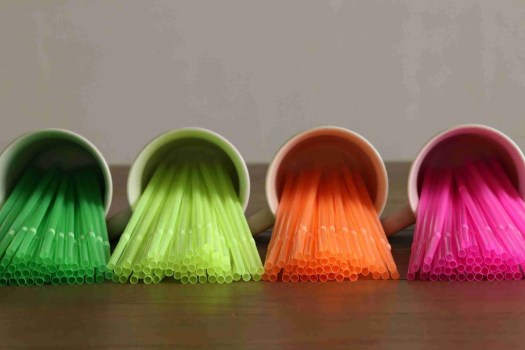
Colored plastic straws sorted in cups by color, neon green, neon yellow, neon orange, and neon pink.
Image by Marjon Besteman-Horn from Pixabay.

I threw my disposables into the trash/recycling receptacle like I’m supposed to, how are they ending up in the rivers and ocean?

One of the critical issues with all the media about single-use disposable plastics is that the biggest question is often not answered: How does the plastic end up in the ocean in the first place?

Most people assume that once they’ve placed their disposables into a receptacle, those disposables go to the proper facility. What people don’t know is that many items don’t make it to the recycling facility or landfill. Since that’s out of our control, it seems impossible to do anything about it. But it’s not impossible by any means. The best way to guarantee that your single-use disposable plastics don’t end up in the ocean is…

To just not use them! Refuse them. Find an alternative. Then you do have control. We have the power to be the change.

So back to the question – how are plastics ending up in the rivers and ocean?

There are so many causes! Spillage from recycling that has been transported across the ocean for years to Asia; plastic products shipped across the ocean to the U.S. have spilled from ships; the fishing industry regularly dumps their trash into the ocean; trash and litter get blown or washed into storm drains and rivers that then feed into the ocean; illegal dumping; beach trash; river pollution; microbeads washing down drains; and debris from natural disasters and floods. Plastic bags are picked up by the wind and blown into waterways that flow into the ocean.

Starbucks is one company that is striving to end use of plastic straws by 2020. Photo by Nadine Shaabana on Unsplash
Starbucks is one company that is striving to end the use of plastic straws by 2020. Photo by Nadine Shaabana on Unsplash.

Ok, so what steps can I take?

First, let’s support the Aquarium Conservation Partnership. You can do this by signing the pledge (linked under Additional Resources below).

Second, refuse. Just say no thank you. To all single-use disposable plastics. Because recycling is not the answer. Only about 9% of our plastics get recycled. That means 91% is not recycled!

Third, if you must have something commonly produced as a single-use disposable plastic, like a straw, please buy a reusable one. Paper disposables and supposedly biodegradable straws are a better option, but it’s still going to be thrown away after one use. Try a stainless steel straw, glass straw, or bamboo straw.

Fourth, tell others! Tell your friends, your co-workers, your favorite restaurant, the local coffee shop, and your local school. So many to tell!

Fifth, participate in trash clean-up efforts. Join the Litterati. Maybe you’ll prevent some of the trash you pick up from entering the ocean.

Single use disposable plastic straw found buried in the sand, Hilton Head Island, October 2018.
Single-use disposable plastic straw found buried in the sand, Hilton Head Island, October 2018. Photo by Marie Cullis.

Last, but not least: Stop supporting businesses that resist change. Consumers hold power: if businesses refuse to meet demands like eliminating single-use plastics, choose not to patronize them. Your spending decisions can push businesses to adapt or risk losing profitability.

Blue poster advertising that The Trading Post, a popular restaurant in Emerald Isle, NC, is recognized as an "Ocean Friendly Establishment" by the Plastic Ocean Project and Surfride Foundation, as "We Only Serve Straws Upon Request." An illustration of a Green Sea Turtle is swimming in waves with fish at the bottom.
Poster advertising that The Trading Post, a popular restaurant in Emerald Isle, North Carolina, is recognized as an “Ocean Friendly Establishment” by the Plastic Ocean Project and Surfride Foundation. “We Only Serve Straws Upon Request.” I love it and will eat there to support businesses like this! Photo by Marie Cullis.

Final Thoughts

Collectively, have the power to create change just by modeling the best behavior. Refuse that straw. Be polite, of course. But just say no. You might influence someone else to refuse straws too. If everyone starts refusing straws, businesses won’t need to order as many. Then the plastic straw manufacturers will have to produce less. And then less will end up in landfills, in nature, and in the oceans. Carry a reusable stainless steel straw with you. Be the change! And as always, thanks for reading.

Forest Gump meme on straws, I couldn't stop giggling at this, so I'm reposting it here.

Additional Resource:

First Step, Skipping the Plastic Straw Pledge.

Footnote:

  1. Page, “What We Do,” Aquarium Conservation Partnership, accessed January 12, 2025. ↩︎

Halloween Candy Wrappers: A Plastic Nightmare

Last updated on October 30, 2024.

Trick-or-treating on Halloween is a tradition. Photo by rawpixel on Unsplash
Trick-or-treating on Halloween is a tradition. Photo by rawpixel on Unsplash.

Did you know that Americans spent a record-setting $12.2 billion on Halloween in 2023? Or that we spent $3.6 billion on candy that is individually wrapped and thrown away?1 And that most of it’s not recyclable and just ends up in landfills (or bodies of water)?

Don’t have guilt. Get inspired!

I don’t want to make you feel bad about it. That’s not why I’m here. And I do recognize the importance of individually-wrapped items since the Covid-19 pandemic. But I want to inspire you to be forward-thinking. I want to get you thinking about next year, and what we can do to eliminate some of the wastefulness.

Halloween is one of my favorite holidays, and I absolutely participate! Especially because I have a young son and I want to share all of the Halloween traditions with him. Surely, I can reduce waste from this holiday and still have a silly great time!

So what can we do going forward?

Start thinking about the big picture and ask questions: How many candy wrappers do we throw away, just in the United States? How many costumes are tossed in a landfill instead of reused or donated? What is the total amount of decorations made of cheap plastic that get used for only one Halloween before they end up in a landfill? Do many pumpkins go into a landfill instead of being used as food or composted? How many resources are wasted on this one holiday?

I’m actually not sure. I couldn’t find exact data for any of those things. But today I’m focusing on candy.

Bowl of Halloween candy from a trunk-or-treat event.
Bowl of Halloween candy from a trunk-or-treat event. Photo by Marie Cullis.

Candy & Their Wrappers

Recycle Nation calls Halloween candy “Halloween’s Environmental Nightmare.” Putting plastic wrappers into regular recycling is not possible.2 They aren’t made of materials that are collected by recycling facilities. Hershey’s Kisses, gold chocolate coins, and other types of candies are wrapped in aluminum foil, which is great if you live in a town or city that accepts aluminum foil through the recycling system. Unfortunately, where I live in the Southeast, it is not accepted. Even so, foil-wrapped candies would be better than plastic!

Sometimes candy wrappers can be upcycled. TerraCycle and lots of artists on Etsy.com make upcycled candy wrapper bags, purses, and many other items. TerraCycle sells zero-waste boxes for candy and snack wrappers, and they take the collected materials and make them into new products.3hey are expensive, and not everyone can afford this option. Realistically, recycling candy wrappers is not the solution.

So what is the solution? There are a few ways to drastically reduce plastic waste.

Plastic Halloween candy wrappers from a Halloween event. Photo by me.
Plastic Halloween candy wrappers from a Halloween event. Photo by Marie Cullis.

Trick-or-treaters at your house

If you purchase candy to give out to trick-or-treaters, think about candy that comes in fully recyclable packaging, such as cardboard or paper.4 Think Nerds, Junior Mints, Pixie Sticks, Dots, or Milk Duds. Find lollipops that are paper-wrapped and not plastic-wrapped. Maybe small boxes of raisins or paper-wrapped truffles. Another great idea is to buy individually wrapped candies in bulk, such as chocolate candies wrapped in aluminum foil.

Another idea I’ve found online is giving out coins for trick-or-treating. I remember finding quarters in my Halloween bag when I was a kid. Have kids close their eyes, reach into a bowl, and grab a handful. Child obesity is very high these days, so this could be a good option!

Coin jar, Photo by Michael Longmire on Unsplash
Photo by Michael Longmire on Unsplash.

Think outside the box! Maybe seed packets or small wooden toys? Pencils or crayons? Drinks in aluminum cans, which might be quite refreshing after running from house to house all evening. Anything to stop this huge plastic waste stream. Others suggest different types of fruit, such as oranges and tangerines, but the fear of poisoned foods will likely result in the fruit being thrown away.

If you are having a Halloween party, purchase candy in bulk using your own jars or cloth bags to avoid the candy wrapper dilemma altogether. Wrap candies in small paper bags and decorate them!

Individually wrapped candies create a litter and plastic problem. Photo by Tucker Good on Unsplash
Individually wrapped candies create a litter and plastic problem. Photo by Tucker Good on Unsplash.

Taking your children trick-or-treating

How about reducing the amount of trick-or-treating you participate in? It’s fun to go house to house (or trunk to trunk), and kids love the reward of candy. But you, as a parent, know how much candy is enough for your household – so stop there. This is how our family does it. We try to focus on the experience and fun, not the candy gathering. Encourage the fun by just walking the neighborhood, and shifting the focus from obtaining an excessive amount of candy. Maybe just stop at every other house on your route. Your whole family will still have a great time!

My son trick-or-treating, on the walkway leading up to a house with pumpkins and Halloween decorations.
My son trick-or-treating in a neighborhood with lots of costuming and decorations. Photo by Marie Cullis.

Trash Art?

Last, how about using the candy wrappers for art? There are hundreds of art project ideas out there, just search “upcycle candy wrappers” online and you’ll find them. Anything from vases to handbags, hair bows to dresses. This is one of my favorites that I’d like to try someday:

Upcycled candy wrapper vase, found on Pinterest
Upcycled candy wrapper vase, found on Pinterest.

Trash & Litter

The last thing I want to say about candy wrappers is the amount of litter they create on Halloween. Kids don’t necessarily mean to drop things, they just do – even the environmentally-conscious ones. I’m part of the Litterati, and I plan to photograph and pick up every piece of litter that I see while taking my son trick-or-treating. It will be mostly candy wrappers, but we live in a city that has the Tennessee River flowing right through the center of it. So I feel compelled to pick up those wrappers!

Can you do the same thing, pick up the candy wrappers and trash? Can you join the Litterati? Will you be the change?

As always, thanks for reading. I’d love to know if you have any out-of-the-box ideas about reducing waste from Halloween. Please leave me a comment below!

Footnotes:

  1. Article, “How Much Americans Spend on Halloween,” Investopedia, Updated October 17, 2024. ↩︎
  2. Article, “Candy Wrappers: Halloween’s Environmental Nightmare” Recycle Nation, October 8, 2015. ↩︎
  3. Webpage, “Candy and Snack Wrappers – Zero Waste Box™,” TerraCycle, accessed March 28, 2021. ↩︎
  4. Book, Zero Waste Home: The Ultimate Guide to Simplifying Your Life by Reducing Your Waste, by Bea Johnson, Scribner, New York, 2013. ↩︎