The Packaging Industry and How We Can Consume Differently, Part 12

Last updated on December 11, 2021.

Brown glass dropper jar surrounded by pink petals
Photo by Karolina Grabowska from Pexels

In my last article, I wrote about several companies offering cleaning products with refill options. Today, we will look at refill options for personal care products.

“To protect the health of humans and fellow creatures who share our planet, the urgent priority must be to eliminate single-use consumer plastic, and to invest in reusable, refillable and package-free approaches.”1

The Refill Shoppe

This company sells refillable hair, body, and home products made with non-toxic, vegan, and biodegradable ingredients.2 They have a storefront in California but offer online ordering as well. They are a Certified B Corporation, meaning they use the power of business to solve social and environmental problems. Their products can be purchased and refilled in pouches that you return to the company with a prepaid envelope, and they sanitize and reuse the pouches rather than just recycling them. They even offer many customizable products with the same refill options. Next time I run out of conditioner or bubble bath, I plan to try them!

Plaine Products

Plaine Products aluminum shampoo bottle

This company was founded by two sisters who want to stop plastic pollution.3 Plaine Products sells shampoo, conditioner, lotion, hand wash, and body wash in aluminum containers. The first time you purchase, you receive a reusable pump. This is great, as you’re not getting a disposable new pump with every purchase. When you order a refill, you switch the pump to the new container. Rinse the empty bottle out and ship it back to Plaine Products at their cost. They will sanitize and reuse the bottles, creating a closed-loop system with minimal waste. Their products are vegan and cruelty-free, and they are also a Certified B Corporation. I plan to try their products in the near future! There’s an additional review under Additional Resources below.

Fillaree

I wrote about Fillaree in my article about refillable cleaners, but they also carry personal use products, so I’m mentioning them again here. They sell refillable liquid hand soap, shampoo, conditioner, and body wash. You can refill any of these at stores that carry their products, and the hand soap and body wash are available as mail subscriptions.4They plan to offer refills by mail on their other products soon as well. This is a growing company with an ideal business model. The customer buys the refill product, which provides 2-4 refills in the original container, and then ships the empty containers back to the company for refilling at the company’s cost. They sanitize and refill the containers and ship them again.

Fillaree hair products in aluminum bottles

by Humankind

Mouthwash tablets in glass cups

This company’s tagline is, “high-performing personal care products
that are kinder to your body and our planet.” They’ve created refills that use little or no plastic and they do not ship water, reducing emissions. They sell shampoo and conditioner bars, mouthwash tabs, deodorants in refillable containers, and cotton swabs without a plastic container. This company uses vegan ingredients, its products are cruelty-free, it is a carbon-neutral company, and most refill packaging is home compostable. I’ve tried their conditioner bar and cotton swabs, and while a bit expensive, the products so far are high quality.5

“Great personal care products don’t have to come at Earth’s expense.” -by Humankind

Bite

Bite Toothpaste Bits jar

“One billion toothpaste tubes are thrown out each year.”

Think about that for a second, one billion plastic tubes, tossed out annually! Most toothpaste tubes are not recyclable, either. The founder of Bite set out to solve this problem but was also concerned about the questionable ingredients found in common toothpaste and the fact that oral care products are tested on animals. She wanted to create a toothpaste that was healthy for our bodies, not tested on animals, and plastic-free. Bite toothpaste bits sell in refillable glass jars and have safer ingredients. The company offers a refill subscription plan, lists their ingredients on their website, and ships only in recyclable corrugated boxes and paper mailing envelopes. The refills come in 100% home compostable pouches.6 I’m very excited about this company, and I recently purchased Bite products which I’ll be reviewing in a future post. You can also read Beth Terry’s review of Bite, which I’ve linked under Additional Resources below.

The very week I wrote this, Bite released a plant-based dental floss in a refillable glass container, much like Dental Lace (see below). Refills ship in compostable pouches. Two weeks after that, Bite released a line of mouthwash tabs in reusable tins.

“Whether it’s mindlessly tossing out an empty toothpaste tube or glossing over the ingredients list, small daily actions can shape the future of our planet. By uncovering how we can be better to ourselves and to the earth, we are one step closer to a healthier and plastic-free world.”- Bite Toothpaste Bits

Dental Lace

Dental Lace glass container

Did you know that most dental floss is made of plastic, some of which contain dangerous PFCs (perfluorochemicals)? And sold in plastic containers? Well, there’s a better option that’s natural and compostable, and in refillable glass containers. Dental Lace was begun by a librarian, and we all know how awesome librarians are. The floss is made from silk and can be composted instead of put in the trash. The glass containers are decorative, refillable, and recyclable. The packaging is all home compostable.7 I have personally used this product for about 3 years now, and I love that I can floss and not create a ton of non-recyclable waste while doing so. Below is a video review from zero-waste platform Trash is For Tossers:

Solutions

“If you want to eliminate waste in your life – and in the world – the answers will always come down to one simple thing: consume differently.” -Tom Szaky

I’ve included this quote in many of my packaging series articles, as it succinctly summarizes what we need to do going forward. Consume differently. We must look for more sustainable, longer-lasting products. We must look for less packaging in our consumables and seek refillable options. If we demand better from companies and vote with our spending, we can make great changes.

This is not a comprehensive list of all the companies that offer refillable products but rather a list of resources. I have listed companies that I have either personally tried or researched.

We have one more topic to explore in this series: food packaging. So look for my next and final article in my Packaging series soon! By subscribing, you will receive it directly in your inbox! Thank you for reading!


This post does not contain any affiliate links nor did I get paid to promote any of the products in this post.

Additional Resources:

Article, “Shampoo Bars Eliminate the Need for Plastic Packaging,” Because Turtles Eat Plastic Bags website, October 2, 2019.

Review, “Why I Love Plastic-Free Bite Toothpaste Bits,” My Plastic Free Life website, March 21, 2019.

Article, “My Top 5 Zero Waste Shower Essentials,” Going Zero Waste website, May 19, 2017.

Footnotes:

The Packaging Industry and How We Can Consume Differently, Part 11

Last updated on June 20, 2024.

Water bottle refill center painted sign
Photo by Meritt Thomas on Unsplash

In my last article about the packaging industry, we explored companies with recycling built into their business models, have creative packaging, or use limited or no packaging. Today, we are going to look at refillable packaging.

Besides refilling bottles or jugs at a water refill station, other consumer refill options could make a significant impact on the amount of disposed of plastic and packaging. The idea is that you buy your products in containers that are either reusable or are returned to the company for sanitation and reuse or recycling. This eliminates disposable packaging and should be one of the major solutions to our packaging problems. I was encouraged to discover just how many companies offer refillable solutions!

“To protect the health of humans and fellow creatures who share our planet, the urgent priority must be to eliminate single-use consumer plastic, and to invest in reusable, refillable and package-free approaches.”1

Cleaning Products

Of the several types of refillable products on the market, I wanted to start with cleaners because they are the easiest to refill. Most cleaning products are made of about 90% water and almost all are sold in single-use disposable plastic bottles or pouches. Additionally, most major brand cleaners are full of harsh chemicals, toxic ingredients, and phthalates (“fragrance”). To make matters worse, in the United States companies are not required to list their ingredients on the label. So what can we do to get away from harmful products that are in disposable packaging? It turns out, there are lots of options!

I have not tried many of these products because I make my own Easy DIY Cleaner that I use for windows, counters, floors, and bathrooms. But I am still looking at options for liquid dish soap, laundry products, personal use items, and food items that have plastic-free packaging and non-toxic ingredients.

Supermarket aisle with cleaning productsSupermarket aisle with cleaning products. Photo by me

Fillaree

I discovered Fillaree earlier this year, and I love their business model.8 They sell liquid dish soap, cleaners, shampoo, conditioner, body wash, and other products. You buy your first bottle and when you run out, you can bring it back to the store to refill. Their products are sold in stores, many in North Carolina where they’re based but also in Knoxville, Tennessee, and Atlanta, Georgia. If you don’t live near a store that sells their products, as I do not, they have a mail program for their dish soap, hand soap, and all-purpose cleaner. No packaging waste! Here’s a Fillaree chart showing how it works:

Fillaree mail in refillables chart

I’ve recently purchased their products and tried their mail-in program. The liquid dish soap comes in a glass pump bottle and the refill comes in a plastic jug that you mail back in a prepaid envelope for the company to reuse. This is an ideal system. I will fully review their products in a future post – but I can tell you that so far, it’s very easy to use. It’s just a little expensive.

Meliora Cleaning Products

Meliora banner plastic free packaging

Meliora Cleaning Products is a Certified B Corporation that makes non-toxic cleaners and detergents that are sold in plastic-free refillable packaging.9 Their All-Purpose Cleaner and the refill container can make 18 bottles. They sell powdered laundry detergent in steel and cardboard containers. You can buy refills in recyclable/compostable paper bags and have no plastic waste. I’m excited about this company! I tried their laundry detergent and oxygen cleaner and I like their products. You can read more about Non-Toxic & Plastic-Free Laundry Detergents.

Supernatural

Supernatural starter set with glass bottles and vials

This company uses all-natural essential oil blends for all of their cleaning products, with no chemicals.10 The customer mixes the solutions with water in reusable glass spray bottles. Supernatural’s products ship in glass vials and all items ship with only cardboard packaging. No plastic waste! “When I conceived Supernatural it was out of a desire to create something that’s never been made before: all-natural cleaning products that are sustainably sourced, with the lowest carbon footprint possible, that smell unbelievably amazing,” wrote the founder. They also sell aromatherapy products using essential oil blends.

Blueland

Blueland's products image

With a mission to stop plastic waste and pollution by selling cleaning products in reusable containers, Blueland sells reusable bottles and concentrated refills. Their products have no toxic ingredients, are vegan, and cruelty-free. They ship with all recyclable and/or compostable packaging.11

As I was writing this, Blueland announced that they are doing away with PVA in their laundry tabs! PVA is an acronym for polyvinyl alcohol, which is a petroleum-based plastic that dissolves in water but the plastic stays in the water system. It is commonly used as a wrapper for convenient pre-measured amounts of dishwasher and laundry detergent tabs. They are allegedly dissolvable and biodegradable, but recent studies confirm that all of the plastic does not break down. “PVA does not fully biodegrade in most wastewater treatment facilities. This can potentially result in an estimated 60-82% of intact, PVA particles released into our oceans, rivers and canals,” the company states. Blueland now sells naked laundry detergent tabs. This is a really big deal, and I’m even more excited about this company now!

UPDATE June 2024: Whole Foods now carries Blueland Handsoap products.

Blueland handsoap products on two shelves at Whole Foods.
Photo by Marie Cullis.

ThreeMain

ThreeMain product line

This company’s mission is to eliminate plastic packaging in household cleaning products. Sold in aluminum containers and refillable, the company does not appear to use plastic packaging for shipping. They use limited ingredients and list all of them on their website. They are also a carbon-neutral company. The company does use plastic refill pouches but they will reclaim these to send to TerraCycle at their cost, where they will actually be recycled. They have a blog that covers healthy and sustainable living.12

Branch Basics

This company was founded by three women who experienced health problems, both personally and within their families, but discovered renewed health by removing toxins from their homes, food, and lives. They founded Branch Basics to get back to basic, clean living and to inspire others to do so. You select a bottle and buy “The Concentrate” which makes multiple types of cleaner – you use different amounts of water and concentrate in each type of cleaner. I really like that they have one cleaner for almost everything! It is a #1 plastic bottle, but it is significantly less plastic wasted since the product lasts so long. I am also excited about their Wellness Center resource page, which has articles about healthy living.13

Branch Basics The Concentrate diagram

“We believe choices like the food we put in our bodies, the paint we put on our walls, and the cleaners we use around our homes have power; the power to rob us of good health or to cultivate it.” -Branch Basics14

Replenish & CleanPath

Replenish bottle refill diagram

CleanPath, which is part of Replenish,15 are refillable bottle systems that offer concentrated cleaners and foaming hand soap, which saves time, resources, and money.16 The company’s mission is to eliminate waste from buying products in disposable plastic bottles. The founder designed a system where the consumer buys the plastic bottle once and refills it with a concentrated refill pod that attaches to the bottom of the bottle. Each pod can make 4-6 bottles of cleaner. By only shipping the concentrate and no water, it greatly reduces emissions and reduces plastic waste. However, I believe that the pods must be recycled at the end of their life, so this is still plastic waste although much less. Replenish and CleanPath claim to use less toxic ingredients and real essential oil bases for fragrance.

JAWS

JAWS (an acronym for Just Add Water™ System) wanted to reduce plastic waste and reduce emissions by shipping cleaning products without water. They founded their company on this principle: “Stop Shipping Water. It’s the Right Thing to Do.” The products are EPA Safer Choice certified but not necessarily all non-toxic. But they offer full ingredient lists on their website for each product.17 Like Replenish and CleanPath, the pods are not reusable which does still create plastic waste, albeit less plastic waste.

Grove Collaborative

As the name suggests, this collaborative company sells its own products but also sells products from other companies that manufacture like-minded products. They are a Certified B Company that sells household cleaners and personal use items that use safe, non-toxic ingredients but also offer some refillable products and containers. Grove uses a take-back program for their refill pouches, which customers return to them and they send them to TerraCycle for recycling. They have carbon-neutral and plastic-neutral practices, use ethical supply chains, and use sustainable materials for their products. This company might be a good solution as a one-stop shop, but it does seem to be subscription-based only.18
Grove laundry starter set

Truman’s

Trumans surface care starter kit

Inspired to create simple cleaning products, minimize the number of cleaners in the home, and reduce plastic waste, Truman’s created a system of refillable products. They ship them in fully recyclable cardboard packaging. While I respect any company that is trying to do something good, this company sells its pods in PVA, which I do not recommend using. Truman’s also includes upcycled polyester towels in their starter kits, and fibers from polyester (which is plastic) get into the water supply from washing machine drainage.19

Cleancult

Cleancult carton refill

Cleancult sells refills for its line of cleaning products, and its refills are shipped in 100% paper mailers.20 The company is very transparent in its ingredients and explains in detail what every ingredient does, which I really like! It is a carbon-neutral company too. However, Cleancult uses cartons for some refills. These are lined with a thin layer of plastic on the interior and exterior. If you read my article about cartons, you’ll recall that although they contain far less plastic than regular plastic bottles, cartons are not recyclable in many areas. Also, the company uses PVA for its dishwasher and laundry tabs. I do not recommend using any product with PVA, but I like that this company is taking steps in the right direction.

Cleancult Laundry Detergent refill, blue carton with a half coconut at bottom, and bubbles.
Photo by Marie Cullis.

Update January 2023: I tried Cleancult detergent, pictured above, and while I liked how my clothes came out and smelled, the carton went into the trash. There is no way to recycle these cartons in my area, and mailing them to the Carton Council is cost-prohibitive. Hopefully, the company will find another type of packaging in the future.

Common Good

Common Good dish soap glass bottle

Common Good began in an effort to develop products with non-toxic ingredients that were safe around children and pets, as well as reducing plastic waste.21 Its products are Leaping Bunny certified and their biodegradable cleaning formulas are refillable at nationwide refill stations (although there is not one in my area). When purchasing online, the refills come in plastic pouches. While these use 86% less plastic than traditional plastic bottles, Common Good does not take the pouches back. They must be taken to stores that accept plastic bags for recycling. It is not clear if these collection sites result in actual recycling, which I wrote about in a previous article, so these may end up in landfills.

Refillable Systems are on the Rise

Writing this post, I was so encouraged to learn that there are more refill shops than I knew about! I hope that you have discovered a few companies that you’d like to try out. We can all help end plastic packaging waste by using a refill system. I plan to try several of these products and once I do, I’ll be sure to review them! In my next post, I will cover refillable systems for personal use products. Thank you for reading!

“Plastic was meant to last forever, but most is only used once. 8 billion tons of plastic trash – that iced coffee you had last week, that toothbrush you used when you were 4 – are still on the planet.” -Blueland

This post does not contain any affiliate links nor did I get paid to promote any of the products in this post.

Footnotes:

The Packaging Industry and How We Can Consume Differently, Part 10

Last updated on August 22, 2024.

Light bulb
Image by Arek Socha from Pixabay

In my multi-part series about the packaging industry, I’ve written about many types of packaging, packaging problems, and packaging solutions. Today I’m going to explore companies that already incorporate sustainability into their business model and those that are designing innovative and creative packaging.

But first, I wanted to exhibit my newest finding. In my post about packaging and Amazon, I wrote that Amazon does not currently reclaim any of its shipping packagings. Since then, I stumbled upon this compelling concept from Finland company Repack, a reusable and returnable packaging service.22 Check out this short video:

Companies with recycling built into their business model

Dr. Bronner

Dr. Bronner’s brand of organic liquid soaps has been around since 1948 and is a familiar brand in most healthy grocery stores. The company reuses and recycles within its facilities. They have been exclusively using 100% post-consumer recycled polyethylene (PET) plastic bottles for their soaps for the past 10 years. Approximately half of their post-consumer recycled plastic bottles are made from plastic sourced from curbside pick-ups in the state of California.

“‘Bottle-to-bottle’ recycling, the recycling of plastic bottles into new bottles, is also uncommon. Most times the plastic picked up on curbsides is ‘downcycled,’ shipped to countries like China, where it’s used to create synthetic fabrics for carpets and clothes, then shipped back to the United States for sale. Bottle-to-bottle recycling helps to close the loop and results in fewer greenhouse gas emissions.”23

Dr. Bronner's Cosmic Principles chart
Dr. Bronner’s Cosmic Principles

Unilever

Despite owning brands that use single-use disposable packaging, Unilever has been building sustainability efforts into their company for a decade. They set a goal to reduce pre-consumer waste which is the waste that is created during the manufacturing process. This is something we don’t normally consider but is a part of the packaging waste stream. The company applied a Zero-waste-to-landfill (ZWTL) concept where all non-hazardous solid waste “is not landfilled but instead reused, recycled, composted, or disposed of via some other outlet,” wrote Tony Dunnage in The Future of Packaging. “Today Unilever sees no landfill waste in its factories, has proud and inspired employees, has achieved $234 million in annual savings and cost avoided (to reinvest back into the business), and has created 1,000 jobs in the wider economy.”

Unilever also set a goal of using 100% reusable, recyclable, or compostable plastic packaging by 2025. They feature a lot of goals related to plastic packaging and recycling on their website.24 While I appreciate the effort that they are putting toward building sustainability into their business, we all know that recycling will not fix the problem of plastic waste. They need to move away from plastic packaging as much as possible.

This company owns dozens of brands of products you’re familiar with: Vaseline, Axe for men, Breyers ice cream, Dove, Hellman’s mayonnaise, Lipton Tea, Klondike bars, Q-tips, Pond’s beauty products, and many more. Many items could be packaged without plastic. Hellman’s mayonnaise could be returned to the glass jars in which they were once sold. I recently used up a tube of Vaseline lip therapy and when I went to dispose of it, I found no recycling symbol or number. So I saved it to recycle through TerraCycle, but Unilever’s intent for the tube’s end of life was the landfill. Some companies are using #5 plastic for tubes like these, which is still hard to recycle, but at least it is an attempt. Unilever can do better.

Q-tips

Unilever packages Q-tips in a plastic-covered box, and while recyclable, it’s just not necessary and fuels the plastic waste stream. These could easily be sold in a cardboard box. Environmental writers often suggest contacting companies directly about packaging changes. Most of the time I just stop buying products that have plastic packaging, but I decided I’d write to Unilever. I used their ‘Contact us’ page and simply asked if they’d consider moving away from plastic and selling Q-tips in cardboard packaging.

The response I got was more of a programmed response rather than a tailored customer service representative response. Only in the first paragraph did they indicate that “packaging is regularly evaluated” and that “the container could change at some time in the future.” The focus of the email was on sending me a replacement coupon so that I can buy more Q-tips. Thanks but no thanks, Unilever. I’ve switched to a brand of cotton swabs that comes in cardboard packaging. The most interesting part of this email was that next to the logo was the slogan, “Make Sustainable Living Commonplace.” Will this company live up to its own marketing?

Unilever email response to me.

Creative Packaging as Part of the Product

Toys are the best examples of creative packaging. The first example is Disney’s Moana doll. The packaging had instructions to separate the paperboard and plastic for proper recycling, and also encouraged children to use the Moana packaging in their play! Part of the packaging turns into a boat for the doll to go “exploring.” Here’s a quick video showing how it worked:

Last year, my son got a remote-controlled Monster Jam Grave Digger Truck whose cardboard packaging turned into a scaled ramp. While this is very cool, I will say that the toy broke within a couple of months, which only added to the plastic waste stream. 

A third toy, Educational Insights Design & Drill Bolt Buddies, also transforms the packaging into a corresponding setting for the toy:

Here’s one more example in a pack of boys’ underwear. For some reason, it is difficult to find children’s underwear that isn’t prepackaged in plastic. But this particular brand used innovative packaging. The plastic package is also a pencil pouch, and the paper insert has a coloring sheet on the back side of it. Though this is not the reason to purchase a specific product, it certainly is an improvement.

Package of Star Wars boys' underwear.
Package of Star Wars boys’ underwear. Photo by me.
Bonus! Pencil case and coloring page! label
Label on package advertising “Bonus! Pencil case and coloring page!” Photo by me.
Plastic pencil pouch with zipper
Plastic pencil pouch with zipper. Photo by me.
Plastic pencil pouch with zipper.
Plastic pencil pouch with zipper. Photo by me.

I’m really excited to see such innovations with packaging, as it is typically very wasteful. I think there are lots of opportunities for dual-purpose packaging in all types of products and I hope more companies explore the concept.

Naked Packaging

Lush naked advertisement, girl holding package free Lush products
Lush Naked Products advertisement from the company’s Instagram

This is my absolute favorite because those of us who are striving for zero waste don’t want packaging. Lush Cosmetics is a good example of this, and I mentioned Lush in my post about shampoo bars. Around 35% of Lush Cosmetics’ products are sold without packaging, or “naked.” The overall impact of 35% is astounding: “Since 2005, we’ve sold more than 41 million shampoo bars, saving 124 million plastic bottles from ever being produced,” according to Lush.25

Lush shampoo bar
Lush shampoo bar

Products from Lush use recycled and recyclable materials. They also have a take-back program for items sold in their black plastic pots, such as body lotions and masks. They’ll even reward customers with a free face mask after returning a certain number of their pots. They use a closed-loop system for these – they send the pots back to their recycler who molds them into new pots for Lush.

“When it comes to packaging, less is more.” – Lush Cosmetics

I hope that more retailers start doing this when there’s no need for packaging. Many small businesses and Etsy shops will ship without extra packaging or plastic packaging upon request, so make sure to ask! Aquarian bath does not use plastic at all, and they can ship their bar soap and shampoo bars without packaging, or naked.26 So be sure to ask about this option when buying!

Sappo Hill

Sappo Hill berry soap

This company’s soaps and shampoo bars are naked, or package-free. We started buying this brand because it was a moderately priced package-free soap available locally at Whole Foods and the late Earthfare. But they ship package-free as well. It’s a very mild soap and it has never irritated my dry, sensitive skin. The soaps are vegan, cruelty-free, biodegradable, and handcrafted.

Sappo Hill cardboard insert from package, advertising its many good things.
Package insert from a recent order.

Sappo Hill prevents over 9 tons of packaging from going into landfills every year by not individually wrapping their soaps. They also have a near Zero-Waste facility.27 The company included this statement in a recent order: “In an effort to reduce waste in our nation’s landfills, the materials Sappo Hill uses for packaging with your order are recycled. This may include packing peanuts, newspaper, tissue paper, and plastic air-filled pillows, et al. Recycling feels good.”28

Limited Packaging

Nourish Natural Bath Products

Nourish bar soap

This company29 makes my absolute favorite bar soaps with safe ingredients and sells them with a simple paper wrapper that I put in the compost. Additionally, they ship with all paper packaging:

Nourish shipment with all paper packaging
Nourish shipment with all paper packaging. Photo by me

They still sell some products in #1 plastic bottles, such as lotions and body washes. But they’ve recently come out with a refillable option for their liquid soaps. The next post in this series will be about refillable options to reduce packaging.

Ethique

Ethique Pinkalicious shampoo bar

Ethique sells shampoo, conditioner, body and facial soap, and moisturizers, all in the form of bars.30 This reduces emissions from the shipping of heavier liquid products. All packaging and shipping materials are plastic-free. They use cruelty-free, vegan, plant-based, and sustainably produced ingredients. I am interested in trying their products!

Solutions

Truthfully, if you ask a retailer to use less packaging or plastic packaging, they often will comply to keep you a satisfied customer. This works especially well with smaller companies and Etsy shops. So if you’re buying, speak up! I do this all the time and I often get complimented, not judged, for being so eco-conscious. Additionally, less packaging usually saves the company money! If you’re ordering online, you can put this request in the notes section on the order page. If there isn’t one, feel free to send the company a quick email either through their ‘Contact Us’ form or by replying to the confirmation order email.

There are many companies I did not mention and many packaging innovations that I may not have included, so feel free to share those. Thank you for reading, and please subscribe. In my next post, I will explore refillable packaging options, which may be another great solution in solving the waste and packaging crises.


“If you want to eliminate waste in your life – and in the world – the answers will always come down to one simple thing: consume differently.” -Tom Szaky

This post does not contain any affiliate links nor did I get paid to promote any of the products in this post.

Additional Resources:

Article, “Bar Soap & Why It’s Better than Liquid Soap,” Because Turtles Eat Plastic Bags website, November 9, 2018.

Article, “Shampoo Bars Eliminate the Need for Plastic Packaging,” Because Turtles Eat Plastic Bags website, October 9, 2019.

Footnotes:

The Packaging Industry and How We Can Consume Differently, Part 9

Last updated on April 10, 2021.

Online shopping exchange, hands coming out of computer screens
Image by Mediamodifier from Pixabay

In my last article, I wrote about giant retailer Walmart and its role in the packaging industry. Today I explore the packaging impact of the largest online retailer, Amazon. They have a number of sustainability initiatives and appear to be very transparent on their website in their efforts toward sustainability. But is it enough?

“Reducing packaging waste, one package at a time at Amazon, we obsess over providing a great packaging experience to our customers.”

Person shopping Amazon from their smartphone
Image by Hannes Edinger from Pixabay

Packaging for online shopping is different

Packaging at the retail store level is designed to stand out on the shelf to entice consumers to buy it. Sometimes packaging is oversized to prevent theft. With online shopping, these are not issues since the consumer is seeking the products directly. “This allows brands to rethink the optimum packaging for the use of the product, freeing designs from shelf height or having to maintain a visual size comparison with competitive products,” wrote Lisa McTigue Pierce in The Future of Packaging.

“The primary challenge we see is that packaging designed for brick-and-mortar retail is in many cases not optimal for online fulfillment. Packaging designed to stand out on a retail shelf is often oversized, with expensive “romance” design aesthetics, redundant features to prevent theft and not capable of surviving the journey to the customer.” -Brent Nelson, Amazon

Frustration-Free Packaging Program

Like Walmart, retail companies work with Amazon to optimize and reduce packaging. Amazon’s Frustration-Free Packaging Program (FFP) began in 2008. This program offers more sustainable packaging that is right-sized, reduces damage during shipping, is made of 100% curbside recyclable materials, does not contain plastic clamshells or wire ties, and is easier to open. Amazon collaborates with manufacturers to help them innovate and improve their packaging, reducing frustration, and cutting waste and costs. “Since 2015, we have reduced the weight of outbound packaging by 33% and eliminated more than 880,000 tons of packaging material, the equivalent of 1.5 billion shipping boxes,” Amazon states. The following are examples of companies working with Amazon to achieve these objectives.

Philips Norelco One Blade Shaver

One Amazon Frustration-Free Packaging case study was the Philips Norelco One Blade shaver project. The plastic clamshell used to both advertise from the store shelf and prevent theft wasn’t necessary for direct purchasing and shipping. Philips reduced the number of packaging components from 13 to 9 and reduced the packaging volume by 80%.

Norelco Frustrayion Free packaging diagramNorelco Frustrayion Free packaging diagram

Philips Hue Smart Lighting

Again, Philips worked directly with Amazon to greatly reduce its packaging waste and volume for this product.  Even though the same amount of packaging components were used, the packaging volume and air were vastly reduced and the frustration-free version is mostly recyclable cardboard instead of plastic.

Diagram showing Amazon standard packaging vs. Frustration free packaging

Fisher-Price Toys

The packaging for toys is often designed to draw the consumer’s attention on the shelf, but this isn’t necessary for online retail settings. So Fisher-Price was able to reduce its packaging components from 19 to just 1, reduce packaging volume by 88%, and reduced the amount of air shipped by 99%!

Fisher-Price toys Frustration Free packaging diagram

Hasbro

Hasbro also works with Amazon on packaging design:

Frustration-Free Packaging Program Certification

Today, this program requires certification. In 2019, Amazon updated the program’s guidelines which included instructions about how to calculate recyclability, product-to-packaging ratio, and requirements for oversized items. Suppliers on Amazon had to switch to the appropriate packaging or pay a surcharge on each item shipped. But Amazon works directly with manufacturers to innovate and improve their packaging functionality in order to certify, according to Amazon’s sustainability report. They have testing facilities that identify steps manufacturers can take to improve their packaging. Now more than 2 million products qualify under the FFP program.

Overall, the FFP program sounds great, but I find that products with this option are difficult to find. That may be because the option is not offered since many companies are certified to use Frustration-Free Packaging automatically. But next time you’re ordering from Amazon, if this option is available, please select it and avoid packaging waste! Here’s what you’ll see if it is an option:

Lego Friends set from Amazon showing frustration free packaging option

Current Packaging Sustainability Initiatives

Amazon’s packaging sustainability mission is “to optimize the overall customer experience by collaborating with manufacturers worldwide to invent sustainable packaging that delights customers, eliminates waste, and ensures products arrive intact and undamaged.” Additionally, Amazon committed $10 million to the Closed Loop Fund; they’ve committed funding to support The Recycling Partnership in its effort to improve recycling across the United States; they are a member of the Sustainable Packaging Coalition (SPC). Amazon also uses the How2Recycle labeling system mentioned in my post about Walmart packaging.

Screenshot of Amazon's homepage

Plastic Air Pillows

More often than not, however, it seems that Amazon ships items with what are called ‘air pillows,’ those plastic bags filled with air to cushion products. In theory, these can perhaps be reused or recycled through a place that accepts plastic bags for recycling (note that those are likely not recycled). But largely, they add to the plastic bag waste stream and pollute our waterways. The use of these is the exact opposite of sustainability.

French press shipped from Amazon, with plastic air pillows.
French press shipped from Amazon, with plastic air pillows. Note: I ended up returning this French press and was able to reuse the same air pillows. But in most cases, air pillows are not reusable.

In another order, Amazon used a box closer to the size of the item package, and thus did not use air pillows. I wish they ship products like this more often.

Computer speakers shipped without plastic air pillows.
Computer speakers shipped in a cardboard box without plastic air pillows.

What to do with Amazon Packaging

It can be confusing and overwhelming to figure out what to do with all that packaging. Note that Amazon makes no attempt to reclaim its packaging for reuse or direct recycling. This is a missed opportunity to greatly reduce the impact of its packaging. The packaging is solely the consumer’s responsibility.

They have a page that helps you figure out what to do with their packaging. You can view each type of packaging Amazon that uses in its shipping and delivery, and see how they suggest you dispose of it. Their cardboard boxes and brown paper packaging are recyclable in most municipal recycling systems. However, their common bubbled and plastic shipping bags are difficult to recycle. You have to take them to a specific location that collects those types of plastic films, such as Publix which I mentioned in a previous post.

Last year, Amazon launched a fully recyclable paper padded mailer that protects products during shipping. I have received one or two of these but I was not aware that these were fully recyclable until researching for this post. Although you do not get a choice of packaging at checkout, fully recyclable packaging is long overdue so I’m glad it’s now available.
Amazon package recycling page

But Amazon’s priority is profit

In many ways, I am excited about all of the things Amazon is doing for sustainability. Amazon will always be looking at profit first, and overall they could do so much more. They should be more directly involved with Extended Producer Responsibility (EPR), which I wrote about in a previous post. Amazon encourages and advises its suppliers to follow EPR concepts, but the company does not have a take-back program for its own shipping packages.

Many consumers want to buy products that are sustainable and eco-conscious, but often don’t know what options they have. Amazon could make a significant difference just by overtly advertising their sustainable packaging options and Frustration-Free Packaging (FFP) program. I suspect many people just throw away much of the packaging they receive only because they don’t know what else to do with it.

Overall, Amazon is not doing enough. They, alone, have the ability to change the entire packaging industry.

Solutions

The most important thing you can do for the environment and your finances is to buy less. You can try to avoid purchases from Amazon and instead choose a local retailer. When you do make purchases, be a conscious consumer. Next time you order from Amazon, look for the FFP option if it’s available. Recycle all cardboard and recyclable mailers in your curbside recycling or at your local recycling center. Save the plastic mailers and recycle them at a local grocery store that accepts them. Last, but not least, the Plastic Pollution Coalition currently has a petition asking Amazon to stop using single-use plastic packaging. I’ve signed, will you please sign too?

Below, I’ve listed several companies that sell environmentally friendly packaging for shipping. There is no reason that companies like Amazon can’t switch to those types of mailers.

In my next post, I’ll explore companies that already have sustainability built into their products and unique packaging solutions. In a future post, I’ll address whether online shopping or in-person shopping is better for the environment.

Thanks for reading, and please subscribe!

“If you want to eliminate waste in your life – and in the world – the answers will always come down to one simple thing: consume differently.” -Tom Szaky

Companies that sell eco-friendly shipping packaging:

EcoEnclose

Ecovative Design and Paradise Packaging – mushroom packaging

Ranpak paper packaging

Uline carries a line of paper cushioning products

Western Pulp sells molded fiber packaging

Footnotes:

The Packaging Industry and How We Can Consume Differently, Part 8

Last updated June 9, 2021.

Exterior of a Walmart superstore
Image by jimaro morales from Pixabay

In my last article, I wrote about Extended Producer Responsibility (EPR) and Take-back programs. It’s hard to talk about packaging without addressing two giant corporations that sell the most goods to consumers and thus the most packaging, Walmart and Amazon. These are huge companies that can make a big difference in packaging waste. There are thousands of companies that follow the practices of these businesses, so they are also influential. I’ll cover Walmart in this post and Amazon in the next. 

Walmart started looking at packaging early

The company has made some positive changes in the packaging world over the last 15 years. From redesigning shoeboxes to use less paper, to lightweighting wine bottles to use less fuel, and to reducing the number of wire ties in toy packaging, Walmart has made some differences. In some ways, they’ve led the way in packaging innovations.

“When we first began in product sustainability, one of the first things we started on was packaging, because packaging cuts through every category.” -Laura Phillips, Senior Vice President of Sustainability, Walmart

Walmart’s vision for sustainability began in 2005 when the company partnered with suppliers to improve packaging on its private-label toy line. “By reducing the packaging on fewer than 300 toys, Wal-Mart saved 3,425 tons of corrugated materials, 1,358 barrels of oil, 5,190 trees, 727 shipping containers and $3.5 million in transportation costs, in just one year,” according to the 2006 press release.36 The company took what it learned from that and developed its Packaging Scorecard in 2006. That was later embedded in the company’s Sustainability Index.

The Sustainability Index, developed by The Sustainability Consortium37 collects and analyzes information about a product’s life cycle. This includes sourcing, manufacturing and transporting, selling, customer usage, and end of life. Walmart uses the data to identify key social and environmental issues. Suppliers can view their scores, see how they rank relative to the field, and gain insight into opportunities for improvement.

“Wal-mart sparked much of the interest in packaging sustainability with the introduction of its Packaging Scorecard in 2006.” – Lisa McTigue Pierce38

New sustainability model

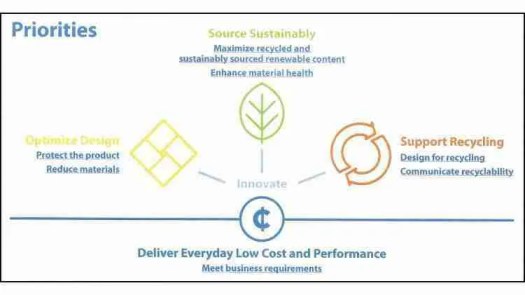
Today, Walmart has three tiers in its sustainability model for its brands, suppliers, manufacturers, and package designers to develop more efficient and sustainable packaging.39 These tiers are optimizing packaging design, sourcing packaging materials sustainably, and supporting recycling in packaging. They encourage the suppliers and brands they work with to follow this model for their packaging.

Walmart chart

How2Recycle label

Walmart argues that consumers are confused about recycling. This is because recycling systems are inconsistent, the packaging is not correctly labeled, and there’s too much of it. So Walmart encourages its suppliers to use the How2Recycle label. This is a consistent labeling program that clearly shows consumers what is and is not recyclable. How2Recycle’s “mission is to get more materials in the recycling bin by taking the guesswork out of recycling.”40 While this labeling does help with recycling confusion, it shifts the responsibility of disposal to the consumer.

Walmart’s aspiration is Zero Plastic Waste

Walmart’s goal is zero plastic waste, and they acknowledge the challenges of this on their sustainability website.41 They recognize that around 35% of plastic produced is used in packaging and that most of that is thrown away after a single-use. While plastic packaging can protect products, it is mostly a means of transporting products. But then it becomes waste. Project Gigaton is the “Walmart initiative to avoid one billion metric tons (a gigaton) of greenhouse gases from the global value chain by 2030.”42 Walmart believes that sometimes plastic is the most practical solution for packaging in terms of overall carbon footprint. But they want to find end-of-life solutions.

Walmart shifts responsibility 

Walmart interior
Photo by Hanson Lu on Unsplash

Walmart has shifted some of the responsibility of packaging waste to the consumer and municipal recycling systems. The company claims, “Society’s ability to collect and recycle plastic waste has failed to keep up with exponential increases in plastic production.” The company recognizes that there are huge challenges in the recycling industry. But they claim that recycling infrastructure is weak and that less than half of US households have access to recycling. While the latter part is absolutely true, the recycling industry simply can’t keep up.

The overproduction of plastic for the last four decades has been perpetuated by companies and corporations, manufacturers, the American Chemistry Council, and the petroleum industry. They produced so much at such an exponential rate and then shifted the burden of that waste to municipalities and the recycling industry. The U.S. was so overwhelmed that they had to ship that waste to foreign countries, like China, which has since banned the practice due to human health concerns from plastic pollution. Recycling is not the answer. We cannot possibly recycle all of the plastic away.

Walmart can do better

Walmart is in a unique position as a global top retailer. They began looking at packaging sustainability earlier than many companies and made early changes in packaging. But they’ve continued to promote single-use disposable items and other cheap “throw-away” merchandise. I viewed this month’s Walmart ad and it promotes picnic season items. Sale items include single-use items like polystyrene plates, plastic cups, packages of plastic forks, as well as cookies, chips, soda, and water in single-use plastic containers. Of the approximately 119 items pictured in the sales ad, about 82 had plastic packaging or were made of plastic.

The company could do so much more, and they even acknowledge that on their sustainability page:

“We recognize that these aren’t challenges we can solve alone and we want to open our doors to a more collaborative approach within the industry. We want to look for and share new solutions to reducing the use of ‘avoidable’ plastic as well as improving recyclability and the use of recycled plastic in our Private Brand packaging.”

This gives me the impression that they want to do better. While I respect the company’s initiatives, I know that the environment will always come second to profit. Remember that Walmart is a global top retailer and profit is always going to be their first priority. Walmart wants to be sustainable IF they can still turn a profit; IF they can get consumers to pay for it; and IF it will encourage more buying. Overall, I think Walmart can do more to prevent plastic waste.

“No need to recycle something that doesn’t exist in the first place!” -Dougie Poynter43

Walmart (Sam's Club) water bottle on the beach in South Carolina.
Walmart (Sam’s Club) water bottle on the beach in South Carolina. Photo by me

Thanks for reading, and please subscribe. In my next post, we will look at the packaging practices of the world’s largest online retailer, Amazon.

“If you want to eliminate waste in your life – and in the world – the answers will always come down to one simple thing: consume differently.” -Tom Szaky

Footnotes:

The Packaging Industry and How We Can Consume Differently, Part 7

Last updated on August 23, 2021.

Bell pepper and green beans in convenient plastic packaging
These food items do not require this much packaging. Photo by me

In my last article, I introduced take-back programs. Today we will continue that topic and look at programs that are a bit more successful, meaning that the rate of recycling is high.

Snack bag found on the beach in South Carolina. Photo by me

“Plastic packaging for food makes up the majority of municipal waste in America.” -A Plastic Ocean

TerraCycle programs

I love TerraCycle’s entire concept of making new things from waste, and I think its mission of recycling everything and eliminating waste is brilliant. Many companies sponsor take-back programs through TerraCycle at no cost to the consumer.44 These are awesome for waste streams in which there is no recycling option. There’s one for instrument strings, pens and writing tools  (which has a waiting list), and Brita filters. I participate in Bausch + Lomb’s free program to recycle contact lenses and their blister packs (and they accept all brands, not just Bausch + Lomb).45 This particular program has drop-off sites all over the place, usually at eye care offices. I love this one because I have to wear contact lenses for vision correction.

Though these programs encourage recycling and keep waste from littering the environment, they actually discourage companies from exploring new packaging options. A company can sponsor a recycling stream, such as waste from applesauce packets, juice pouches, snack bags, cosmetic and personal care items, and pay TerraCycle to recycle the items. In this way, the companies can take a passive approach and not have to deal with the problem directly. It gives consumers the impression that those companies are taking sustainable actions, but it really makes waste the consumer’s problem. It takes a lot of time and effort to clean, save, and ship the items; and even if the program is free, not everyone can or will voluntarily do it. These programs are a band-aid for the gushing wound of pollution.

“These programs are often funded by consumer product brands and are usually just a mechanism for the company to claim their non-recyclable products are recyclable.” -Jennie Romer, attorney and sustainability expert46

Again, I love what TerraCycle is doing! But I think it gives companies a reason to not be more active in their sustainability efforts. I think it’s a way for companies to take a NIMBY (“not in my back yard”) approach but not have to do much more than cover the minor costs. TerraCycle should be used for things people cannot avoid using, such as Brita filters, contact lenses, laundry detergent waste, shoes, and school supplies. But there are alternatives for things like snack bags, applesauce pouches, and coffee pods. Consumers should seek alternatives for those rather than trying to recycle them.

Image by WikimediaImages from Pixabay

Glass Bottle Exchange

Homestead Creamery returnable milk bottles
This type of milk bottle used to be commonplace. Photo from Homestead Creamery

Historically, the bottled beverage industry used take-back programs during the twentieth century. This system of using returnable glass bottles for milk and soft drinks was better than recycling because it was truly a circular economy system. It is also the most sustainable type of container deposit program. Bottles were washed and refilled as many as 20-50 times. While a few companies use this system today through a deposit program, like Homestead Creamery (sold at some Kroger’s grocery stores), this system of glass bottle exchange has largely disappeared in the United States. However, you can check Drink Milk In Glass Bottle’s website to see if there are any options in your region.47

Glass Coca-Cola bottles in red carry cases
Remember these? Image by SatyaPrem from Pixabay

Container Deposit Programs

A very successful type of take-back program is the container deposit program. While sometimes controversial, they reduce litter and environmental pollution and improve recycling rates. The consumer is charged a deposit fee of 5 or 10 cents per bottle or can. When the consumer returns that item for recycling, they get their deposit money back. This can include glass, plastic, and aluminum bottles and cans. Some call this system a tax, but it is clearly a deposit – when you return the container you get your money back, unlike with taxes.

Soda can with container deposit information engraved.
Many cans and bottles feature container deposit information as shown here. Photo by me

Benefits

The Container Recycling Institute (CRI) promotes the bottled beverage deposit system internationally.48 There are so many benefits to this system, as CRI President Susan Collins noted:49

      • Dramatic reductions in litter and marine debris
      • Reductions in energy use and greenhouse gas emissions due to fewer containers that need to be made from virgin materials
      • Additional jobs in recycling
      • More high-quality scrap for manufacturers
      • Extra income for consumers, charities, and community groups

Here’s a great short video from CRI explaining the system:

These systems are not meant to replace curbside recycling, but to supplement them to increase overall recycling. Curbside recycling is still not available to 50% of the American population, and curbside doesn’t address away-from-home consumption. Even where it is available, recycling rates have gradually dropped. “This decline is due in part to the increase in consumption of beverages away from home, and in public places where there are few available collection outlets for recycling. The drop in the recycling rate is also due to the shift away from aluminum to PET, which has a lower recycling rate,” according to Bottled Up: Beverage Container Recycling Stagnates (2000-2010).50

“Using only single-stream curbside recycling (blue bins) fails to achieve even half of the recycling rate of container deposit laws. While curbside programs should be part of the recycling equation, because 30 percent to 50 percent of beverage containers are consumed away from home, residential programs alone can’t possibly be expected to produce high recycling rates.” -Susan Collins, CRI President

Container Deposit Programs are Quantifiably Successful

The first US beverage container deposit laws were passed in the early 1970s in Oregon and Vermont. Currently, this program exists in 10 US states and Guam, and 30 other countries around the world. “States with container deposit laws capture beverage bottles for recycling at a significantly higher rate, and the quality of recycled materials (meaning the level of contamination) is superior to materials collected from curbside recycling programs.”51 The overall recycling rate for bottles and cans with a deposit is 59%, compared to only 22% for bottles and cans without a deposit. Clearly, this system works well. The graph below shows the rates:

Graph from the Container Recycling Institute (CRI)

The participating states are California, Connecticut, New York, Vermont, Michigan, Maine, Hawaii, Iowa, Massachusetts, and Oregon. Oregon’s bottle capture rate is 81%. Sadly, there are no states in the southeast or states that border the Gulf of Mexico that participate. These are missed opportunities to protect our oceans and rivers.

Examples

Oregon’s BottleDrop Refillables program is a successful, circular loop between the program and craft breweries. Consumers pay a deposit and return the bottles to get the deposit back. Bottles are sorted, washed, inspected, and delivered back to Oregon’s craft beverage producers. According to their website, 598,755 bottles have been saved from being crushed and recycled.52 An example in Europe is Germany, where almost 46% of all drinks are sold in reusable bottles which are refilled 40-50 times before being sent for recycling.

Container Deposit Programs as Law

Legislation for this system is commonly referred to as “Bottle Bills.” A national bottle bill could be implemented as part of the recently proposed Break Free From Plastic Pollution Act of 2020. This would make the collection, redemption, and recycling of bottles and cans regulated and consistent and could increase the recycling rate to 80%!

“For the sake of our climate, our oceans and our future generations, we must do more to collect high-quality recyclable bottles and cans that can be used to produce new products. A national container deposit-refund law can make that happen.” -Susan Collins, CRI President53

Unfortunately, bottlers are usually against such bills because they do increase costs for them, though only slightly. Elizabeth Royte, the author of Bottlemania, wrote that every time a new Container Deposit bill is introduced or an expansion is proposed for an existing one, “Coke, Pepsi, and other bottlers hire lobbyists and run ad campaigns designed to stop them. And they usually do.” But the companies making so many single-use disposable containers need to step-up and be part of the solution.

Containers as Litter

I personally grew up in a container deposit state that also had curbside recycling, and never even thought to question it. It was just what we did (in addition to curbside recycling). Our family brought back bottles and cans to the grocery store each week, and we’d receive either the cash or a credit on our grocery total. I continued this practice into my adulthood. I didn’t see as much litter on the sides of the roads. In Tennessee, I feel like I see trash on every street, playground, and parking lot; much of the litter is from single-use beverage containers. According to CRI, beverage containers comprise 40-60% of litter.

Image of plastic container art dolphin shaped to represent percentages of plastic containers recycled.
See this and additional plastic art projects by clicking on the image. Photo from CRI

“There are many quantifiable but just as important benefits of increased container recycling: the cleaner roadways, the healthier waterways, the growth in local jobs and green businesses and the satisfaction that we are doing what’s right not only for the planet but for future generations.” –Bottled Up: Beverage Container Recycling Stagnates (2000-2010)54

Solutions

Some companies use greenwashing and ‘sustainability’ to make consumers buy more. However, as long as packaging remains the responsibility of the consumer, we must consume less and buy more consciously. Companies must invest in better packaging and establish Extended Producer Responsibility programs. States must implement Container Deposit Programs to curb the impact of single-use disposable beverages. These systems reduce litter and increase recycling rates. Ultimately, though, ceasing the use of single-use disposable containers is one of the most impactful things we can do for the environment.

Thanks for reading! Here’s a link to the first post in this series in case you missed it. In my next post, I’ll explore companies that are already making recycling and reduction part of their mission.

“If you want to eliminate waste in your life – and in the world – the answers will always come down to one simple thing: consume differently.” -Tom Szaky

Note: There are no affiliate links in this post; all links are for informational purposes only.


Additional Resource:

Publications, Data Archive, Container Recycling Institute, accessed February 28, 2021.

Footnotes:

The Packaging Industry and How We Can Consume Differently, Part 6

Last updated June 20, 2021.

Another plastic product graphic
Image by Pete Linforth from Pixabay

If you’ve been following my series on the Packaging Industry, hopefully, you’ve found it informative! In my last article, I wrote about Extended Producer Responsibility (EPR). Today, I’ll tell you about one type of EPR, called Take-back programs.

Take-back programs are designed to ‘take back’ discarded items that are not accepted in regular recycling streams like curbside pickup. These programs are typically separate from municipal programs. They are often hosted by manufacturers or companies, for a variety of purposes.

Purposes of Take-Back Programs

Take-back programs exist for several reasons:

        • To reduce contamination of municipal recycling efforts
        • For recycling, at least parts of the items
        • To prevent toxic materials from entering landfilled
        • Simply to draw in customers

It is often a combination of one or two of those reasons. “Some collections, like the ones for e-waste and plastic bags, are often not so much a recycling effort as an attempt to reduce contamination of municipal solid waste streams and ensure proper disposal,” wrote Chris Daly in The Future of Packaging.

Earth friendly graphic
Image by Clker-Free-Vector-Images

‘Eco-friendly’ and ‘sustainability’ are good for business

Many people want to buy from companies that ‘take back’ or recycle items. So companies have had an influx of marketing campaigns in recent years for consumers to bring back their containers for recycling. However, not all companies are actually socially responsible and transparent in the process – and some are not recycling the things we bring back at all!

That is greenwashing! If a company cannot actually fulfill its promise of recycling or taking back items, then that is false advertising.

“In the face of increasing demand for more corporate social responsibility and environmental-friendliness, however, the authenticity of some of these recycling programs is questionable.” -Chris Daly

Types of Take-Back Programs

There are many types of take-back programs, so I am presenting the most common ones here.

Computer waste
Computer and other e-waste. Image by dokumol from Pixabay

Plastic Bags, Styrofoam, and Electronics Take-Back Programs

Many stores accept things that typically cannot be recycled, such as plastic grocery bags, styrofoam, and electronics. These programs are good for businesses because they generate foot traffic and brand affinity. This also prevents those items from going to a landfill. It also prevents them from going into your curbside bin, where they will contaminate recycling. Grocery stores, such as Publix, accept plastic bags, #4 plastic bags and Amazon Prime type shipping envelopes, toilet paper wrap, produce and bread bags, dry cleaning bags, styrofoam egg cartons, and styrofoam meat trays. Staples and Best Buy take back many electronic items for recycling. Many electronics companies, such as Samsung,51 have take-back programs of their own, through the mail or drop sites.

While it’s not clear what happens to any of those items, at least there’s a chance that some of those are actually recycled. Also, toxic materials will not leach into groundwater from landfills. In the meantime, these companies appear to be eco-friendly. They can also physically draw you into the stores. Might as well pick up some milk and eggs or printer paper, or maybe check out the new iPhones since you’re already there?

Plastic bag from Food City
Plastic bag from Food City. Photo by me
Publix

Publix states that “by inspiring customers to recycle these items, we ensure they are disposed of properly and keep them out of the environment and landfills.” It is unclear if these items are actually recycled as they do not specify what they do with the items. The corporation indicates that they are collected at their return centers and “then processed and sold to be made into other items.”54 That’s vague, but I still respected Publix for the effort.

Until I read that Publix actually claims that plastic bags are more sustainable than paper bags! In fact, the entire post is dedicated to promoting plastic over paper. I am appalled and extremely disappointed in Publix for making false claims such as “plastic bags use 71% less energy to produce than paper bags.” Among the many others, “using paper bags generates almost five times more solid waste than using plastic bags,” is similarly outrageous.55

Recycling bins at Publix. Photo by me
Amazon Prime envelopes
Amazon Prime plastic envelopes, accepted at some grocery stores for “recycling.” Note that Amazon does not take these back directly. Photo by me
A Microwave

A few years ago, I had a Hamilton Beach brand microwave that stopped working. I begrudgingly replaced it with a new microwave and immediately searched for a proper way to dispose of it but to no avail. I found out that Hamilton Beach will recycle and “properly dispose” of their products if you mail them to them at your cost.56 So I measured and weighed the microwave and looked up the shipping cost on USPS – and it would have been $41! So instead I put it in my shed and forgot about it for a while.

Last year, I called Staples to see if they accepted microwaves. They told me on the phone that yes, they do accept microwaves. So I loaded it in the car and took it to my local Staples. When I got to the service desk, I again asked if they’d recycle the microwave. They said yes. However, when I was researching for this post this week, I discovered that their site says they do not accept kitchen appliances. Now I wonder if that microwave was recycled, or if it was tossed in the trash after all. I guess I’ll never know, but I sure tried.

Brother brand printer ink cartridges.
Image by tookapic from Pixabay

Ink Cartridges, Light Bulbs, and Rechargeable Batteries Take-Back Programs

These programs are designed to keep contaminants out of landfills, as all three types of these items contain toxic materials. A few companies offer “rewards” in exchange for recycling. For example, Staples offers $2 back in rewards per recycled ink cartridge. This creates brand loyalty, as you are more likely to buy your ink there regularly if you are trying to use this rewards program. In fact, you have to – their rules state that you can earn the $2 per cartridge “if the member has spent at least $30 in ink and/or toner purchases at Staples over the previous 180 days.” This is only a good deal if you buy enough ink to keep up with that. At least these cartridges are likely recycled. Other companies, such as HP, have many ways for consumers and businesses to recycle their ink cartridges and electronics.57

Many hardware stores and home improvement centers, such as Lowe’s and The Home Depot, take back used compact fluorescent light bulbs and rechargeable batteries. Batteries Plus Bulbs will accept certain types of light bulbs and batteries, although not alkaline. For alkaline battery recycling, see my article from earlier this year.

Compact fluorescent light bulb
Compact fluorescent light bulb, image courtesy of Pixabay

Textile Recycling

The textile industry is notoriously wasteful, especially now that major retailers promote new fashion trends weekly rather than seasonally. But there are a few companies that have take-back programs. Patagonia may be the best example of this as they’ve had the program for a long time, don’t push new trends weekly, and stand by the quality of their products. Patagonia accepts all its products for recycling if the items can no longer be repaired or donated.58

Nike’s Reuse-A-Shoe product claims to take their old shoes grind them down to use in performance products and sports surfaces.59 The NorthFace and Levi’s are among others that take back some of their clothing for reuse or recycling. However, please know that clothing is so disposable in western society that second-hand clothing is overwhelming other parts of the world, creating waste problems in those areas. The solution for textiles is to buy less clothing, wear your clothing for a long time, and buy second-hand when possible.

Donated clothing stacks at a Goodwill outlet being prepared to be sent to various aftermarkets.
“A tour of the Goodwill Outlet warehouse and retail store in St. Paul, MN, in April 2019. Goodwill processes and recycles enormous amounts of material. Its outlets take in things that didn’t sell in Goodwill stores and separates them for various aftermarkets.” Photo by MPCA Photos on Flickr, Creative Commons license (CC BY-NC 2.0)

Solutions

Take-back programs offer a solution for some items that are hard to dispose of, such as computers, batteries, and light bulbs. It isn’t clear if these programs result in real recycling. Sometimes the companies are not transparent about their take-back program details. The real solution is for companies to invest in a system that can make these items reusable, in a circular economy or closed-loop system. We also need to consume less in general.

In my next post, I’ll examine two types of take-back programs that have high success rates. Thanks for reading, and please subscribe!

“If you want to eliminate waste in your life – and in the world – the answers will always come down to one simple thing: consume differently.” -Tom Szaky

Footnotes: