The Packaging Industry and How We Can Consume Differently, Part 2

Last updated on May 21, 2023.

Plastic bottles and bags (trash) in a variety of clear, white, blue, yellow and greens together.
Photo by Magda Ehlers from Pexels.

In my last article, I introduced the topic of packaging and the environmental crisis it has created. I left off with an explanation of greenwashing (read here about how to avoid greenwashed products), and in this article, I’m going to describe two terms that are often misused in advertising.

Remember: the answer to packaging is to reduce our reliance on it; to stop using it.

Styrofoam cup floating in water with plantlife
Photo by Jesse Gardner on Unsplash.

“Biodegradable” and “Compostable”

If only these words were the solutions to our global packaging problem! Unfortunately, they are two of the most abused terms in greenwashed advertising. Biodegradable refers to any material that decomposes in the environment. Compostable means that the material is organic matter that will break down and turn into soil. These words do not always mean what we think when it comes to sustainable packaging. In fact, if biodegradable and compostable items go into the trash and then a landfill, they do not biodegrade. Nothing in a landfill breaks down. Worse, the contents of landfills release methane gas, a major contributor to global warming.

But misleading marketing makes us believe that biodegradable plastics are better. “According to the Federal Trade Commission’s Green Guides, it is deceptive to market a product as biodegradable if the item does not completely decompose within one year after customary disposal, so items that are customarily disposed of in landfills cannot be marketed as ‘biodegradable in landfills.'”1 Regardless, the term is often misused.

Biodegradable plastics will only break down under the right conditions, such as in an industrial composting facility, not in a backyard composting system. But commercial composting facilities don’t all accept even certified compostable plastic products because the chemicals in the plastic hurt the final value of the compost.

Industrial Composting Facilities

There are several types of composting systems. A home compost system is mainly food and yard waste that you can set up yourself. Commercial composting refers to a municipal or city composting facility that accepts food and/or yard waste. An industrial composting facility requires precise processing conditions under a controlled biotechnological process. In order to be effective, these conditions include a certain high temperature, moisture level, aeration, pH, and carbon/nitrogen ratio.

Industrial composting facilities are not available in many places. There are about 200 in the US, serving less than 5% of the population. If there is notince

If there is a facility in your area, it still does not guarantee the items will be composted. The reality is that many facilities cannot tell the difference between compostable plastics from regular plastics other than by carefully reading the label on each item. This is not practical with the number of disposables we currently discard, so many items go to the landfill.

“Industrially compostable (also known as commercially compostable) items are those that will likely not break down in your home compost, but will break down under specifically controlled temperatures and pressures designed to create compost at a large scale…If a plastic-resembling item is labeled ‘compostable,’ it is probably industrially compostable only.” -Eve O. Schaub, author of Year Of No Garbage2

Examples

Let’s look at four examples of greenwashed and problematic products.

Wincup polystyrene disposable cups

I saw this single-use disposable coffee cup that a colleague had purchased, and the images of green leaves and biodegradable claims drew my interest. The company, called WinCup and based out of Stone Mountain, Georgia, claims to be a leading manufacturer of disposable polystyrene products.

First, these cups will not biodegrade unless they are put into biologically active landfills, which are far and few between. On their website, they claim that their “cups biodegrade 92% over 4 years” and “under conditions that simulate a wetter, biologically active landfill.”3 What is this type of landfill? My understanding is that it is similar to an industrial composting facility, in the facility adds moisture to assist with breakdown.

Most people toss these cups into the regular trash, which then goes to landfills. These cups will not break down in a landfill. Additionally, if these cups end up in the ocean, they will likely not break down and will also leach toxins. When marine life ingests those toxins, they make their way up through the food chain to us.

BASF ecovio line

BASF, a major chemical corporation, claims to “combine economic success with environmental protection and social responsibility.”4 I found some greenwashed marketing on their website about compostable plastic:
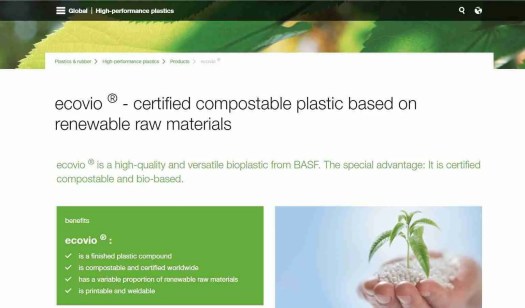
BASF website screenshot for "compostable" plastic

BASF used Ecovio film applications to make organic waste bags, fruit and vegetable bags, carrier bags, agricultural films, etc. Their claim is that the product is compostable, but the fine print indicates it is compostable “under the conditions of an industrial composting plant.”5

Screenshot from BASF's website about their compostable bags

This picture is misleading, as it shows a person putting a bag of compost into a compost bin. This gives the impression that these bags will break down in any compost collection when that is not the case. BASF’s compostable certification is the ASTM D6400, which is specifically for industrial composting facilities.6 Those are not available in most municipalities or states. If these products go into a landfill, it makes no environmental impact whatsoever. They also cause the same pollution problems as regular plastic.

A person holding 'compostable' plastic cups found at Jones Beach State Park, Long Island, New York.
‘Compostable’ plastic cups found at Jones Beach State Park, Long Island, New York. Don’t buy these! Photo by Brian Yurasits on Unsplash.

“So let me make sure I understand this. I’m supposed to get my one-use, takeaway cup, and as the name indicates, I take it away. And then when I’m done I . . . bring it to the nearest industrial composting facility? Oh sure, I think there’s one of those at the mall in between the Hallmark Store and the movie theater.” -Eve O. Schaub, author of Year Of No Garbage7

World Centric products

World Centric brand cups.
World Centric brand cups. Photo by Marie Cullis.
World Centric brand spoons in package.
World Centric brand spoons. Photo by Marie Cullis.

This seems like a great company: they are a Certified B company, they donate 25% of their profits, and they participate in carbon offsets. Their products, “Made from plants, not petroleum,” are made from renewable plants. Specifically, the spoons are made from 70% non-GMO corn and 30% talc. While this is technically better for the environment, these are still single-use disposable items that are only compostable in a “commercial composting facility.” The likelihood that these products will make it into a commercial composting facility after their single use is low. If they go to the landfill, they will likely not break down at all. At least this company isn’t using fossil fuels to make its products.

Molded fiber take-out packaging

molded fiber take out container

These “compostable” and “plastic alternative” molded fiber take-out containers seemed like a magnificent alternative to plastic until they were discovered to contain PFOAs (per- and poly-fluoroalkyl substances). These chemicals, protect the fibers from becoming wet and soggy. The same compounds are in most nonstick cookware. They cause cancer, thyroid disease, reproductive problems, and immunotoxicity in children.

Though marketed as compostable, these chemicals do not disappear. They get into the soil from the compost, and potentially into whatever is grown in that soil. Worse, these chemicals make it into the waterways and eventually into our drinking water.

My family ate out of these types of containers multiple times. Of course, I had no idea at the time that these contained PFOAs. Many major eateries have stopped using these.

Solution

In general, we must consume less. We must end the production and use of single-use disposable items. Most importantly, being aware of these problems is key because we can all make a difference.

In my next article about packaging, I’ll explain bioplastics, which are often advertised as biodegradable or compostable. Thank you for reading, and please subscribe to get the next post in your inbox!

“If you want to eliminate waste in your life – and in the world – the answers will always come down to one simple thing: consume differently.” -Tom Szaky

Additional Resources:

Article, “The bowls at Chipotle and Sweetgreen are supposed to be compostable. They contain cancer-linked ‘forever chemicals,'” by Joe Fassler, TheCounter.org, August 5, 2019. Read this excellent article for more information on molded fiber food containers.

Article, “The breakdown of biodegradable plastic, broken down,” by Sarah DeWeerdt, Anthropocene Magazine, May 7, 2019.

Article, “Will compostable packaging ever be able to solve our waste problem?” by Adele Peters, fastcompany.com, September 3, 2019.

Footnotes:

Only You Can Prevent Beach Trash

Last updated on February 11, 2024.

Trash with the words "100% Leakproof" on it
“100% Leakproof.” Photo by Marie Cullis.

In my recent article about my trip to Hilton Head Island and its environmental consciousness, I mentioned that the beaches are really clean and well-maintained. Even with their efforts, I still picked up about 300 pieces of trash during my week there. Of course, I logged these into my Litterati app.

I thought I could put the images of my trash to good use, to show people how they can prevent beach and ocean pollution!

I bet you already know a lot about this. But if you share this article, it might enlighten others who will then use preventative measures. And then the world could be a less polluted place!

“Worldwide, 73 percent of beach litter is plastic.” -National Geographic7

Common Types of Beach Trash

I noticed that the same types of trash commonly appear on beaches all over the country. So I’ve divided this article into sections based on the common types of trash I’ve found.

Image of a Plastic water bottle in the surf with a blue label.
Plastic water bottle almost in the surf. Photo by Marie Cullis.

Plastic drink bottles and caps

These are the most common items I pick up EVERYWHERE, and not just on beaches. Our love affair with drinks in single-use disposable plastic bottles and cups (I’m including styrofoam in this classification because styrofoam is chemically a plastic) is completely out of control. I even picked a red Solo cup that I used to collect cigarette butts and microplastics! I picked up many single-use disposable drink items like these:

What can you do?

Buy a reusable drink container (or two) and use that for all your liquid refreshments. I have two: a Kleen Kanteen for water; and a Hydroflask coffee cup. They handle pretty much everything.

If you must buy a beverage, please dispose of it properly.

Food and snack wrappers

I find this type of litter on the beach (and everywhere else) very often. This includes food wrappers, containers, zipper bags, etc. Below is an image of a washed-up cannonball jellyfish next to the plastic lid of a cylindric chip container.

Plastic bottle cap next to a washed up jellyfish.
Plastic lid next to a washed-up jellyfish. Photo by Marie Cullis.

Here are some additional examples of food and snack wrappers:

What can you do?

Follow the saying, “Leave it cleaner than you found it.” Or “carry in, carry out.” Don’t lose track of your trash and disposables. Put them inside your beach bag until you can find a proper trash can. You can also consume less prepackaged food, which will be better for your health as well.

Beach Toys

This is one item that is particular to beaches but so easily preventable. Children scatter and lose their things easily, and almost all beach toys are made of plastic. When people leave these items on the beach, they go straight into the ocean during high tide.

Toy pink crab sand toy.
Photo by Marie Cullis.
A toy buried in the sand.
Photo by Marie Cullis.

You can see how easily small toys are overlooked in the next image. Can you guess what that is?

A toy car buried in the sand.
Photo by Marie Cullis.

If you guessed a toy car, you’ve got a good eye!

Here are some other examples of left behind or broken toys:

Yellow plastic toy boat.
We found this and my son named it “Mr. Boat.” We kept this one and donated the rest. Photo by Marie Cullis.

In particular, we found multiple plastic bucket straps, as they are not usually permanently affixed. These are easily forgotten about but this cheap plastic will make it into the ocean by the next morning.

There are a few brands, such as Green Toys, that feature a rope strap that is not easily removed. The bucket is even made of recycled plastic. It’s the one we own and play with year-round.

What about the packaging for all of those beach toys?

A plastic net bag that the plastic beach toys were sold in.
A plastic net bag that the plastic beach toys were sold in, from American Plastic Toys Inc. Photo by Marie Cullis.

Below are images of a discarded boogie board left at a wash station near the beach. I’d seen these little styrofoam balls lining parts of the beach and I couldn’t figure out what they were from. I did not manage to get a good photo of them. Once I found this broken board and looked at it closely, I could see that these cheap boards were simply nylon or polyester fabric (fabrics made from plastics) over styrofoam. You could not make a worse product for the beach – a product meant to be used in the water that is made of cheap materials and not meant to last more than one vacation – WOW.

Please don’t buy these. This one made it into a proper trash can, but how many end up in the ocean?

What about the dog’s toys? These can be easily lost. And yes, they are made of plastics and other synthetics.

A yellow tennis ball made by Kong.
Photo by Marie Cullis.

What can you do?

The best thing you can do is to not leave beach toys behind. The best way to keep track of your children’s toys is simply to own less of them. Perhaps just one bucket and one shovel, for example. In general, kids don’t need many toys when playing outdoors to stay entertained and engaged. Besides the sand and water, the beach offers so many shells, sticks, seaweed, and other washed-up items that kids are curious about and love to experiment with.

Place broken toys in your beach bag immediately so that you don’t accidentally leave them behind.

As for dog toys, how about throwing a stick for Fido instead of a ball or plastic Frisbee?

Items related to smoking

This is another common item I find everywhere and not just at the beach. Corporations make cigarette butts out of synthetic materials that do not biodegrade. Plastic lighters are found in the stomachs of birds and marine animals. Honestly, I used to smoke a long time ago and I sometimes threw cigarette butts on the ground. I had no idea how bad they were for the environment. I pick them up regularly now as part of my Litterati mission, as I feel like I owe the environment for this terrible habit I used to have.

Cigarette lighter lying in the ocean's surf.
Photo by Marie Cullis.

I gathered dozens of cigarette butts and several lighters on the beach, here are a few examples:

I also picked up plastic tips from Swisher Sweets, a brand of inexpensive flavored tip cigarillos.

What can you do?

Don’t smoke! But if you do, can you please discard your waste properly?

Straws

Aren’t straws like so last year?

No, not really. Not yet. Despite straw bans in different parts of the world.

Everywhere we went in Hilton Head served straws, sometimes automatically in the drink. I’m not criticizing the Island for this, because it happens in my town too. But I hope all eateries eventually end this practice. The exception was the Watusi Cafe on Pope Avenue, which served paper straws – thank you!!!

What can you do?

Ask the server to not give you a straw before he or she brings your drink. I used to decline the straws when the server would set them down on the table, but since so many places automatically put them in the drink, I try to cut them off at the pass. Once that straw is opened and in a drink, it doesn’t matter whether or not I use it. The restaurant will now trash it.

I don’t use a straw very often anymore, but if I need one, I have my Final Straw.

Plastic Bags

I still found a couple of plastic bags on the beach despite the town’s ban on plastic bags!

White transparent plastic back stuck to dune fencing.
Photo by Marie Cullis.

What can you do?

Decline plastic bags no matter where you live! Bring your own cloth bag.

If you don’t have a bag, can you carry your items without one? I can’t tell you how many times I’ve stopped at a store and purchased one item that the cashier bagged. I don’t need a bag for one item! Give them the bag back right away and say thanks but no thanks!

Many stores do have a paper bag option if you ask for one. If not, they likely have an empty box readily available that you can put your purchases in.

Beach tent/umbrella parts

Many people bring their own beach tents and umbrellas to the beach. But sometimes they leave waste from them. Below you can see where I found a plastic tent stake accidentally left behind and a zip tie of which I found several. The last image is of a full plastic water bottle that someone tied to a nylon string. I found this buried in the sand but the string was sticking out. Once I pulled it out, it was obvious that someone most likely used it as a weight to hold something down. Clever – but forgotten, an immediate pollutant – this would’ve been in the ocean after high tide.

What can you do?

Collect all of the parts to your tents and umbrellas, even if it’s trash. Double-check before you leave that you haven’t forgotten anything.

Everyday Non-Beach items

I find many items on the beach that are not necessarily beach items but items that people use daily. These items include wet wipes or baby wipes (most often not made of anything biodegradable even if the packaging makes that claim); dryer sheets; plastic dental picks; cellophane; condom wrappers; and even a bullet casing (pictured below).

Wet wipe or baby wipe in the sand
Wet wipe or baby wipe. Photo by Marie Cullis.
Wet wipe or baby wipe in the sand
Wet wipe or baby wipe. Photo by Marie Cullis.
Dryer sheet in the sand
Dryer sheet. Photo by Marie Cullis.
Bullet casing on the beach, red plastic.
Bullet Casing. Photo by Marie Cullis.

The most surprising things I’ve ever found on a beach were plastic tampon applicators in the Gulf of Mexico. At first, I thought, there’s no way someone changed their tampon on the beach! But I found not just one, but multiple of these and I’ve also since found them along the Tennessee River. It dawned on me that these items were not left behind by careless beach-goers, but more likely washed up from trash and from sewage disposal that made it into the ocean. It turns out that litter collectors colloquially call these “beach whistles.”

"Beach whistle," or tampon applicator
“Beach whistle,” or tampon applicator. Photo by Marie Cullis.

What can you do?

In general, the best thing you can do is cut down on disposable items, especially single-use disposable plastic items. Even if you’re not leaving these items on the beach, they’re making it onto the beaches and the items are only a portion of what’s washed up from the ocean. Meaning, there’s way more in the ocean.

The answer is to not use disposable items. It isn’t always easy, so just work on solving one problem at a time – that’s what I’m doing and sharing with you on this website!

Beach sunset
Photo by Marie Cullis.

Thanks for reading, please subscribe in the box above. Love your beaches and ocean. And keep being the change!


Footnote:

Inspiration Abounds on Hilton Head Island

Last updated on February 11, 2024.

Hilton Head Island after sunrise, the wide beach at low tide with sun rising at center. People walking.
Hilton Head Island just after sunrise. Photo by Marie Cullis.

If you read my article about my family’s weekend trip to Hilton Head Island last fall, then you already know how much we love the island. We recently returned from a week-long trip there, and inspiration was all around! Besides the natural beauty of the island and the gorgeous beaches, there are many environmentally conscious things I appreciate about Hilton Head Island.

My son sitting in the surf, looking out at the vast and beautiful ocean.
My son sitting in the surf, looking out at the vast and beautiful ocean. Photo by Marie Cullis.
Sunset on Hilton Head Island, silhouetted tress with the orange sun just behind them, blue and orange hued sky above.
Sunset on Hilton Head Island. Photo by Marie Cullis.

Plastic bag ban in Beaufort County, South Carolina

They implemented a plastic bag ban last fall, and I am here to tell you that from a tourist’s perspective, businesses have not been hurt by this. People were shopping in all the shops and supermarkets and the plastic bag ban did not seem to deter anyone from spending money. I have not found any studies on the result of this ban in the last 8 months, but I imagine the impact has been huge!

Unfortunately, I read that Target and Walmart are using supposedly “reusable” plastic bags. However, since they are made of the same material as regular plastic bags, they defeat the whole purpose as far as plastic production goes. I did not happen to shop at either store while there so I did not witness this first hand.

At the other shops and stores I visited, I received only paper bags when I didn’t have my cloth bags with me. I love it! Can’t we do this everywhere?

Dunes with a palm tree against a cloudless blue sky.
Gorgeous dunes on HHI. Photo by Marie Cullis.

Wildlife

There’s a lot of cherished and protected wildlife on the island. We saw all types of birds, including pelicans – my favorite! We saw dolphins, tons of fish, and several types of crabs. There are also bald eagles, alligators, and turtles living on the island but we didn’t personally get to see those this time. The local government’s website educates on sustainable living, the types of local wildlife, native plants, biodiversity, and ecosystems, and how everyone can help protect those things.

Pelicans flying in a line over the ocean near sunset, pink and purple hues on a blue sky.
Pelicans flying in a line over the ocean near sunset. Photo by Marie Cullis.
Baby crab, dark gray.
Baby crab! Photo by Marie Cullis.

Sea Turtle Conservation Efforts

Although we did not see sea turtles this trip, we saw at least 7 cordoned loggerhead sea turtle nest areas. They were marked with orange signs provided by the South Carolina Department of Natural Resources, which alerts the public about the protection of this endangered species through federal and state laws.

Loggerhead sea turtle nest sign, cordoned and marked by the South Carolina department of Natural Resources.
Loggerhead sea turtle nest, cordoned by the South Carolina Department of Natural Resources. Photo by Marie Cullis.
Three loggerhead turtle nests on the north end of the island (Port Royal area), cordoned off by the SC Department of Natural Resources.
Three loggerhead turtle nests on the north end of the island (Port Royal area). The SC Department of Natural Resources cordoned off the nests. Photo by Marie Cullis.

Many Atlantic coast towns have laws, regulations, and organizations to protect sea turtle nests. On Hilton Head Island, lights on buildings and hotels cannot shine in the direction of the beach. People are only permitted to use red or “turtle-safe” flashlights on the beach between 10 p.m. and 6 a.m. between May and October. They have a volunteer organization (Sea Turtle Patrol HHI) that patrols, monitors, and reports on sea turtle nests. They also clean up beach litter and plastics.

Recently, a Kemp’s Ridley turtle made a nest on Hilton Head Island, a first-time event for the most endangered of all the sea turtle species! Wow!

The Coastal Discovery Museum has an “Adopt-a-Nest” Program, which not only sponsors the protection of a sea turtle nest but also supports the museum’s educational programs. Of course, this idea excited me so I adopted a nest while writing this post! They emailed me to let me know that my nest will be the 277th one this year and that they’ll keep me informed on the progress of my adopted nest.

Can I inspire you to adopt a nest as well? Just use the link above!

UPDATE February 11, 2024: Since writing this article, I have been able to adopt a sea turtle nest in Hilton Head every year. It’s one of my ways of giving back.

Baby sea turtles on the beach.
Photo by Skeeze on Pixabay.

Coastal Discovery Museum

The Coastal Discovery Museum on the island is a great non-profit and Smithsonian Affiliate, dedicated to educating and protecting the natural resources, history, and ecosystems of the region. Their mission “inspires people to care for the Lowcountry,” through their many programs, exhibits, talks, and tours. What a great organization.

We’ve visited several times in past years but this year we did a Dolphin and Nature Cruise with the museum and really enjoyed it. And yes, we did see dolphins! The museum docent provided a dolphin skull replica and spoke about the anatomy, diet, and lifestyle of the local dolphins. The captain provided a rich tour of the history and nature of the island. Both the captain and museum docent were very knowledgeable and kept the passengers engaged for the entirety of the cruise. They even let each of the kids drive the boat for a few minutes!

My son driving the boat on the Dolphin & Nature Cruise.
My son driving the boat on the Dolphin & Nature Cruise. Photo by Marie Cullis.

Beach Trash

Hilton Head Island’s beaches are very clean and well-maintained. And there are both trash and recycling cans up and down the beach. Even so, I still picked up about 300 pieces of trash during my week there. Of course, I logged these through Litterati (see also my article on Litterati). My next article will be about the types of trash I found and what you can do to prevent beach trash and ocean pollution!

Thanks for reading, and please subscribe!

Support “The Story of Plastic”

Last updated on April 23, 2023.

Rows and rows of yellow rubber duckies on shelves.
Rubber duckies are actually made of plastic. Photo by JOSHUA COLEMAN on Unsplash.

Update 4/23/2023: This film was released in April 2020 and premiered on the Discovery Channel on April 22, 2020, the 50th anniversary of Earth Day. This is an informative and well-presented film on plastics – I highly recommend it!


Have you ever heard of The Story of Stuff? It’s a 20-minute film (linked below) that is “a fast-paced, fact-filled explanation of the consumerist economy.” It began with the writer and the founder of The Story of Stuff Project, Annie Leonard. She’s an amazing person and a leader in environmental and social issues. It is 100% worth your time to watch!

The Story of Story Project has since come out with more than a dozen high-quality short documentary films that explain the relationship between consumer products and environmental problems. But their newest one is really exciting!!! It’s called…

The Story of Plastic

“These days, more and more of our Stuff is being made from one very problematic material: plastic.

They want to tell the hidden stories surrounding plastic. The production, the pollution, and the health hazards. Here’s the trailer:

Do we need another film about plastic?

Yes, we do. There aren’t enough of them. The ones that do exist are really good and the message is getting out, but we need even more people to hear and see and understand the message: Plastic is ruining our environment, poisoning us (cancer, endocrine and thyroid diseases, etc.), and littering our landscapes. The Earth is so beautiful – don’t we want it to stay that way?

And recycling is not the answer. Only 9% of our plastic is actually getting recycled! That means 91% is ending up in landfills, the ocean, rivers and lakes, beaches, parks, and our neighborhoods. It even ends up in the food we eat and the water we drink.

plastic bottles, rope, and other waste on the beach.
Photo by John Cameron on Unsplash.

The Story of Stuff Project is fundraising to complete this project. Please help me support this worthy cause. They are asking people to become “a Plastic Insider by starting a recurring monthly donation supporting The Story of Plastic production fund today.” There are insider perks: your name will be in the credits of the film and you gain access to behind-the-scenes videos. Here’s a video of supporters who spend their lives on a sailboat:

I signed up as a monthly, recurring donor today. Can you help too? You can also make a one-time donation in any amount you’d like. And if you’re really ambitious, you can create your own Facebook fundraiser!

“The Story of Plastic isn’t just a movie. It’s a call to action.”

Are you as excited about this film as I am? Leave a comment below! Thank you for reading.


Additional Resources:

Website, how to watch The Story of Plastic

Film, The Story of Stuff

Book Review: One Plastic Bag: Isatou Ceesay and the Recycling Women of The Gambia

Last updated on December 23, 2022.

One Plastic Bag: Isatou Ceesay book cover

There are inspirational and motivated women all over the world. Women who amaze us, withstand the negativity and overcome the obstacles she faces.

I discovered One Plastic Bag: Isatou Ceesay and the Recycling Women of the Gambia, by Miranda Paul, at my local library. Upon reading this book to my son, I was really impressed with this story. Check to see if your local library offers it!

After reading the book I wanted more information about Isatou Ceesay.

I felt that she is so inspirational that I should dedicate a whole post to her. She has been committed to upcycling plastic bags and reducing waste in The Gambia since the 1990s. The waste problem in The Gambia really bothered her. Plastic and trash were everywhere. The landscape was littered. People used plastic to make fires burn faster, but the toxins released in the fumes from burning plastic are unimaginable. She decided she would find a way to recycle or upcycle some of the plastic waste.

More than just recycling

But her story is not just about recycling and plastic. It’s also about empowering women and improving the standard of living! The book tells the story at a children’s level about how she had to work in secret in the beginning because it was illegal for women to work at the time, and people ridiculed her. But she began making recycled plastic bag purses. Isatou hired a few women to help and hired more as time went on, even establishing a women’s cooperative to craft and sell the items for income. The business kept growing and it helped the environment, the people, and the economy.

Isatou also helped co-found The Women’s Initiative Gambia whose mission is: “Women’s Initiative Gambia helps financially poor women in The Gambia to improve their skills and income so as to raise the standard of living of their families and their communities.” Today they have many projects beyond plastic bag recycling, including briquette making as a fuel source, gardening, tie-dye and batik, recycled paper bead making, food preservation, and many other projects.

Here’s a quick video highlighting Isatou Ceesay’s accomplishments:

“I think that when you abuse your environment, you abuse yourself.” -Isatou Ceesay

DIY Opportunity

And if you have too many plastic bags yourself and want to make a plastic bag crocheted purse? She’s got a how-to video! I’ll update this post if I try it. And if any of you try this, please message me or leave a comment below! I can’t wait to see what you’ve done!

“People thought I was too young and that women couldn’t be leaders. I took these things as challenges; they gave me more power. I didn’t call out the problems – I called out solutions.” -Isatou Ceesay

Well said. I think we should all have that attitude. Let’s be the change together!

Footnotes:

Bag It: The Movie

Last updated December 11, 2022.Bag It film cover art

Have you seen this documentary? Bag It is an excellent film, and I wholeheartedly recommend it! It’s a great introduction to not only the problem of plastic bags but of plastics in general. Please check out the trailer:

A must-see documentary

I cannot say enough good about this film. It really hits on all the topics, from the perspective of an everyday person like you or me. Before I saw this film myself a couple of years ago, I had only limited knowledge of plastics, recycling, and toxic products. This film was like my gateway to bigger individual topics – like plastic bag usage; the Great Pacific Garbage Patch; toxins in food from plastic packaging; and single-use disposable plastic…everything. I had thought about those things, but I hadn’t researched them or even read much about them. I love this film! And Jeb Berrier is pretty funny too.

The film also introduced me, through interviews in the film, to a variety of plastic experts, ocean and marine life experts, and organizations trying to make the world a better place. To name a few: Beth Terry of myplasticfreelife.com; Annie Leonard of the Story of Stuff Project; Dr. Sylvia Earle of Mission Blue; Algalita (founded by Captain Charles Moore); the Midway Atoll National Wildlife Refuge; Oceana; the Environmental Working Group; authors Elizabeth Royte and Daniel Imhoff; and so many more that I’m forgetting to include. The filmmakers’ requests for interviews with the American Chemistry Council and others in the plastics industry were denied or received no response. Unfortunately, that has been fairly typical with films that investigate and educate the public on the plastic problem.

Plastic bags that have somehow made it into my home. I'm saving these for trash clean ups when I go hiking.
Plastic bags that have somehow made it into my home. I’m saving these for trash clean-ups when I go hiking. Photo by Marie Cullis.

Take action with Bag It The Movie

I was completely inspired by this movie! As I mentioned above, this film is one that led me to other important films, authors, individuals, and organizations that are all making a difference and trying to educate people. I consider Bag It to have been a core part of our household’s path to great changes.

I looked up the film’s website in anticipation of writing this article, and I was even more inspired! Most of their site is dedicated to using the film as a tool to educate schools, communities, and whole towns. They offer the ability for any person or organization to host a screening for a fee and have a free downloadable pdf Screening Tool Kit, which has step-by-step instructions and resources for screening Bag It. They also have a free downloadable pdf to initiate a Bag It Town campaign, meaning a plastic bag ban.

In my article about a weekend trip to Hilton Head Island, where I discovered that that town is implementing a plastic bag ban this month, I mentioned that I might try to propose one where I live! Between both, I’m SO moved and even more encouraged. If I do propose one in my town, I definitely know where to start now. With the tools provided by Bag It!

Thank you for reading! Stay inspired and be the change!

Plastic Bag laws in U.S. map from https://www.plasticbaglaws.org/
Plastic Bag laws in the U.S. from plasticbaglaws.org.

Footnote:

What’s the Big Deal about Plastic Straws?

Last updated on January 12, 2025.

straws colorful, Photo by Bilderjet on Pixabay
Photo by Bilderjet on Pixabay.

There is a coalition of aquariums across the United States striving to reduce the use of plastic straws. The coalition, called the Aquarium Conservation Partnership (ACP), is a collaboration of 22 public aquariums in 17 states, including the Tennessee Aquarium. They help advance conservation policies, educate and inspire audiences, and commit to sustainable business practices.1

Aquariums are awesome and full of wonder and thousands of children go through them daily. So they are poised to be leaders in positive change, and this is a great example of that! One of the things they’re doing is asking restaurants and others in the hospitality industry to reduce the use of straws by only giving them out upon request, instead of automatically. They’re asking individuals to sign a pledge to stop using plastic straws.

My son looking up at a large aquarium tank at the Tennessee Aquarium when he was just 2 and a half.
My son at the Tennessee Aquarium when he was just 2 and a half. Photo by Marie Cullis.

What’s wrong with plastic straws?

First, the sheer amount of them! Just like with all single-use disposable plastic products, it’s the over-consumption of them. Think 500 million plastic straws per day. That’s more than one straw per person per day in the United States. Our consumption has gone way overboard and has created a waste stream that is too large for us to keep up with! Second, they are not recyclable at all.

Don’t feel guilty about having used plastic straws. Just please refuse plastic straws – START TODAY. Politely refuse those plastic straws – if everyone refuses just one straw per day, we’ll more than cut our usage in half!

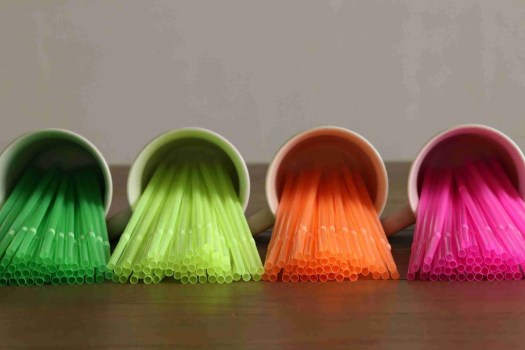
Colored plastic straws sorted in cups by color, neon green, neon yellow, neon orange, and neon pink.
Image by Marjon Besteman-Horn from Pixabay.

I threw my disposables into the trash/recycling receptacle like I’m supposed to, how are they ending up in the rivers and ocean?

One of the critical issues with all the media about single-use disposable plastics is that the biggest question is often not answered: How does the plastic end up in the ocean in the first place?

Most people assume that once they’ve placed their disposables into a receptacle, those disposables go to the proper facility. What people don’t know is that many items don’t make it to the recycling facility or landfill. Since that’s out of our control, it seems impossible to do anything about it. But it’s not impossible by any means. The best way to guarantee that your single-use disposable plastics don’t end up in the ocean is…

To just not use them! Refuse them. Find an alternative. Then you do have control. We have the power to be the change.

So back to the question – how are plastics ending up in the rivers and ocean?

There are so many causes! Spillage from recycling that has been transported across the ocean for years to Asia; plastic products shipped across the ocean to the U.S. have spilled from ships; the fishing industry regularly dumps their trash into the ocean; trash and litter get blown or washed into storm drains and rivers that then feed into the ocean; illegal dumping; beach trash; river pollution; microbeads washing down drains; and debris from natural disasters and floods. Plastic bags are picked up by the wind and blown into waterways that flow into the ocean.

Starbucks is one company that is striving to end use of plastic straws by 2020. Photo by Nadine Shaabana on Unsplash
Starbucks is one company that is striving to end the use of plastic straws by 2020. Photo by Nadine Shaabana on Unsplash.

Ok, so what steps can I take?

First, let’s support the Aquarium Conservation Partnership. You can do this by signing the pledge (linked under Additional Resources below).

Second, refuse. Just say no thank you. To all single-use disposable plastics. Because recycling is not the answer. Only about 9% of our plastics get recycled. That means 91% is not recycled!

Third, if you must have something commonly produced as a single-use disposable plastic, like a straw, please buy a reusable one. Paper disposables and supposedly biodegradable straws are a better option, but it’s still going to be thrown away after one use. Try a stainless steel straw, glass straw, or bamboo straw.

Fourth, tell others! Tell your friends, your co-workers, your favorite restaurant, the local coffee shop, and your local school. So many to tell!

Fifth, participate in trash clean-up efforts. Join the Litterati. Maybe you’ll prevent some of the trash you pick up from entering the ocean.

Single use disposable plastic straw found buried in the sand, Hilton Head Island, October 2018.
Single-use disposable plastic straw found buried in the sand, Hilton Head Island, October 2018. Photo by Marie Cullis.

Last, but not least: Stop supporting businesses that resist change. Consumers hold power: if businesses refuse to meet demands like eliminating single-use plastics, choose not to patronize them. Your spending decisions can push businesses to adapt or risk losing profitability.

Blue poster advertising that The Trading Post, a popular restaurant in Emerald Isle, NC, is recognized as an "Ocean Friendly Establishment" by the Plastic Ocean Project and Surfride Foundation, as "We Only Serve Straws Upon Request." An illustration of a Green Sea Turtle is swimming in waves with fish at the bottom.
Poster advertising that The Trading Post, a popular restaurant in Emerald Isle, North Carolina, is recognized as an “Ocean Friendly Establishment” by the Plastic Ocean Project and Surfride Foundation. “We Only Serve Straws Upon Request.” I love it and will eat there to support businesses like this! Photo by Marie Cullis.

Final Thoughts

Collectively, have the power to create change just by modeling the best behavior. Refuse that straw. Be polite, of course. But just say no. You might influence someone else to refuse straws too. If everyone starts refusing straws, businesses won’t need to order as many. Then the plastic straw manufacturers will have to produce less. And then less will end up in landfills, in nature, and in the oceans. Carry a reusable stainless steel straw with you. Be the change! And as always, thanks for reading.

Forest Gump meme on straws, I couldn't stop giggling at this, so I'm reposting it here.

Additional Resource:

First Step, Skipping the Plastic Straw Pledge.

Footnote:

  1. Page, “What We Do,” Aquarium Conservation Partnership, accessed January 12, 2025. ↩︎