The Packaging Industry and How We Can Consume Differently, Part 2

Last updated on May 21, 2023.

Plastic bottles and bags (trash) in a variety of clear, white, blue, yellow and greens together.
Photo by Magda Ehlers from Pexels.

In my last article, I introduced the topic of packaging and the environmental crisis it has created. I left off with an explanation of greenwashing (read here about how to avoid greenwashed products), and in this article, I’m going to describe two terms that are often misused in advertising.

Remember: the answer to packaging is to reduce our reliance on it; to stop using it.

Styrofoam cup floating in water with plantlife
Photo by Jesse Gardner on Unsplash.

“Biodegradable” and “Compostable”

If only these words were the solutions to our global packaging problem! Unfortunately, they are two of the most abused terms in greenwashed advertising. Biodegradable refers to any material that decomposes in the environment. Compostable means that the material is organic matter that will break down and turn into soil. These words do not always mean what we think when it comes to sustainable packaging. In fact, if biodegradable and compostable items go into the trash and then a landfill, they do not biodegrade. Nothing in a landfill breaks down. Worse, the contents of landfills release methane gas, a major contributor to global warming.

But misleading marketing makes us believe that biodegradable plastics are better. “According to the Federal Trade Commission’s Green Guides, it is deceptive to market a product as biodegradable if the item does not completely decompose within one year after customary disposal, so items that are customarily disposed of in landfills cannot be marketed as ‘biodegradable in landfills.'”1 Regardless, the term is often misused.

Biodegradable plastics will only break down under the right conditions, such as in an industrial composting facility, not in a backyard composting system. But commercial composting facilities don’t all accept even certified compostable plastic products because the chemicals in the plastic hurt the final value of the compost.

Industrial Composting Facilities

There are several types of composting systems. A home compost system is mainly food and yard waste that you can set up yourself. Commercial composting refers to a municipal or city composting facility that accepts food and/or yard waste. An industrial composting facility requires precise processing conditions under a controlled biotechnological process. In order to be effective, these conditions include a certain high temperature, moisture level, aeration, pH, and carbon/nitrogen ratio.

Industrial composting facilities are not available in many places. There are about 200 in the US, serving less than 5% of the population. If there is notince

If there is a facility in your area, it still does not guarantee the items will be composted. The reality is that many facilities cannot tell the difference between compostable plastics from regular plastics other than by carefully reading the label on each item. This is not practical with the number of disposables we currently discard, so many items go to the landfill.

“Industrially compostable (also known as commercially compostable) items are those that will likely not break down in your home compost, but will break down under specifically controlled temperatures and pressures designed to create compost at a large scale…If a plastic-resembling item is labeled ‘compostable,’ it is probably industrially compostable only.” -Eve O. Schaub, author of Year Of No Garbage2

Examples

Let’s look at four examples of greenwashed and problematic products.

Wincup polystyrene disposable cups

I saw this single-use disposable coffee cup that a colleague had purchased, and the images of green leaves and biodegradable claims drew my interest. The company, called WinCup and based out of Stone Mountain, Georgia, claims to be a leading manufacturer of disposable polystyrene products.

First, these cups will not biodegrade unless they are put into biologically active landfills, which are far and few between. On their website, they claim that their “cups biodegrade 92% over 4 years” and “under conditions that simulate a wetter, biologically active landfill.”3 What is this type of landfill? My understanding is that it is similar to an industrial composting facility, in the facility adds moisture to assist with breakdown.

Most people toss these cups into the regular trash, which then goes to landfills. These cups will not break down in a landfill. Additionally, if these cups end up in the ocean, they will likely not break down and will also leach toxins. When marine life ingests those toxins, they make their way up through the food chain to us.

BASF ecovio line

BASF, a major chemical corporation, claims to “combine economic success with environmental protection and social responsibility.”4 I found some greenwashed marketing on their website about compostable plastic:
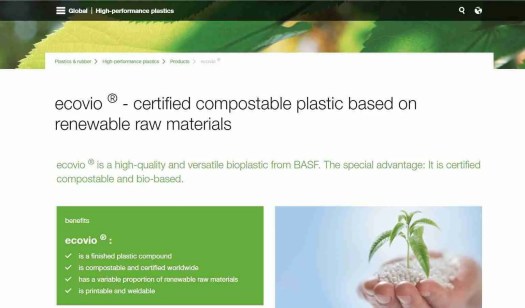
BASF website screenshot for "compostable" plastic

BASF used Ecovio film applications to make organic waste bags, fruit and vegetable bags, carrier bags, agricultural films, etc. Their claim is that the product is compostable, but the fine print indicates it is compostable “under the conditions of an industrial composting plant.”5

Screenshot from BASF's website about their compostable bags

This picture is misleading, as it shows a person putting a bag of compost into a compost bin. This gives the impression that these bags will break down in any compost collection when that is not the case. BASF’s compostable certification is the ASTM D6400, which is specifically for industrial composting facilities.6 Those are not available in most municipalities or states. If these products go into a landfill, it makes no environmental impact whatsoever. They also cause the same pollution problems as regular plastic.

A person holding 'compostable' plastic cups found at Jones Beach State Park, Long Island, New York.
‘Compostable’ plastic cups found at Jones Beach State Park, Long Island, New York. Don’t buy these! Photo by Brian Yurasits on Unsplash.

“So let me make sure I understand this. I’m supposed to get my one-use, takeaway cup, and as the name indicates, I take it away. And then when I’m done I . . . bring it to the nearest industrial composting facility? Oh sure, I think there’s one of those at the mall in between the Hallmark Store and the movie theater.” -Eve O. Schaub, author of Year Of No Garbage7

World Centric products

World Centric brand cups.
World Centric brand cups. Photo by Marie Cullis.
World Centric brand spoons in package.
World Centric brand spoons. Photo by Marie Cullis.

This seems like a great company: they are a Certified B company, they donate 25% of their profits, and they participate in carbon offsets. Their products, “Made from plants, not petroleum,” are made from renewable plants. Specifically, the spoons are made from 70% non-GMO corn and 30% talc. While this is technically better for the environment, these are still single-use disposable items that are only compostable in a “commercial composting facility.” The likelihood that these products will make it into a commercial composting facility after their single use is low. If they go to the landfill, they will likely not break down at all. At least this company isn’t using fossil fuels to make its products.

Molded fiber take-out packaging

molded fiber take out container

These “compostable” and “plastic alternative” molded fiber take-out containers seemed like a magnificent alternative to plastic until they were discovered to contain PFOAs (per- and poly-fluoroalkyl substances). These chemicals, protect the fibers from becoming wet and soggy. The same compounds are in most nonstick cookware. They cause cancer, thyroid disease, reproductive problems, and immunotoxicity in children.

Though marketed as compostable, these chemicals do not disappear. They get into the soil from the compost, and potentially into whatever is grown in that soil. Worse, these chemicals make it into the waterways and eventually into our drinking water.

My family ate out of these types of containers multiple times. Of course, I had no idea at the time that these contained PFOAs. Many major eateries have stopped using these.

Solution

In general, we must consume less. We must end the production and use of single-use disposable items. Most importantly, being aware of these problems is key because we can all make a difference.

In my next article about packaging, I’ll explain bioplastics, which are often advertised as biodegradable or compostable. Thank you for reading, and please subscribe to get the next post in your inbox!

“If you want to eliminate waste in your life – and in the world – the answers will always come down to one simple thing: consume differently.” -Tom Szaky

Additional Resources:

Article, “The bowls at Chipotle and Sweetgreen are supposed to be compostable. They contain cancer-linked ‘forever chemicals,'” by Joe Fassler, TheCounter.org, August 5, 2019. Read this excellent article for more information on molded fiber food containers.

Article, “The breakdown of biodegradable plastic, broken down,” by Sarah DeWeerdt, Anthropocene Magazine, May 7, 2019.

Article, “Will compostable packaging ever be able to solve our waste problem?” by Adele Peters, fastcompany.com, September 3, 2019.

Footnotes:

Plastic Free July!

Last updated on February 11, 2024.

Hi everyone, July is almost here! What does that mean for you? Hotter weather, fireworks, and barbecue?

Well, did you know it also means PLASTIC FREE JULY?!Choose to Refuse Single-Use Plastic logo, plasticfreejuly.org

What is Plastic Free July?

“Plastic Free July is a global yearly challenge where millions of people give up single use plastic during the month of July. It aims to raise awareness of the amount of single-use disposable plastic items in our lives and challenges people to do something about it.” 1millionwomen.com.au7

I wanted to write a short post to introduce you to this annual challenge. It was created by the organization plasticfreejuly.org.

Why Go Plastic-Free and Not Just Recycle?

Because only 9% of plastic sent to recycling actually gets recycled.

Recycling is NOT the answer.

Because plastic has entered every ecosystem across the planet.

Plastic containers of convenience food at the supermarket.
Plastic is embedded in our culture, especially surrounding convenience foods. Photo by Marie Cullis.

Let go of Shame

Are you just discovering the ramifications of disposable plastics? Or are you still struggling to take your first step toward eliminating disposable plastic from your house and life? Or have you already gone plastic-free?

Whichever situation you find yourself in, the first thing you need to do is let go of any guilt or shame. I don’t want you to feel those emotions when it comes to your habits surrounding plastics, because negative feelings won’t propel you to action.

I want you to feel enlightened, hopeful, enthusiastic. If you’re just starting and you’ve already thought about these issues then you’ve already consciously taken the first step. Go you!

Sign up to take the Challenge!

Resources

There are many organizations, websites, films, and social media groups dedicated to the plastic crisis and going plastic-free. I’ve listed my favorites on my Recommended Websites page. Please check out some of my other articles related to plastic here and here.

Sea turtle swimming in the ocean - an underwater view looking down.
Image by Amanda Martino on Pexels.

Beyond July

July is a great month to become aware of the problems and to start. However, once July is over you can keep going! You can help prevent the plastic crisis from getting worse. Be the change!

Before you go, if you have four minutes, please watch this video from The Story of Stuff Project:

Thanks for reading, Happy July!


Footnote:

Inspiration Abounds on Hilton Head Island

Last updated on February 11, 2024.

Hilton Head Island after sunrise, the wide beach at low tide with sun rising at center. People walking.
Hilton Head Island just after sunrise. Photo by Marie Cullis.

If you read my article about my family’s weekend trip to Hilton Head Island last fall, then you already know how much we love the island. We recently returned from a week-long trip there, and inspiration was all around! Besides the natural beauty of the island and the gorgeous beaches, there are many environmentally conscious things I appreciate about Hilton Head Island.

My son sitting in the surf, looking out at the vast and beautiful ocean.
My son sitting in the surf, looking out at the vast and beautiful ocean. Photo by Marie Cullis.
Sunset on Hilton Head Island, silhouetted tress with the orange sun just behind them, blue and orange hued sky above.
Sunset on Hilton Head Island. Photo by Marie Cullis.

Plastic bag ban in Beaufort County, South Carolina

They implemented a plastic bag ban last fall, and I am here to tell you that from a tourist’s perspective, businesses have not been hurt by this. People were shopping in all the shops and supermarkets and the plastic bag ban did not seem to deter anyone from spending money. I have not found any studies on the result of this ban in the last 8 months, but I imagine the impact has been huge!

Unfortunately, I read that Target and Walmart are using supposedly “reusable” plastic bags. However, since they are made of the same material as regular plastic bags, they defeat the whole purpose as far as plastic production goes. I did not happen to shop at either store while there so I did not witness this first hand.

At the other shops and stores I visited, I received only paper bags when I didn’t have my cloth bags with me. I love it! Can’t we do this everywhere?

Dunes with a palm tree against a cloudless blue sky.
Gorgeous dunes on HHI. Photo by Marie Cullis.

Wildlife

There’s a lot of cherished and protected wildlife on the island. We saw all types of birds, including pelicans – my favorite! We saw dolphins, tons of fish, and several types of crabs. There are also bald eagles, alligators, and turtles living on the island but we didn’t personally get to see those this time. The local government’s website educates on sustainable living, the types of local wildlife, native plants, biodiversity, and ecosystems, and how everyone can help protect those things.

Pelicans flying in a line over the ocean near sunset, pink and purple hues on a blue sky.
Pelicans flying in a line over the ocean near sunset. Photo by Marie Cullis.
Baby crab, dark gray.
Baby crab! Photo by Marie Cullis.

Sea Turtle Conservation Efforts

Although we did not see sea turtles this trip, we saw at least 7 cordoned loggerhead sea turtle nest areas. They were marked with orange signs provided by the South Carolina Department of Natural Resources, which alerts the public about the protection of this endangered species through federal and state laws.

Loggerhead sea turtle nest sign, cordoned and marked by the South Carolina department of Natural Resources.
Loggerhead sea turtle nest, cordoned by the South Carolina Department of Natural Resources. Photo by Marie Cullis.
Three loggerhead turtle nests on the north end of the island (Port Royal area), cordoned off by the SC Department of Natural Resources.
Three loggerhead turtle nests on the north end of the island (Port Royal area). The SC Department of Natural Resources cordoned off the nests. Photo by Marie Cullis.

Many Atlantic coast towns have laws, regulations, and organizations to protect sea turtle nests. On Hilton Head Island, lights on buildings and hotels cannot shine in the direction of the beach. People are only permitted to use red or “turtle-safe” flashlights on the beach between 10 p.m. and 6 a.m. between May and October. They have a volunteer organization (Sea Turtle Patrol HHI) that patrols, monitors, and reports on sea turtle nests. They also clean up beach litter and plastics.

Recently, a Kemp’s Ridley turtle made a nest on Hilton Head Island, a first-time event for the most endangered of all the sea turtle species! Wow!

The Coastal Discovery Museum has an “Adopt-a-Nest” Program, which not only sponsors the protection of a sea turtle nest but also supports the museum’s educational programs. Of course, this idea excited me so I adopted a nest while writing this post! They emailed me to let me know that my nest will be the 277th one this year and that they’ll keep me informed on the progress of my adopted nest.

Can I inspire you to adopt a nest as well? Just use the link above!

UPDATE February 11, 2024: Since writing this article, I have been able to adopt a sea turtle nest in Hilton Head every year. It’s one of my ways of giving back.

Baby sea turtles on the beach.
Photo by Skeeze on Pixabay.

Coastal Discovery Museum

The Coastal Discovery Museum on the island is a great non-profit and Smithsonian Affiliate, dedicated to educating and protecting the natural resources, history, and ecosystems of the region. Their mission “inspires people to care for the Lowcountry,” through their many programs, exhibits, talks, and tours. What a great organization.

We’ve visited several times in past years but this year we did a Dolphin and Nature Cruise with the museum and really enjoyed it. And yes, we did see dolphins! The museum docent provided a dolphin skull replica and spoke about the anatomy, diet, and lifestyle of the local dolphins. The captain provided a rich tour of the history and nature of the island. Both the captain and museum docent were very knowledgeable and kept the passengers engaged for the entirety of the cruise. They even let each of the kids drive the boat for a few minutes!

My son driving the boat on the Dolphin & Nature Cruise.
My son driving the boat on the Dolphin & Nature Cruise. Photo by Marie Cullis.

Beach Trash

Hilton Head Island’s beaches are very clean and well-maintained. And there are both trash and recycling cans up and down the beach. Even so, I still picked up about 300 pieces of trash during my week there. Of course, I logged these through Litterati (see also my article on Litterati). My next article will be about the types of trash I found and what you can do to prevent beach trash and ocean pollution!

Thanks for reading, and please subscribe!

Homeschool Pre-K Lesson on Pollution & Environment

Last updated on February 3, 2024.

Colored pencils, writing workbooks, flashcards, and Brainquest game on a table. Preschool materials.
Photo by Taylor Heery on Unsplash.

In 2015, I began doing homeschool pre-k lessons with my son. I would put together little thematic lesson plans that we would do together one morning per week. Each lesson would usually incorporate art activities, sensory activities, books, play activities, and writing, all related to the topic of the week. I mixed these up with the occasional musical component, educational video, trips to a related museum/zoo/aquarium, and/or nature adventure.

In late 2016, I decided to introduce the topic of environmental issues and pollution. Even though he was only 3, I thought my son would get something out of it, and in retrospect, he did! So I thought I’d share some of the activities we did. Feel free to use or share any of these ideas!

Oil Spills

My son still recalls the activity where we put toy animals into blue water polluted by an oil spill. I was inspired by a blog post where they used feathers in their experiment.8 I added toy animals and showed how oil in the water stayed on the animals. Here’s what we did:

We started with plain blue water to represent the ocean.

We started with plain blue water to represent the ocean. I used Sargent watercolor magic to dye the water but you can use blue food coloring too. Place a towel under your container – it’s going to be messy and oily!

Next, I mixed cocoa powder with vegetable oil, as recommended by Almost Unschoolers. We started with feathers but then I quickly realized that he’d love playing with his toy animals even more.

My son experimenting with toy animals in the "oil spill."

We added a few more animals as we continued to play and experiment. He observed several times that the oil wouldn’t simply rinse off the animals or his hands.

My son experimenting with toy animals in the "oil spill."

My son experimenting with toy animals in the "oil spill."

My son experimenting with toy animals in the "oil spill."

My son had so much fun that he asked me to do it again several months later!

Recycling & Composting

Recycling sticker game from the Dollar Tree.I bought a sticker set from Dollar Tree which included four cardboard recycling cans with stickers. The cans represented plastic, paper, aluminum, and compost. My son took the stickers and placed them on the appropriate can and he only needed a little help. It was a fun activity to do together! You can find similar games or activities online.


Pollution Jar

The last activity we did was to create a pollution jar. I got the idea from Pinterest but cannot credit the blog because it no longer exists. I asked my son to help me choose pieces of trash of various types of materials. We chose different types of plastics, paper, string, etc. We did not use any food waste.

Our pollution jar.

Then we filled the jar with tap water and put the lid on.

Our pollution jar.

We kept this jar for over a year. Over time the materials did not break down, especially the plastics. While that may be obvious to an adult, this was new and interesting information for a preschooler. He thought it was cool. I will say that when I disposed of it, the smell of chemicals from that jar was disturbing.

Other Ideas

We took a walk along the Tennessee River for that lesson as well, just to notice our surroundings. What sounds did we hear? What animals did we see? Did we notice any litter along the river? We talked about how the rivers and oceans are connected; that oceans are full of life; that water and air are our most precious resources. Even if a young child doesn’t understand everything you’re explaining, know that they are absorbing some of it and admiring your knowledge.

Photo of my son at the Tennessee Aquarium.
We went to the Tennessee Aquarium!

If you search “pollution lesson preschool” on Pinterest or Google, you’ll find a ton of additional great ideas!

I hope you can use some of these ideas with your little one. Feel free to ask questions or leave your ideas in the comments below! Thanks for reading, and please subscribe below!

All the photos in this article, except for the top one, were taken by me.


Footnote:

Book Review: “You Wouldn’t Want to Live Without Plastic!”

Last updated on February 1, 2024.

You Wouldn't Want to Live Without Plastic! book cover.

I love books and love sharing them with my son. However, once in a while, we come across a book that offers poor or inaccurate information. This book is one of those. I like to focus on positive reviews, but I feel reviewing this book is important for people to be aware of because it has a lot of misleading information, in my humble opinion.

We know that while there are a few great uses for plastic in the world, such as plastic heart valves and vision care, most plastics are wasteful, full of toxins, and are not reusable. Unfortunately, we humans have gone overboard on plastic consumption and waste, which is why we have to fight so hard to reverse the damage now.

The Good

The book provides a concise history of plastic development and manufacturing, which is helpful for the recommended age range of 8-12 years. The story explains that post-1950s was “the beginning of our ‘throwaway’ lifestyle. Instead of repairing something, we throw it away and buy something new to replace it.” Here is a missed opportunity to express that that is the wrong thing to do environmentally.

The story mentions that certain types of plastics can be used to make strong materials for safety. These include clothing to protect firefighters and race car drivers, and helmets for sports and biking/motorcycling. Some plastic is even made fireproof. As I said, plastics do have their place, sometimes.

The book indicates that there are problems with plastic, but not until toward the end of the story. It mentions that animals ingest plastics and that plastics are polluting the ocean. It offers solutions such as recycling and incineration. But as we know, only about 9% of plastics are actually recycled. Incineration pollutes the air with toxic chemicals released from plastics during burning.

Some extra facts were listed at the end of the book. One of them, which I feel should have been at the beginning or in the part about the future, was: “Plastic takes so long to break down that nearly every piece of plastic ever made still exists today.” That’s exactly why we have problems now.

Beach pollution in the Dominican Republic, mostly plastic. Photo by Dustan Woodhouse on Unsplash.

The Bad

Since we have such a problem pollution problem now, authors have the opportunity to teach children to look for alternatives in the future. Unfortunately, the majority of the book promotes plastic as a good resource that we NEED. It explains the different methods of plastic production, and how plastic begins as nurdles, although they didn’t use that term. It did not mention the various chemical compositions of plastic, or that they can be toxic to human health.

For example, the book mentions twice that plastic is better for toys because plastic is safer and more durable. Plastic is not more durable than metal or wood. And safer is not always true. If you compare it to toys made from lead, yes, because lead is highly poisonous. But we also know that chemicals like phthalates and BPA are found in many plastic toys and infant items. There are other chemicals in plastics that we don’t know the long-term effects of yet.

Another example indicates that synthetic clothing is better because it will not shrink like clothes made from natural fibers. True that they may not shrink, but we know that microfibers from washing synthetic clothing are in our rivers, lakes, and oceans. Clothing made from natural fibers is best.

Under a subheading entitled Looking Into the Future: “Most plastics are made from chemicals that come from oil, but oil causes pollution, and it will run out one day. Don’t worry, you won’t have to do without plastic. Future plastics will probably be made from natural materials…” called bioplastics.

If it were that easy, why haven’t we been doing that all along?

The Awful

There were a few parts in this book that I think contain extremely misleading information. One example is that the book suggests that plastic home items, such as doors and windows, are better because they last longer than wood. But sometimes those products contain chemicals such as formaldehyde, PFAS, or other chemicals banned in the State of California under as Proposition 65. That legislation requires labeling of such materials now, thankfully, as they have been tied to several diseases and types of cancer.

Here is another example:

If it weren’t for plastic, you’d have to work a lot harder at home…Modern nonstick saucepans are easier to clean than old iron or enamel pans.

Non-stick pans, particularly Teflon, contained dangerous toxins for decades. Those toxins have been linked to thyroid disorders, chronic kidney disease, liver disease, birth defects, and testicular cancer. Only in recent years has that chemical been removed from Teflon, and I’m not convinced that the replacement chemicals concerning human health have been studied thoroughly. Further, who knows what’s in the non-brand versions of Teflon cookware?

My last example is when the book mentions that credit cards, first issued in the 1950s, are made of plastic. “These plastic cards make it easier for people to buy new products from stores.” Oh my, that is Just. So. Wrong. No, credit cards delude people into buying stuff they don’t need and going into debt. Dave Ramsey and like-minded financial experts would probably drop their jaws if they saw that sentence. I don’t like being so critical, but talk about sending the wrong message to our children!

Photo of a person using a blue credit card on a credit card processor on a desk, next to a smartphone and a tape dispenser. Photo by rawpixel on Unsplash.
Photo by rawpixel on Unsplash.

The right messages

Plastic is not evil, but the way we use and waste plastic is evil. If we want to protect our children, our health, and our environment, we’ve got great changes ahead of us to make. So let’s stick to books that teach our children the right messages about health and the environment.

I hope this was helpful. Thank you for reading!

The end of single-use plastics in the European Union!

Last updated on January 28, 2024.

Globe showing Europe. Photo by Tom Grimbert on Unsplash.
Photo by Tom Grimbert on Unsplash.

This is exciting news!

The European Union has passed landmark legislation that will ban single-use plastics like straws, forks, and plates beginning in 2021. This is going to have a major impact worldwide!

According to a Forbes article, “The aim of the directive, which is part of the European Plastics Strategy, is to protect the environment and reduce marine litter by avoiding the emission of 3.4 million tonnes of CO2.” But it will also avoid an estimated $24.9 billion in environmental damages by 2030.9

Plastic is harmful to all life forms

Globally, plastics make up 85% of marine litter, according to the European Commission.10 The World Wide Fund reported that plastics account for 95% in the Mediterranean Sea. “And plastics are even reaching people’s lungs and dinner tables, with micro-plastics in the air, water and food having an unknown impact on their health.”11 It’s going through the entire food chain.

Illustration of clean vs. polluted ocean. Photo by Wild0ne on Pixabay,
Photo by Wild0ne on Pixabay,

Plastic production has increased exponentially since 1960, with the current global production of 322 million tons. That is expected to double or even triple in the next 20 years! Perhaps actions and legislation like this will reverse this growth and waste.

If you read my article about plastic straws, then you know that they are causing environmental problems along with many other single-use disposable plastics. Besides the sheer amount of waste, plastics are harming marine life and posing risks to human health.

Plastic waste and fishing waste are affecting our birds and marine life. Photo by A_Different_Perspective on Pixabay.

Here are some facts from the WWF report on how marine life is harmed by human use of plastics:12

    • Animals mistake plastics for food.
    • Plastic releases up to 30 times more contaminants when it is present in body tissue like the intestines. Those contaminants can cause liver damage or hormone disruption.
    • Today 90% of seabirds have plastic fragments in their stomachs.
    • Over 90% of the damage caused to marine wildlife by human waste is due to plastics.
    • Globally, there are about 700 marine species threatened by plastics, some of which are endangered species.
    • Worldwide, 344 species have been found trapped in plastics! This can be fatal either from drowning or from becoming easy prey.
    • Plastics can cause injuries and deformities.
    • In general, all the fishing gear that is abandoned, lost, or discarded at sea (lines, nets, traps) causes damage to wildlife, trapping and killing fish and other marine animals – a phenomenon known as “ghost fishing”.
    • Plastics have also infiltrated the world of the microscopic. Zooplankton (the small organisms at the base of the marine food chain) involuntarily feed on plastic fragments smaller than 1mm. These fragments can contain toxic substances: by ingesting them the zooplankton transmit them up the food chain, all the way to humans.

The Blue Planet

If you love the Earth’s oceans, you’ll enjoy The Blue Planet series. In 2017, Blue Planet II was released and features the hazards of plastics on marine life. In the video below, David Attenborough, the writer and narrator of many BBC natural history documentaries, said he hoped that Blue Planet II would “open people’s eyes to the damage we are doing to our oceans.” I’m sure their contributions have helped!

Leading the Way

“Single-use plastics are not a smart economic or environmental choice,” said Vice-President Jyrki Katainen of the European Commission. “This is an opportunity for Europe to lead the way, creating products that the world will demand for decades to come, and extracting more economic value from our precious and limited resources.”13 It’s so refreshing to see leaders in the world making plastic waste reduction a priority!

Plastic waste on a beach. We can stop this from happening! Photo by hhach on Pixabay.

Companies will listen to you

Here in the United States, know that you can take action too. Companies follow supply and demand. So if many people are demanding a company to use less plastic or provide reusable containers, the company will listen! Write, call, or email the companies you purchase from and ask that they use less disposable plastic packaging.

Recently, a few large companies including Procter & Gamble, Unilever, Pepsi, and NestlĂ© have introduced reusable packaging for certain products in an attempt to phase out single-use plastics. This is also for public relations because they don’t want to be viewed as giant contributors to the pollution problem. Better late than never, I guess. But this shows that they’re listening to us (or at least watching their sales)!

Refuse single-use disposable plastic! Photo by Elijah O'Donnell on Unsplash.
Refuse single-use disposable plastic! Photo by Elijah O’Donnell on Unsplash.

What You Can Do!

The best thing you can always do is this: REFUSE plastic containers. I have stopped buying 90% of the items I used to because they only come in plastic containers. And my life is pretty much the same. Once in a while, I have to search hard for a product in glass or metal, but it’s just become the norm for me. You can do this too!

There’s got to be more change – we can do it! What are you currently doing to reduce or refuse plastic? Leave me a comment below!

As always, thank you for reading.


Footnotes:

Support “The Story of Plastic”

Last updated on April 23, 2023.

Rows and rows of yellow rubber duckies on shelves.
Rubber duckies are actually made of plastic. Photo by JOSHUA COLEMAN on Unsplash.

Update 4/23/2023: This film was released in April 2020 and premiered on the Discovery Channel on April 22, 2020, the 50th anniversary of Earth Day. This is an informative and well-presented film on plastics – I highly recommend it!


Have you ever heard of The Story of Stuff? It’s a 20-minute film (linked below) that is “a fast-paced, fact-filled explanation of the consumerist economy.” It began with the writer and the founder of The Story of Stuff Project, Annie Leonard. She’s an amazing person and a leader in environmental and social issues. It is 100% worth your time to watch!

The Story of Story Project has since come out with more than a dozen high-quality short documentary films that explain the relationship between consumer products and environmental problems. But their newest one is really exciting!!! It’s called…

The Story of Plastic

“These days, more and more of our Stuff is being made from one very problematic material: plastic.

They want to tell the hidden stories surrounding plastic. The production, the pollution, and the health hazards. Here’s the trailer:

Do we need another film about plastic?

Yes, we do. There aren’t enough of them. The ones that do exist are really good and the message is getting out, but we need even more people to hear and see and understand the message: Plastic is ruining our environment, poisoning us (cancer, endocrine and thyroid diseases, etc.), and littering our landscapes. The Earth is so beautiful – don’t we want it to stay that way?

And recycling is not the answer. Only 9% of our plastic is actually getting recycled! That means 91% is ending up in landfills, the ocean, rivers and lakes, beaches, parks, and our neighborhoods. It even ends up in the food we eat and the water we drink.

plastic bottles, rope, and other waste on the beach.
Photo by John Cameron on Unsplash.

The Story of Stuff Project is fundraising to complete this project. Please help me support this worthy cause. They are asking people to become “a Plastic Insider by starting a recurring monthly donation supporting The Story of Plastic production fund today.” There are insider perks: your name will be in the credits of the film and you gain access to behind-the-scenes videos. Here’s a video of supporters who spend their lives on a sailboat:

I signed up as a monthly, recurring donor today. Can you help too? You can also make a one-time donation in any amount you’d like. And if you’re really ambitious, you can create your own Facebook fundraiser!

“The Story of Plastic isn’t just a movie. It’s a call to action.”

Are you as excited about this film as I am? Leave a comment below! Thank you for reading.


Additional Resources:

Website, how to watch The Story of Plastic

Film, The Story of Stuff