The Packaging Industry and How We Can Consume Differently, Part 2

Last updated on May 21, 2023.

Plastic bottles and bags (trash) in a variety of clear, white, blue, yellow and greens together.
Photo by Magda Ehlers from Pexels.

In my last article, I introduced the topic of packaging and the environmental crisis it has created. I left off with an explanation of greenwashing (read here about how to avoid greenwashed products), and in this article, I’m going to describe two terms that are often misused in advertising.

Remember: the answer to packaging is to reduce our reliance on it; to stop using it.

Styrofoam cup floating in water with plantlife
Photo by Jesse Gardner on Unsplash.

“Biodegradable” and “Compostable”

If only these words were the solutions to our global packaging problem! Unfortunately, they are two of the most abused terms in greenwashed advertising. Biodegradable refers to any material that decomposes in the environment. Compostable means that the material is organic matter that will break down and turn into soil. These words do not always mean what we think when it comes to sustainable packaging. In fact, if biodegradable and compostable items go into the trash and then a landfill, they do not biodegrade. Nothing in a landfill breaks down. Worse, the contents of landfills release methane gas, a major contributor to global warming.

But misleading marketing makes us believe that biodegradable plastics are better. “According to the Federal Trade Commission’s Green Guides, it is deceptive to market a product as biodegradable if the item does not completely decompose within one year after customary disposal, so items that are customarily disposed of in landfills cannot be marketed as ‘biodegradable in landfills.'”1 Regardless, the term is often misused.

Biodegradable plastics will only break down under the right conditions, such as in an industrial composting facility, not in a backyard composting system. But commercial composting facilities don’t all accept even certified compostable plastic products because the chemicals in the plastic hurt the final value of the compost.

Industrial Composting Facilities

There are several types of composting systems. A home compost system is mainly food and yard waste that you can set up yourself. Commercial composting refers to a municipal or city composting facility that accepts food and/or yard waste. An industrial composting facility requires precise processing conditions under a controlled biotechnological process. In order to be effective, these conditions include a certain high temperature, moisture level, aeration, pH, and carbon/nitrogen ratio.

Industrial composting facilities are not available in many places. There are about 200 in the US, serving less than 5% of the population. If there is notince

If there is a facility in your area, it still does not guarantee the items will be composted. The reality is that many facilities cannot tell the difference between compostable plastics from regular plastics other than by carefully reading the label on each item. This is not practical with the number of disposables we currently discard, so many items go to the landfill.

“Industrially compostable (also known as commercially compostable) items are those that will likely not break down in your home compost, but will break down under specifically controlled temperatures and pressures designed to create compost at a large scale…If a plastic-resembling item is labeled ‘compostable,’ it is probably industrially compostable only.” -Eve O. Schaub, author of Year Of No Garbage2

Examples

Let’s look at four examples of greenwashed and problematic products.

Wincup polystyrene disposable cups

I saw this single-use disposable coffee cup that a colleague had purchased, and the images of green leaves and biodegradable claims drew my interest. The company, called WinCup and based out of Stone Mountain, Georgia, claims to be a leading manufacturer of disposable polystyrene products.

First, these cups will not biodegrade unless they are put into biologically active landfills, which are far and few between. On their website, they claim that their “cups biodegrade 92% over 4 years” and “under conditions that simulate a wetter, biologically active landfill.”3 What is this type of landfill? My understanding is that it is similar to an industrial composting facility, in the facility adds moisture to assist with breakdown.

Most people toss these cups into the regular trash, which then goes to landfills. These cups will not break down in a landfill. Additionally, if these cups end up in the ocean, they will likely not break down and will also leach toxins. When marine life ingests those toxins, they make their way up through the food chain to us.

BASF ecovio line

BASF, a major chemical corporation, claims to “combine economic success with environmental protection and social responsibility.”4 I found some greenwashed marketing on their website about compostable plastic:
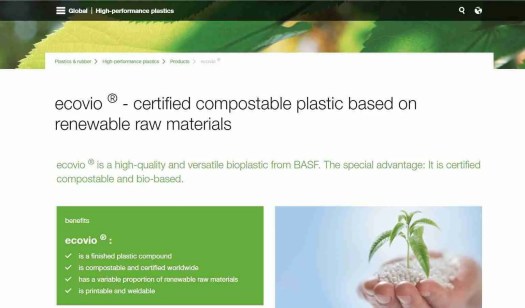
BASF website screenshot for "compostable" plastic

BASF used Ecovio film applications to make organic waste bags, fruit and vegetable bags, carrier bags, agricultural films, etc. Their claim is that the product is compostable, but the fine print indicates it is compostable “under the conditions of an industrial composting plant.”5

Screenshot from BASF's website about their compostable bags

This picture is misleading, as it shows a person putting a bag of compost into a compost bin. This gives the impression that these bags will break down in any compost collection when that is not the case. BASF’s compostable certification is the ASTM D6400, which is specifically for industrial composting facilities.6 Those are not available in most municipalities or states. If these products go into a landfill, it makes no environmental impact whatsoever. They also cause the same pollution problems as regular plastic.

A person holding 'compostable' plastic cups found at Jones Beach State Park, Long Island, New York.
‘Compostable’ plastic cups found at Jones Beach State Park, Long Island, New York. Don’t buy these! Photo by Brian Yurasits on Unsplash.

“So let me make sure I understand this. I’m supposed to get my one-use, takeaway cup, and as the name indicates, I take it away. And then when I’m done I . . . bring it to the nearest industrial composting facility? Oh sure, I think there’s one of those at the mall in between the Hallmark Store and the movie theater.” -Eve O. Schaub, author of Year Of No Garbage7

World Centric products

World Centric brand cups.
World Centric brand cups. Photo by Marie Cullis.
World Centric brand spoons in package.
World Centric brand spoons. Photo by Marie Cullis.

This seems like a great company: they are a Certified B company, they donate 25% of their profits, and they participate in carbon offsets. Their products, “Made from plants, not petroleum,” are made from renewable plants. Specifically, the spoons are made from 70% non-GMO corn and 30% talc. While this is technically better for the environment, these are still single-use disposable items that are only compostable in a “commercial composting facility.” The likelihood that these products will make it into a commercial composting facility after their single use is low. If they go to the landfill, they will likely not break down at all. At least this company isn’t using fossil fuels to make its products.

Molded fiber take-out packaging

molded fiber take out container

These “compostable” and “plastic alternative” molded fiber take-out containers seemed like a magnificent alternative to plastic until they were discovered to contain PFOAs (per- and poly-fluoroalkyl substances). These chemicals, protect the fibers from becoming wet and soggy. The same compounds are in most nonstick cookware. They cause cancer, thyroid disease, reproductive problems, and immunotoxicity in children.

Though marketed as compostable, these chemicals do not disappear. They get into the soil from the compost, and potentially into whatever is grown in that soil. Worse, these chemicals make it into the waterways and eventually into our drinking water.

My family ate out of these types of containers multiple times. Of course, I had no idea at the time that these contained PFOAs. Many major eateries have stopped using these.

Solution

In general, we must consume less. We must end the production and use of single-use disposable items. Most importantly, being aware of these problems is key because we can all make a difference.

In my next article about packaging, I’ll explain bioplastics, which are often advertised as biodegradable or compostable. Thank you for reading, and please subscribe to get the next post in your inbox!

“If you want to eliminate waste in your life – and in the world – the answers will always come down to one simple thing: consume differently.” -Tom Szaky

Additional Resources:

Article, “The bowls at Chipotle and Sweetgreen are supposed to be compostable. They contain cancer-linked ‘forever chemicals,'” by Joe Fassler, TheCounter.org, August 5, 2019. Read this excellent article for more information on molded fiber food containers.

Article, “The breakdown of biodegradable plastic, broken down,” by Sarah DeWeerdt, Anthropocene Magazine, May 7, 2019.

Article, “Will compostable packaging ever be able to solve our waste problem?” by Adele Peters, fastcompany.com, September 3, 2019.

Footnotes:

The Packaging Industry and How We Can Consume Differently, Part 1

Last updated on December 11, 2021.

Yellow excavator on mounds of waste, Indonesia
Waste pile in Indonesia. Photo by Tom Fisk from Pexels.

“Most types of plastic packaging are economically impossible to recycle now and will remain so in the foreseeable future.”7

Waste. We have so much of it that we require large machinery to move it around for us. There’s so much waste that our landfills are overfilling; the ocean is polluted with plastic and toxins; and in parts of the world, people have to spend their days living and working surrounded by large amounts of waste.  This article is the first in a series about the impact of packaging and the packaging industry.

Most packaging comes from items we buy regularly. I recently purchased a bottle of Zyrtec. Almost all medicines come in plastic bottles, but I had to buy a plastic bottle of Zyrtec inside of more plastic packaging! I emailed the company to ask why and if they would consider ending the practice of overpackaging. Unfortunately, Johnson & Johnson, the owner of Zyrtec, sent a generic response: “We appreciate you reaching out to us with your concern. We always value the views and opinions of our consumers…We will make certain your feedback is shared with the appropriate management of our company.” This is the typical response I receive from companies but I keep trying nonetheless.

Zyrtec packaging.
Zyrtec packaging surrounded the small plastic bottle of tablets. Photo by Marie Cullis.

“Recyclable labels on..consumer plastic products do not provide truthful advertising to American consumers and are a cause of contamination and inefficiency plaguing America’s municipal collection and plastics recycling/reprocessing systems.”8

Packaging is Everyone’s Responsibility

I am a recycler and I encourage you to recycle. But unfortunately, recycling isn’t the answer. Globally only about 9% – 13% of plastics are actually recycled. Since recycling doesn’t work in our current systems, we must find better solutions. Less packaging is one idea.

Corporations and companies are not doing enough to prevent plastic pollution, especially through the packaging industry. They have the power to stop producing packaging with disposable plastics and the resources to create more sustainable packaging. But we consumers have power too, to convince those companies to change.

“As consumers, we don’t give ourselves enough credit for how powerful we really are…View your purchases as having a direct impact on the goods and services companies choose to make.” -Tom Szaky, TerraCycle

I recently read The Future of Packaging: From Linear to Circular by Tom Szaky and 15 packaging industry leaders. The book exposed me to more information about packaging and the packaging industry than I knew existed. Then I read other books and several articles about the packaging industry. So I decided to share what I’ve learned with you, in several posts.

Single baking potato sold in plastic packaging for microwavable "convenience".
Single-baking potato sold in plastic packaging for microwavable “convenience”. Photo by Marie Cullis.

“And then there’s the ubiquitous plastic packaging, which envelops practically every product imaginable, from apples to eggs, foam bath to lipstick, toy cars to printer cartridges.”9

Packaging history

How did we get to today, where we have packaging for every single item? Packaging inside of packaging? So much packaging, often made from either mixed materials or unrecyclable materials, that we now have a waste crisis? How did we get here?

Packaging used to be sustainable and reusable with very little waste. Glass bottles held soft drinks, milk, medicine, etc. Consumers returned these and the companies sanitized and refilled them. During World War II citizens collected scrap metal, paper, rubber, and even cooking waste. Cities sometimes issue quotas for recycling.

Beginning in the post-war era, packaging increased to make life more “convenient” and “easier” for women running households. At the same time, the global population was growing at a higher rate than ever before – tripling between 1950 and 2010. Consumerism grew along with increased wealth and disposable income in the Western world. Plastic packaging in all forms became cheaper to create and ship while increasing convenience for consumers.

Life Magazine article of August 1, 1955 about "throwaway living".
Life Magazine article of August 1, 1955.

The False Notion that Plastic is More Sanitary

Plastic also became the “sanitary” way to serve and sell food, a somewhat false notion that persists even today. While plastic can prevent foods from cross-contamination and spoilage, it is not the only material that can do so. There are many options but sadly, plastic has become the standard.

DuPont advertising for cellophane wrapped produce
“Clean and fresh” advertising of DuPont cellophane to increase convenience.

“The spreading fear of a contaminated environment has spawned legions of buyers of bottled water, pasteurized egg and dairy products, and irradiated meats and seafood. Packaging can be highly misleading, however.” -Daniel Imhoff, Paper or Plastic

For a full history of plastic packaging and plastic in general, I recommend  Susan Freinkel’s Plastic: A Toxic Love Story.

Cover of Plastic: A Toxic Love Story

The Current Situation

“Packaging and containers are the largest segment of municipal solid by waste by product category.” -Beth Porter, author of Reduce, Reuse, Reimagine

Packaging today is out of control. Despite solutions, ideas, and innovations, there is far too much packaging in everything, made of all material types. “Today, the average American throws out at least three hundred pounds of packaging a year,” according to Susan Freinkel. In 2017, nearly 30% of U.S. municipal solid waste was from containers and packaging according to the Environmental Protection Agency (EPA).10 This amounted to 80.1 million tons. The EPA estimated that about 50% of that was recycled but only 13% of plastics were recycled (but the number is most likely under 10%).

“About half of all goods are now contained, cushioned, shrink-wrapped, blister-packed, clamshelled, or otherwise encased in some kind of plastic.” -Susan Freinkel, Plastic: A Toxic Love Story

Many types of packaging are not recyclable. Even the ones that are recyclable are often not recycled. One solution is to avoid purchasing as many products in packaging as possible, something I often write about. You can read my article on going plastic-free with food consumption.

The sad truth is that branding and marketing often drive packaging design, rather than environmental issues. This is beginning to change, but not at a fast enough pace to keep up with the rate of consumer packaging disposal.

“More often than not, the perceived value of being ‘green’ is trumped by bottom-line costs.” -Daniel Imhoff, Paper or Plastic

What is Greenwashing?

Greenwashing is advertising or promotions in which green marketing is deceptively used to persuade the public that an organization’s products, aims, and policies are environmentally friendly when they are not. Let’s call this what it is: this is false advertising. Here’s a video with excellent explanations:

I encourage you to read up on greenwashing because it’s everywhere!  Many companies participate in this practice. Remember the Volkswagen scandal? Volkswagen intentionally advertised low emissions vehicles but they actually equipped those vehicles with software that cheated emissions testing. Those vehicles emitted as much as 40 times the allowed amount of pollutants. While that’s an extreme example, this happens often and is so subtle that you aren’t aware of it.

Please see my page on how to identify and avoid greenwashing.

Consumers expect companies to dedicate themselves to making a positive social or environmental impact…they want to be able to trust them to prioritize ethics. – KoAnn Vikoren Skrzyniarz, founder and CEO of Sustainable Life Media, “Consumers Care,” The Future of Packaging

In my next article, I’ll detail some of these greenwashing terms, such as “biodegradable,” “compostable,” and “bioplastics”.

Thank you for reading! Please watch for future parts of this series by subscribing.

“If you want to eliminate waste in your life – and in the world – the answers will always come down to one simple thing: consume differently.” -Tom Szaky


Additional resource:

Article, “The cost of plastic packaging,” by Alexander H. Tullo, Chemical & Engineering News, October 17, 2016.

Footnotes:

The Truth about Recycling Batteries

Last updated on August 10, 2025.

Lego Stormtrooper surrounded by Duracell batteries, black background.
Image by StockSnap from Pixabay.

Recently, we went to the Hazardous Waste facility in Chattanooga, Tennessee, to drop off used alkaline batteries (aka single-use, dry cell, or primary cell) that we’ve been saving for almost a year. However, hazardous waste would not accept them, informing us that “they were fine to put in the regular trash.” I’ve been taking them there since 2016, perhaps twice per year, and they always accepted them. Did they used to accept them, and now they don’t? Did they never accept them, and just put them in the landfill instead of properly informing me? I don’t know the answer but either way, I was shocked and disappointed.

I believed alkaline batteries were recyclable for many years. Years ago, I used to bring them to Batteries Plus (now Batteries+Bulbs) for recycling. But in the last decade, they stopped taking them. The store clerks told me several times that the recommendation has been to place them in the trash because they are “safe” for landfills. I’ve even been told that alkaline batteries are “good” for landfills because the alkalinity balances out the acidic environment of landfills.

Is any of this true?

No, it isn’t. Those are myths.

According to Consumer Reports: “If your old batteries end up in a landfill, pollutants like these can leak out into the environment and contaminate groundwater, damage fragile ecosystems, and even make their way into the food chain.”8

The argument is that mercury, a highly toxic metal, is no longer a threat. Mercury content in batteries has decreased significantly since the passage of the 1996 Battery Act, which also changed their classification from hazardous waste to non-toxic or non-hazardous.11 Some argue that naturally occurring metals in batteries pose no threat to the environment.

But why take the chance while the experts argue it out? Any single-use disposable item is now a threat anyway because of the sheer volume of items we throw away.

Illustrated cartoon of a dead, leaking battery.
Image by acunha1973 on Pixabay.

So can alkaline batteries be recycled?

Technically, yes. But practically, no.

While the recycling of alkaline batteries does exist, they are more expensive to process and they don’t contain valuable materials like other types of batteries do. Thus there is no financial incentive to recycle them, so they are only recycled when mandated by law.

Are there laws about battery disposal/recycling?

In some places, yes. More than twenty states have laws about battery disposal. But most are concerned with rechargeable type batteries, which are much more recyclable. In Tennessee, there are no battery recycling requirements. California has the most strict laws – not surprising since California is always in the lead when it comes to laws regarding unsafe, toxic, and dangerous products.

A few states require some retailers to collect batteries for recycling. Others require that battery manufacturers fund or organize battery collection programs.12 Making the manufacturers responsible is one solution. This model is called Extended Producer Responsibility.

Variety of used batteries on a white background.
Image by StockSnap from Pixabay.

What do the manufacturers recommend?

I checked with three large battery manufacturers for their recommendations on alkaline battery disposal. Overall, I was displeased.

Duracell: “Our alkaline batteries are composed primarily of common metals—steel, zinc, and manganese—and do not pose a health or environmental risk during normal use or disposal…Therefore, alkaline batteries can be safely disposed of with normal household waste, everywhere but California.”13 They encourage customers to contact the local government for disposal options in their area.

Vermont passed a law that implements Extended Producer Responsibility. A state law passed in 2016 law that requires primary battery producers, such as Duracell, to fund a free statewide collection and recycling program. Yay for Vermont!

Energizer contends that “unless you live in California, you’ve been tossing non-rechargeable batteries safely in the trash for at least 19 years.”14 Well, if it’s not safe in California, it’s probably not safe anywhere. Toxins don’t change by crossing a border.

Energizer shucks responsibility on the website. They also take credit for an effort to which they did not contribute. “Since its inception in 1994, Call2Recycle has recycled over 100 million pounds of used rechargeable batteries. This national mindset to recycle has enabled Energizer® to pioneer technology that reuses battery material to create new batteries. So already we’re helping to make a difference.”15 No, they’re not. If these statements were true, they’d take responsibility for the afterlife of disposable batteries.

Rayovac: “Batteries can be disposed of with normal household waste in most US states.”16 They, too, refer consumers to Call2Recycle. They offer information on their commitment to sustainable production but offer no real solutions for disposable alkaline batteries.

Photo of AA Energizer brand batteries, white background.
Image by Photoshot from Pixabay.

Where can you recycle batteries?

Call2Recycle is a good resource for recycling in general. The latter, a leading battery stewardship program, has collection sites for batteries in different parts of the nation. There are no battery recycling laws in Tennessee, Georgia, or Alabama. But maybe your state does have a battery recycling law. Check out this map from Call2Recycle:

Graphic of the U.S., showing states by color for battery recycling laws.
Image courtesy of call2recycle.org.

There are a few places you can pay to recycle alkaline batteries, but it’s very costly for us as consumers:

        • TerraCycle offers alkaline battery recycling buckets starting at $39 and up to $151.
        • Call2Recycle sells a box for $68 for battery recycling and other items.
        • BigGreenBox also sells one for $71.95.

Solutions

There are several solutions at the consumer level that we can implement.

    • Stop buying alkaline or single-use disposable batteries, and switch to rechargeable batteries. They are reusable and much more recyclable! This is what I am planning to do effective immediately. I read reviews on rechargeable batteries and decided to order a Panasonic Eneloop rechargeable battery set. Read my review Eneloop batteries.

      Image of Panasonic eneloop Power Pack.
      Panasonic Eneloop Power Pack.
    • Reduce your overall dependence on batteries. I know this is not always feasible, especially with children’s toys and remote controls, but opt for plugging in whenever possible. You can also buy smarter in the future, purchasing items that don’t require alkaline batteries.
    • Recycle the ones you can through one of the above-mentioned services, or by checking Call2Recycle’s website for free battery recycling near you. (As of March 2024, there are still no options offered in my area.)
    • Write to the battery manufacturers and request that they do more to improve recycling and awareness about disposal. This probably won’t do much, but it’s worth a try!
Close up photo of batteries.
Photo by Hilary Halliwell from Pexels.

I hope this was helpful, and thank you for reading! Leave me a comment or question below! Keep trying to be the change, and please share and subscribe!

Footnotes:

DIY & Zero Waste Gift Wrapping (for All Occasions!)

Last updated on March 9, 2024.

Christmas wrapping paper and ribbon, red and white colors, on black table, scissors in background.
Image by tookapic from Pixabay.

Americans spend an estimated 3 to 7 billion dollars annually on wrapping paper. We buy wrapping paper, something we are intentionally going to throw away. We are paying for stuff that’s going to go into the trash!

Maybe it’s time we reallocated those funds.

Wrapping paper and gift wrap often come wrapped itself in plastic film, which is not recyclable. We use the paper once to wrap gifts and then we throw it away. Some wrapping paper has a plastic coating, making it non-recyclable. On top of that, the plastic tape we use on gifts makes the paper unrecyclable (because of “contamination”) in most municipalities.

What can you do?

There are so many things you can do to make a difference in the amount of waste we produce, and often even save money. Here are just a few ideas:

      • Use the alternative methods in this post for gift wrapping.
      • Reduce the overall number of gifts you give – think minimalism!
      • Gift e-gifts! Think ebooks, e-audiobooks, music: gift subscriptions to Audible, Kindle Unlimited, Spotify, a video game, or any other similar online subscription.
      • Gifts for experiences – tickets to the movies, theater, ballet, climbing gym, museums, or the spa! What would the person you’re gifting really like?
      • See my Black Friday article for additional ideas.

There are so many alternatives! But first things first…

Let’s talk about tape

Stop buying “Scotch” or plastic tape. I know this seems crazy, but if you want to reduce waste and plastic pollution, plastic tape has got to go. I recommend gummed paper tape, which I first learned about from the blog, My Plastic Free Life. The tape is water-activated and is super sticky with just a tiny amount of moisture. I cut out small strips of the paper tape, apply a tiny bit of water with a paintbrush and let it get gummy, and then apply the tape.

Paper tape roll, scissors, water cup, and paintbrush
Supplies: Paper tape roll, scissors, water cup, and paintbrush.
Cut strips of paper tape
Cut out strips of paper tape.
Paintbrush to brush water on paper tape
Use the paintbrush to brush on a tiny amount of water. You don’t need much to make it adhere.

It’s not the most attractive tape, but if the gift wrap is going to be trashed or recycled after the gift is opened, who cares? People you are giving gifts to probably know you well enough to understand that you’re an eco-warrior. Be proud. And if you are worried about it, you could decorate the tape.

You can find paper tape at local office supply stores and on Amazon. Just steer clear of the types that are “reinforced” because they contain fiberglass filaments, which are plastic fibers. This defeats the purpose of using paper tape to be eco-friendly.

Use up gift wrap that’s already in your house

If you’ve got wrapping paper you’ve already purchased, please use that up and don’t waste it. You can glue small scraps together to make a larger piece to waste even less.

Large piece of wrapping paper made from scraps.
A second gift I wrapped from the same large piece.
A second gift I wrapped from the same large piece. This one used leftover plastic ribbon and a leftover store-bought gift tag. I have used these up and no longer purchase plastic ribbon or gift tags.

Eliminate plastic bows and ribbon

Bows sold at regular stores are usually made of plastic. Even if you reuse them for several years, they eventually must be thrown away. Stop buying these and look for alternatives online or make your own. Cycle out the plastic ribbon in your home as well, switch to a cloth (not polyester, because that’s plastic too) ribbon, or just use pretty string or twine. You can also make some out of fabric or old t-shirts! Ideas abound online!

Silver and blue gift bows on a white background.
Plastic bows: pretty but bad for the environment. Photo by DiEtte Henderson on Unsplash.

Eliminate store-bought gift tags

Gift tags are often stickers or plastic-coated paper, and sometimes have a plastic band or ribbon to attach it with. You can make your own tags out of regular paper or leftover gift wrap which can be recycled.

You can also write directly on the gift with a marker. This is what I’ve switched to most recently, and it saves me time. Here’s one I did recently, using leftover wrapping paper and a plastic bow that I’ve been reusing for several years (I haven’t cycled all of those out yet):

Gift with handwriting on the paper in place of a gift tag, with a red bow.

Gift bags

Gift bags are often plastic-coated paper, so I don’t recommend buying these. They are reusable, but they do have an end life and aren’t recyclable. Cycle these out and don’t purchase more.

Switch to uncoated paper gift bags. If they are plain, you can decorate them! One zero-waster recommended using regular shopping bags and decorating them by placing a used greeting card over the logo but you could glue any pretty picture over it, from an old magazine or calendar. You could also place a photograph over the logo and let that be part of the gift (grandparents would love a photo of their grandchildren, for example).

Alternatives to buying wrapping paper

Furoshiki (Fabric)

Two furoshiki wrapped gifts
Image by Weekend Knitter on Flickr. Creative Commons BY-NC-ND 2.0 license.

Furoshiki, a Japanese tradition of wrapping items in cloth for carrying and gift-giving. Often the fabric is meant to be reused for other purposes. This is an eco-friendly and gorgeous way to wrap gifts and it’s the one I primarily use now. I love pretty fabrics, and even though I’m striving for minimalism, I always have a box or two of fabric in the house. What a beautiful way to give gifts! Here are three I’ve done:

Fabric wrapped gift, pink satin

Fabric wrapped gift, red leopard print

Fabric wrapping is also good for odd-shaped or sized items, such as this one:

Tube shaped gift in fabric, red leopard print

It’s easy to learn but it does take practice. I’ve linked a few other helpful resources below under Additional Resources. You can buy fabric remnants at fabric and craft stores for small pieces. Some companies offer unique innovations related to fabric wrapping. For example, Lush Cosmetics sells Knot-Wraps, their version of Furoshiki but they are meant to be used again as a scarf or tote – so it’s like giving two gifts. They are made of either organic cotton or two recycled plastic bottles, and the wraps are gorgeous!

Homemade wrapping paper

I’ve made wrapping paper from many different things! This takes some time but it’s easy and allows for creativity.

Magazines:

This is one of my favorite ways to upcycle old magazines! I glued random magazine pages together to make large sheets. After wrapping, I let my son decorate the package. Please note, this is also before I switched to the paper tape, so you’ll see Scotch tape on the gift as well as a plastic bow I reused:

I collected a few old art magazines to make wrapping paper. The next two images show one of the large sheets I made, and the images below those show wrapped packages using that paper.

The brown paper tape is hardly noticeable on these packages.

Another publication I used was High Five magazine, a popular children’s magazine. We had several years’ worth so I just grabbed one older edition and tore out the colorful pages. You can see in the following images how I glued individual pages together until I had one large sheet:

Here’s a gift I wrapped:

Child art:

This is another favorite, especially for gifts to family members. You can glue pieces of child art together and make a large sheet, just like you would with magazine pages. It makes this wrapping paper truly one-of-a-kind! Grandparents will be delighted with original pieces of artwork wrapped around the gift you’ve chosen for them.

You can even just use one coloring book page to wrap small gifts. Here’s one I wrapped last Christmas with a single sheet (but with plastic ribbon and a gift tag I still had leftover):

Reclaimed books:

You can use pages from old books to make wrapping paper – children’s books, photography books, or just plain pages of text from books. You can find cheap books at any thrift or second-hand store. Many used bookstores, such as McKay’s here in Tennessee, have a “free” bin of unwanted books. These are items that were not accepted by the store but that people did not want back. I have not personally tried this method but think it would be really cool. What a great way to honor these books and upcycle!

books on table, like at a sale.
Photo by Min An from Pexels.

Toilet paper wrap:

Toilet paper rolls from Who Gives A Crap
Toilet paper rolls from Who Gives A Crap.

You can use the decorative paper from toilet paper rolls from Who Gives A Crap toilet paperhis eco-friendly company makes recycled and bamboo toilet paper and gives 50% of their profits to help build toilets in places where there are none. I’ve been using this toilet paper since writing my post about toilet paper in 2018. The paper wrappers on these rolls can be used as gift wrap and the company even makes a special holiday edition.

This has become a regular method in my home. You can place stickers or pretty pictures over the logo if you want to cover it up. Here are images of the large sheet of wrapping paper I made and the wrapped gift:

Newspapers or Brown paper

Newspapers or Comics:

You can use the old-fashioned method of using newspapers. This is what many of our grandparents did.

Brown paper:

Cut brown paper from grocery store paper bags or leftover builder’s paper into the size you need and wrap away! Once you’re done, you can color it or paint it with your favorite medium. You can ask your child to help too!

Thank you for reading!

I hope this helps you reduce waste year-round! If you have other ideas about DIY wrapping paper or reducing gift wrapping waste, please leave me a comment below – and don’t forget to subscribe!


Additional Resources:

Guide, “Furoshiki: Japanese Gift Wrapping,” Marie Kondo (KonMari), accessed January 16, 2021.

Article, “How to: Furoshiki (Japanese fabric wrapping),” One Million Women, December 22, 2015.

Article, “Think Outside the (Gift)box: 3 Ways to Wrap Gifts With Fabric,” Craftsy.com, accessed December 23, 2020.

Wrapping with Fabric: Your Complete Guide to Furoshiki - The Japanese Art of Wrapping book coverBook, Wrapping with Fabric: Your Complete Guide to Furoshiki – The Japanese Art of Wrapping, by Etsuko Yamada, 2014.


All photos in this post were taken by Marie Cullis unless otherwise credited.


Footnotes:

Shampoo Bars & Conditioner Bars Eliminate the Need for Plastic Packaging

Last updated on March 9, 2024.

Photo of man with his head under shower water.
Image by Olya Adamovich from Pixabay.

Most shampoo and conditioner brands are sold in plastic bottles. Since we know that 91% of plastic isn’t actually recycled, many of us are trying to find ways to not purchase products in plastic.19 Recently, a colleague asked me what to do about shampoo and its plastic packaging.

Did you know you can buy shampoo as a bar?

No way, you say! Or, maybe you’re thinking ugh, what? Either way, stick with me for a bit.

Last fall, I wrote an article on the benefits of bar soap and how it can be purchased practically packaging-free. I use bar soap for showering out of personal preference. I always found that most body wash and liquid soaps washed down the drain rather than cleansed my body. Once I switched to bar soap, I felt like I got a better lather and a better cleanse, and found that I wasted less soap overall. A bonus is that there are no travel restrictions on bar shampoo, so no need for little plastic travel bottles!

I first discovered shampoo bars on Beth Terry’s site, My Plastic-Free Life.20 I was excited to learn about shampoo bars and switched to them right away. But there have been some issues with various bars, so I’m reviewing those here.

Image of lavender bar soap, light lavender towel, violet vase, and fresh lavender.
Image by joe137 from Pixabay.

“Up to 80 percent of shampoo and 95 percent of conditioner is made of water.” -Brigette Allen and Christine Wong, Living Without Plastic21

How to use a Shampoo Bar

This part is easy! You just rub the bar between your hands like you would with regular bar soap, or directly on your hair and scalp as long as you are gentle. It’s only strange the first time. The lather of a bar is satisfying, and I’ve come to prefer shampoo bars.

Plastic-Free often also means Toxin-Free

Most shampoo bars do not contain the perfumes, chemicals, and harsh detergents that are in major brands of bottled shampoo. This means you will not be exposing your body to toxic ingredients that will strip your hair, disrupt your hormones, or cause cancer. Yes, you read that right – many major brands of shampoo and conditioner contain one or more toxic ingredients. Under Additional Resources, I’ve included a link to a list of ingredients you should avoid, and also a link to review brands on the Environmental Working Group’s Skin Deep site.

I will say that this type of shampoo does take getting used to. Most of us are accustomed to shampoos that strip our hair and scalp of their natural oils, so it will take a few shampoos for your scalp to adjust and not feel greasy. But this is normal and once you adjust, you’ll start to feel and see the benefits of shampoo that is not full of harsh ingredients.

Photo of the shampoo aisle at the grocery store. Many plastic shampoo bottles in many colors.
Most grocery and department stores carry shampoo and conditioner exclusively in plastic bottles. Photo by Marie Cullis.

“The number of shampoo bottles thrown out in the United States every year could fill 1,164 football fields.”-authors Brigette Allen and Christine Wong, Living Without Plastic22

The Shampoo Bars

Here is a review of the brands I’ve tried, in order of preference:

J.R. Liggett’s shampoo bar

J.R. Liggett's shampoo bar

This is the first one I ever tried, mainly because I was able to find this locally at Earthfare (also sold at Whole Foods and Amazon). It is packaged in a recyclable paper wrapper. I’ve switched back to it several times after trying many others, and have decided this is my favorite. It lathers well, the bar does not fall apart over time, and my hair is soft and clean.

There is a bar for every hair type: Original; Moisturizing (for dry, colored or damaged hair); Tea Tree & Hemp (fragrance-free and good for “itchy-flaky scalp”); and several others depending on personal scalp preference.

Sappo Hill

Cream colored Sappo Hill shampoo bars, next to lavender sprigs.

I like Sappo Hill and it is my husband’s preferred bar soap. I discovered their bar soap when I used to shop at Earthfare, and I love that the bars were package-free except for a bar code sticker. After Earthfare closed all of its stores, I went online and discovered that they sell many more scents and that they also make shampoo bars! Their shampoo bars are mild and cleansing. They run a close second to my favorite (above) and are very well-priced. I recommend this brand if you don’t like other shampoo bars.

Aquarian Bath

Pink Shampoo bar in a blue glazed dish from Aquarian Bath on Etsy.

My third favorite is one that I discovered through the website My Plastic-Free Life, called Aquarian Bath.23 This shampoo bar doesn’t break apart and lathers well. These are handmade, vegan, palm oil-free, SLS-free, fragrance-free, dye-free, and not tested on animals.

They will ship their products naked, meaning zero waste or no packaging, which is super! There are many scents and bars with ingredients for each hair type, including one for dandruff, so read each description to find the right one for you. They also sell other types of products with the same qualities.

Nourish Natural Bath Products

Black Shampoo bar from Nourish

Nourish is where I buy the majority of my bar soap for body washing. But in recent years, they’ve come out with shampoo and conditioner bars. I was thrilled about this because I love most of their products! However, while I like the scents and the clean feeling these bars leave in my hair, they have the flaw of crumbling about halfway through the bar’s life. This leaves several small pieces of shampoo bar, and those pieces get smaller and smaller, creating frustration. I’ve tried 3 of these and each bar had this problem. I’m hoping they can improve their binding process.

Lush Cosmetics

Image of Lush shampoo bar, white with pink edges.

I tried a shampoo bar from Lush Cosmetics and it crumbled halfway through its life as well. I did not enjoy the scent either but I highly respect Lush Cosmetics because of their naked packaging. Their products are handmade, vegan, and cruelty-free. This particular bar just didn’t work for me. However, I like and respect the company so much that I plan to try additional shampoo bars. Here’s why:

“Since 2005, we’ve sold more than 41 million shampoo bars, saving 124 million plastic bottles from ever being produced. That’s approximately 3417 tons of plastic saved, or about the weight of 30 blue whales. Imagine if everyone ditched the bottle in favor of the bar!” -Lush Cosmetics24

The Right To Shower Shampoo Bar & Bar Soap

The Right To Shower Shampoo bar packaging with a yellow and orange bar inside, visible through the package window.

I found this brand at Whole Foods, and they claim to help bring mobile showers to people living on the streets, which is pretty cool! It’s a large bar for the price and can be used on both the hair and body, which is an added benefit. These bars are vegan, sulfate-free, are made in the US, use Rainforest Alliance Certified palm oil, are cruelty-free, and are packaged in 100% recycled carton paper. I love the promise of this product! But it does not keep my hair as cleansed as I’d like – I noticed some build-up on my scalp.

Photo of a woman running her hands through her light brown hair, wearing a white sweater, pink background.
Photo by Element5 Digital from Pexels.

What about Conditioner?

When I first started going plastic-free, I made my own conditioner and continued doing so for about 2 years. There are many recipes on Pinterest and I’ve tried a bunch. Most did not work for me – they were either too greasy (coconut oil-based) or left my hair tangly (shea butter-based). The one I settled on uses a combination of oils and aloe vera gel with guar gum as a thickening agent. Unfortunately, the ingredients are not all available plastic-free in the area where I live. Since the beginning of my journey, some companies have developed conditioner bars. Below are the ones I’ve tried.

by Humankind

White conditioner bar, peach background.

This company sells all plastic-free/packaging-free products and orders are carbon neutral (meaning the company contributes to forest preservation to offset the carbon created from shipping their product). I tried their grapefruit-scented conditioner bar and it is my favorite though most expensive. The bars are vegan and made of all-natural ingredients. Unfortunately, it broke into pieces toward the end of its life. I found it very difficult to use 4 tiny pieces to conditioner my long hair, so this was disappointing. But it left my hair soft, manageable, and shiny! I plan to give it another try, and they also sell shampoo bars that I haven’t yet tried.

Nourish

Nourish conditioner bar, pink

I tried Nourish’s conditioner bars in addition to their shampoo bars. They have great scents and they conditioned my thick mane well, leaving it shiny and manageable. However, they crumbled about halfway through the life of the bar. Even so, this one is my second favorite and they are much more affordable than others. They are vegan and made with natural ingredients. They offer a choice of packaging when you order, either compostable plastic or tissue paper wrapping.

HiBar

HiBar conditioner bar packaging and blue bar.

I am still on the fence about this one. It is also a little costly and I don’t like the scent of the blue moisturize bar. But the shape is unique as you can see. The bar is made to hold in your hand while you rub the angled flat part of the bar directly onto your hair. This creates no friction or tugging and allows me to condition my hair much more thoroughly. The same goes for washing my son’s hair – I can conditioner it quicker without tugging, which of course makes hair washing better for him! So I do like the shape but I may need to try a different scent. If I do, I’ll update this article. HiBar Conditioner bars are free of sulfates, phthalates, silicones, or parabens. They also sell shampoo bars. These are sold only in cardboard packaging, no plastic packaging.

Person washing hair in shower, lathering brown hair, angle shows back of head and hands in hair, and bare shoulders.
Photo by Karolina Grabowska from Pexels.

Let Go of Guilt

I’m not perfect. I’m still figuring it all out too. I got very frustrated once with conditioner bars breaking into small pieces that became unusable and purchased conditioner in a plastic bottle! I did at least buy Pacifica Beauty brand because their products are vegan and cruelty-free, as well as toxin-free. But I’m not giving up! 

Remember, the fact that you’re willing to try another method to avoid plastic means a lot. So if your attempts at switching fail, just don’t give up. You will find something that works eventually!

You can do this, and hopefully, this post helps! Thank you for reading, and please subscribe!


This post does not contain any affiliate links nor did I get paid to promote or receive free items for any of the product reviews in this post.


Additional Resources:

Article, 15 Harmful Ingredients In Shampoos And Conditioners That You Should Avoid, Starting Today!” Skinkraft Laboratories, April 21, 2020.

Website, EWG’s Skin Deep, accessed February 16, 2021.

Footnotes:

Saving the Earth is overwhelming, and now the Rainforest is burning!

Last updated on March 9, 2024.

Image of Yellowstone National Park, Wyoming, during the cold season at dusk, blue sky, mist, snowy mountains and blue reflected in water.
Yellowstone National Park, Wyoming, photo by David Mark from Pixabay.

Saving the Earth can feel overwhelming because it is overwhelming.

I had coffee with a friend recently and she told me that it’s hard to know which environmental practices to follow since there are so many problems. She wasn’t sure where to start. I know that most of us feel the same way often.

It is overwhelming to all of us. Though driven by a genuine heartfelt desire to do everything I can to protect the planet, the animals, and ourselves, even I get overwhelmed. Last week, I felt despair and defeat when I learned about the lax environmental policies under Brazil’s President (much like the environmental attitude of our president) that have resulted in rainforests burning down. These fires were likely intentionally set to clear land to use to make profits, and the hot and dry conditions spread them quickly. This week the fires are still burning and the devastation spreads. Scientists indicate that these fires are an 85% increase over last year’s fires.

The rainforests provide 20% of the Earth’s oxygen. Do we really want to do that to ourselves? Deprive ourselves of oxygen? I’m not even addressing the many species that inhabit the rainforests. Or the fact that the rainforest essentially cyclically filters the Earth’s air. Or that rainforests help maintain the temperature of the entire planet.

Photo of a rainforest.
Image by Rosina Kaiser on Pixabay

But it’s not really the Earth that we’re trying to save.

It’s humankind and all living creatures that we are trying to protect. We can’t actually destroy the planet. The planet will go on without us. But if we keep polluting the ocean, burning down the rainforests, egregiously using up all of the natural resources, and contributing to global warming – yes, we humans will all die off. But the Earth will keep turning.

Image of the Earth from space.
Image by WikiImages from Pixabay.

So what can we do?

Keep trying, and keep spreading the message. Do as much good as you can. Spread love and kindness and others will follow.

The best thing to do is start simple. More specifically, start with just one thing. Begin with one small mission, such as refusing plastic bags. Buy some canvas bags at the craft store and keep them in your car for shopping. You can use them for any shopping – the grocery store, department stores, pharmacies, bookstores, any store!

If the plastic waste from food and beverages bothers you, I’ve got a list of 14 Ways to go Plastic Free with Food.

Maybe you’re more concerned about the disposable coffee cups you’re using every day. Buy a plastic-free reusable coffee mug (I recommend Hydroflask) and bring that to the coffee shop every day. Some shops will even give you a small discount for using your own cup.

Perhaps you’re tired of buying gas for your car from one of the worst industries known to the modern world: Big Oil. They drill and spill and don’t care. Is it time for an electric car? Is this even a viable option? From what I’ve been told by two Tesla owners, it is a viable option. Other electric cars have had limits on travel before requiring a recharge, but Tesla has exponentially improved this. If the unacceptable actions of petroleum companies are what bothers you most, start with this issue by researching electric cars. I’d like to save up for a Tesla! Might take me a little time though.

The way we trash our landscapes may be what upsets you. Read my article about Litterati and download the app. Join local trash clean-ups, or just pick up trash in your neighborhood! Any garbage, especially plastics, prevented from washing down storm drains (which usually end up in the ocean) is a small but helpful act!

Heart drawn in the soil.
Image by Carla Burke from Pixabay.

Just start.

Those are just a few examples. It doesn’t matter what problem you fix first, because any change you make will make a difference. You can do this. We can do this. And each time you conquer one challenge, you’ll find yourself motivated to conquer another. It’s addictive, trust me.

This week my newest change is that I joined a green initiative committee at work. I’ve also requested a recycling bin for the office so that I can take the office recyclables home since we do not have adequate recycling.

Many bloggers, myself included, have lists and guides with ways to start. I have a list of books, films, Individuals Making a Difference, and websites to help you learn more. Subscribe to my blog and I’ll show you how I’m tackling one problem at a time. Contact me if you have topics you’d like me to investigate or write about. We can all work through these problems together.

So what about the rainforests?

I don’t have any great advice on this, except to pay attention to what’s going on and vote for people who aren’t denying the problems. Here’s a CNN interview with Jeff Corwin (he’s become a symbol of good stewardship regarding wildlife and environmentalism).

I’m very sad about the rainforests, and I bet you are too if you’re reading this. But staying sad won’t change anything when it comes to environmental issues. Taking action will. Thank you for reading, and please share and subscribe!

Only You Can Prevent Beach Trash

Last updated on February 11, 2024.

Trash with the words "100% Leakproof" on it
“100% Leakproof.” Photo by Marie Cullis.

In my recent article about my trip to Hilton Head Island and its environmental consciousness, I mentioned that the beaches are really clean and well-maintained. Even with their efforts, I still picked up about 300 pieces of trash during my week there. Of course, I logged these into my Litterati app.

I thought I could put the images of my trash to good use, to show people how they can prevent beach and ocean pollution!

I bet you already know a lot about this. But if you share this article, it might enlighten others who will then use preventative measures. And then the world could be a less polluted place!

“Worldwide, 73 percent of beach litter is plastic.” -National Geographic22

Common Types of Beach Trash

I noticed that the same types of trash commonly appear on beaches all over the country. So I’ve divided this article into sections based on the common types of trash I’ve found.

Image of a Plastic water bottle in the surf with a blue label.
Plastic water bottle almost in the surf. Photo by Marie Cullis.

Plastic drink bottles and caps

These are the most common items I pick up EVERYWHERE, and not just on beaches. Our love affair with drinks in single-use disposable plastic bottles and cups (I’m including styrofoam in this classification because styrofoam is chemically a plastic) is completely out of control. I even picked a red Solo cup that I used to collect cigarette butts and microplastics! I picked up many single-use disposable drink items like these:

What can you do?

Buy a reusable drink container (or two) and use that for all your liquid refreshments. I have two: a Kleen Kanteen for water; and a Hydroflask coffee cup. They handle pretty much everything.

If you must buy a beverage, please dispose of it properly.

Food and snack wrappers

I find this type of litter on the beach (and everywhere else) very often. This includes food wrappers, containers, zipper bags, etc. Below is an image of a washed-up cannonball jellyfish next to the plastic lid of a cylindric chip container.

Plastic bottle cap next to a washed up jellyfish.
Plastic lid next to a washed-up jellyfish. Photo by Marie Cullis.

Here are some additional examples of food and snack wrappers:

What can you do?

Follow the saying, “Leave it cleaner than you found it.” Or “carry in, carry out.” Don’t lose track of your trash and disposables. Put them inside your beach bag until you can find a proper trash can. You can also consume less prepackaged food, which will be better for your health as well.

Beach Toys

This is one item that is particular to beaches but so easily preventable. Children scatter and lose their things easily, and almost all beach toys are made of plastic. When people leave these items on the beach, they go straight into the ocean during high tide.

Toy pink crab sand toy.
Photo by Marie Cullis.
A toy buried in the sand.
Photo by Marie Cullis.

You can see how easily small toys are overlooked in the next image. Can you guess what that is?

A toy car buried in the sand.
Photo by Marie Cullis.

If you guessed a toy car, you’ve got a good eye!

Here are some other examples of left behind or broken toys:

Yellow plastic toy boat.
We found this and my son named it “Mr. Boat.” We kept this one and donated the rest. Photo by Marie Cullis.

In particular, we found multiple plastic bucket straps, as they are not usually permanently affixed. These are easily forgotten about but this cheap plastic will make it into the ocean by the next morning.

There are a few brands, such as Green Toys, that feature a rope strap that is not easily removed. The bucket is even made of recycled plastic. It’s the one we own and play with year-round.

What about the packaging for all of those beach toys?

A plastic net bag that the plastic beach toys were sold in.
A plastic net bag that the plastic beach toys were sold in, from American Plastic Toys Inc. Photo by Marie Cullis.

Below are images of a discarded boogie board left at a wash station near the beach. I’d seen these little styrofoam balls lining parts of the beach and I couldn’t figure out what they were from. I did not manage to get a good photo of them. Once I found this broken board and looked at it closely, I could see that these cheap boards were simply nylon or polyester fabric (fabrics made from plastics) over styrofoam. You could not make a worse product for the beach – a product meant to be used in the water that is made of cheap materials and not meant to last more than one vacation – WOW.

Please don’t buy these. This one made it into a proper trash can, but how many end up in the ocean?

What about the dog’s toys? These can be easily lost. And yes, they are made of plastics and other synthetics.

A yellow tennis ball made by Kong.
Photo by Marie Cullis.

What can you do?

The best thing you can do is to not leave beach toys behind. The best way to keep track of your children’s toys is simply to own less of them. Perhaps just one bucket and one shovel, for example. In general, kids don’t need many toys when playing outdoors to stay entertained and engaged. Besides the sand and water, the beach offers so many shells, sticks, seaweed, and other washed-up items that kids are curious about and love to experiment with.

Place broken toys in your beach bag immediately so that you don’t accidentally leave them behind.

As for dog toys, how about throwing a stick for Fido instead of a ball or plastic Frisbee?

Items related to smoking

This is another common item I find everywhere and not just at the beach. Corporations make cigarette butts out of synthetic materials that do not biodegrade. Plastic lighters are found in the stomachs of birds and marine animals. Honestly, I used to smoke a long time ago and I sometimes threw cigarette butts on the ground. I had no idea how bad they were for the environment. I pick them up regularly now as part of my Litterati mission, as I feel like I owe the environment for this terrible habit I used to have.

Cigarette lighter lying in the ocean's surf.
Photo by Marie Cullis.

I gathered dozens of cigarette butts and several lighters on the beach, here are a few examples:

I also picked up plastic tips from Swisher Sweets, a brand of inexpensive flavored tip cigarillos.

What can you do?

Don’t smoke! But if you do, can you please discard your waste properly?

Straws

Aren’t straws like so last year?

No, not really. Not yet. Despite straw bans in different parts of the world.

Everywhere we went in Hilton Head served straws, sometimes automatically in the drink. I’m not criticizing the Island for this, because it happens in my town too. But I hope all eateries eventually end this practice. The exception was the Watusi Cafe on Pope Avenue, which served paper straws – thank you!!!

What can you do?

Ask the server to not give you a straw before he or she brings your drink. I used to decline the straws when the server would set them down on the table, but since so many places automatically put them in the drink, I try to cut them off at the pass. Once that straw is opened and in a drink, it doesn’t matter whether or not I use it. The restaurant will now trash it.

I don’t use a straw very often anymore, but if I need one, I have my Final Straw.

Plastic Bags

I still found a couple of plastic bags on the beach despite the town’s ban on plastic bags!

White transparent plastic back stuck to dune fencing.
Photo by Marie Cullis.

What can you do?

Decline plastic bags no matter where you live! Bring your own cloth bag.

If you don’t have a bag, can you carry your items without one? I can’t tell you how many times I’ve stopped at a store and purchased one item that the cashier bagged. I don’t need a bag for one item! Give them the bag back right away and say thanks but no thanks!

Many stores do have a paper bag option if you ask for one. If not, they likely have an empty box readily available that you can put your purchases in.

Beach tent/umbrella parts

Many people bring their own beach tents and umbrellas to the beach. But sometimes they leave waste from them. Below you can see where I found a plastic tent stake accidentally left behind and a zip tie of which I found several. The last image is of a full plastic water bottle that someone tied to a nylon string. I found this buried in the sand but the string was sticking out. Once I pulled it out, it was obvious that someone most likely used it as a weight to hold something down. Clever – but forgotten, an immediate pollutant – this would’ve been in the ocean after high tide.

What can you do?

Collect all of the parts to your tents and umbrellas, even if it’s trash. Double-check before you leave that you haven’t forgotten anything.

Everyday Non-Beach items

I find many items on the beach that are not necessarily beach items but items that people use daily. These items include wet wipes or baby wipes (most often not made of anything biodegradable even if the packaging makes that claim); dryer sheets; plastic dental picks; cellophane; condom wrappers; and even a bullet casing (pictured below).

Wet wipe or baby wipe in the sand
Wet wipe or baby wipe. Photo by Marie Cullis.
Wet wipe or baby wipe in the sand
Wet wipe or baby wipe. Photo by Marie Cullis.
Dryer sheet in the sand
Dryer sheet. Photo by Marie Cullis.
Bullet casing on the beach, red plastic.
Bullet Casing. Photo by Marie Cullis.

The most surprising things I’ve ever found on a beach were plastic tampon applicators in the Gulf of Mexico. At first, I thought, there’s no way someone changed their tampon on the beach! But I found not just one, but multiple of these and I’ve also since found them along the Tennessee River. It dawned on me that these items were not left behind by careless beach-goers, but more likely washed up from trash and from sewage disposal that made it into the ocean. It turns out that litter collectors colloquially call these “beach whistles.”

"Beach whistle," or tampon applicator
“Beach whistle,” or tampon applicator. Photo by Marie Cullis.

What can you do?

In general, the best thing you can do is cut down on disposable items, especially single-use disposable plastic items. Even if you’re not leaving these items on the beach, they’re making it onto the beaches and the items are only a portion of what’s washed up from the ocean. Meaning, there’s way more in the ocean.

The answer is to not use disposable items. It isn’t always easy, so just work on solving one problem at a time – that’s what I’m doing and sharing with you on this website!

Beach sunset
Photo by Marie Cullis.

Thanks for reading, please subscribe in the box above. Love your beaches and ocean. And keep being the change!


Footnote: